


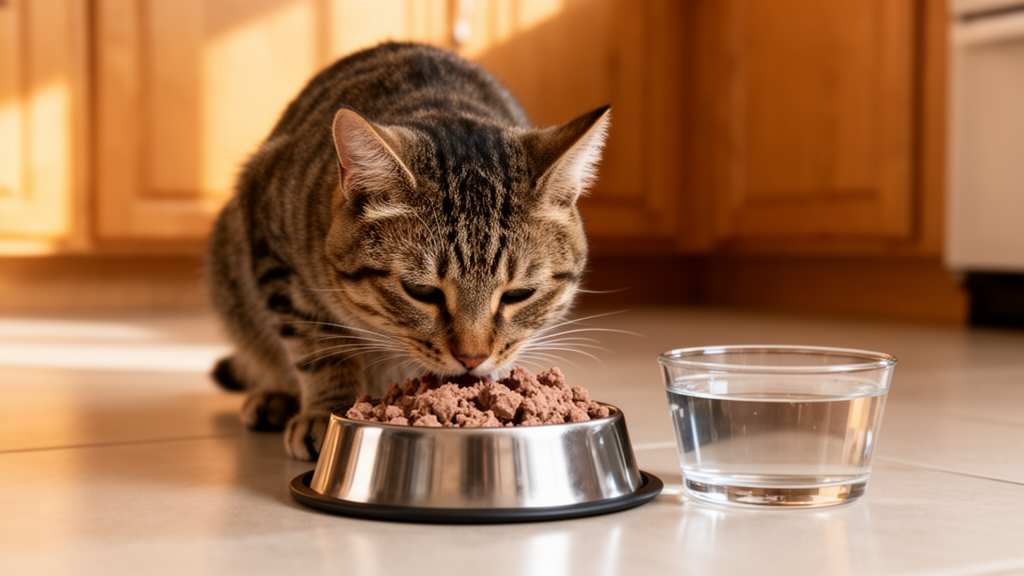
Chronic kidney disease is one of the most common diagnoses in aging cats, and the therapeutic diets prescribed to slow its progression have long carried a reputation among owners and veterinarians alike: that they are unpalatable, that cats will turn up their noses at them, and that this reluctance undermines the entire treatment plan. A new exploratory trial, published in the Journal of Veterinary Internal Medicine, challenges that assumption. In an open-label feeding study conducted entirely in cats’ own homes, a commercial wet renal diet formulated for early-stage kidney disease was accepted by the large majority of 42 healthy feline participants, with no obvious palatability problems emerging over the short test period.
The research team recruited 42 privately owned cats cared for by 31 caregivers, most of them Domestic Shorthairs, predominantly female and neutered, with a median age of four years and a median weight of 4.8 kilograms. Before the trial began, caregivers categorized their cats’ appetites: 16 were described as adaptable eaters, 13 as easy, 10 as selective, and 3 as difficult. The test product was a wet renal diet containing moderate amounts of high-quality protein with restricted phosphorus, sold as soft chunks in gravy. Notably, the researchers used sachets approaching their best-before date, a deliberately conservative choice designed to test the diet under potentially less favorable but still commercially valid conditions.
The study unfolded in three consecutive six-day phases. In Phase 1, each cat received only the wet renal diet, following a one-bowl test methodology. In Phase 2, the cat’s usual wet diet was offered in the same format, serving as the control. In Phase 3, both diets were presented simultaneously in adjacent bowls, with left-right positions alternated daily to prevent side bias. Caregivers recorded food intake, the latency time from presentation to the first bite, predefined feeding-related behaviors, and their own subjective assessments through online questionnaires and daily data sheets. Statistically, the team employed cumulative link mixed models for intake and latency outcomes, generalized linear mixed models for behaviors, and a nested caregiver-cat identifier as a random effect, with Holm-Bonferroni correction applied for multiple comparisons.
The acceptance results were strikingly positive. After six days on the renal diet, caregivers rated acceptance as very good for 25 cats (59.5 percent), good for 4 (9.5 percent), and normal for 3 (7.1 percent), while 10 cats (23.8 percent) were rated as bad or very bad. In 54 percent of all recorded observations, cats ate the entire amount of renal diet offered, and in another 14.7 percent they consumed more than half. Overall, caregivers classified acceptance as positive for 69 percent of the cats. Two pre-trial variables significantly predicted how well the diet went down: appetite type and the cat’s existing attitude toward wet food in gravy or jelly, both at P = .01. Cats seen as easy or adaptable eaters, and those that already enjoyed chunks in gravy, accepted the therapeutic diet more readily.
When the researchers compared intake between the two one-bowl phases, the usual diet held a statistical edge: cats were significantly more likely to reach a higher intake category with their familiar food, with an odds ratio of 3.82 (P < .001). Yet at the individual level, 31 of the 42 cats showed no change in consumption between the two diets, and 2 cats actually ate more during the renal diet phase. Latency to start eating did not differ significantly between phases (P = .07), with cats beginning to eat within half a minute in 72.6 percent of observations during the renal diet phase and 88.9 percent during the usual diet phase. The authors suggest that the intake difference likely reflects the novelty of the renal diet and cats’ well-known tendency to fixate on familiar aromas and flavors, particularly since the study involved a sudden transition rather than the gradual dietary change normally recommended in practice.
The two-bowl preference test delivered perhaps the most encouraging findings. When both diets were available simultaneously, neither was significantly preferred based on recorded intake (P = .34). The renal diet was the first approached in 44 percent of observations and the first eaten in 50 percent, a near-even split. Caregivers’ perceptions were similarly divided: 47.6 percent believed their cat preferred the usual diet, while 45.2 percent perceived a preference for the renal diet. A strong association emerged between perceived acceptance in Phase 1 and later preference (P < .001): 17 of the 25 cats with very good acceptance went on to prefer the renal diet, while every cat with very bad acceptance stuck with the familiar food. Intriguingly, appetite type did not predict preference, with one of three difficult eaters and five of ten selective eaters reportedly favoring the renal diet.
Behavioral observations added nuance but also revealed a methodological pitfall. Lip licking and nose licking were significantly more frequent with the usual diet (P < .001 and P = .01, respectively). However, the data suggested that caregivers struggled to distinguish between allegedly positive reactions, such as licking the feeding bowl or lips, and putatively negative ones, like licking the food or nose. Positive reactions were reported in 11.9 percent of cats with perceived bad acceptance, while negative reactions appeared in 40.5 percent of cats with good acceptance, indicating misidentification. The authors caution that these behavioral outcomes should be interpreted as indicative only, and recommend that future trials educate caregivers on the distinctive features of each licking reaction or use video recording to verify reports.
Beyond the numbers, the caregiver’s perception emerged as the decisive factor in whether a therapeutic diet would be embraced. More than three-quarters of caregivers, 78.6 percent, said they would offer this renal diet to their cats if it were prescribed, and this willingness actually increased between the one-bowl and two-bowl phases, suggesting that familiarity with the diet improved opinions. Among the 11 caregivers with two cats, 4 expressed opposing views depending on each cat’s individual response, underscoring how variable feline food preferences can be even within a single household. Nine cats shifted in their caregivers’ likelihood ratings between phases, mostly in the diet’s favor.
The findings carry practical weight for veterinary practice. The authors argue that the poor acceptance rates reported in previous clinical trials and owner surveys may stem less from the diets themselves and more from the clinical signs that compromise appetite in cats with chronic kidney disease. Their recommendations include introducing a wet renal diet only when appetite is not severely compromised, transitioning gradually rather than abruptly, managing nausea and anorexia with medication when needed, and warming refrigerated food before serving, a practice that may matter greatly for aging or appetite-impaired cats even if it has little effect in healthy younger animals. They also stress the importance of early exposure to wet diets, ideally while kittens are still with the queen, so that therapeutic diets encounter a cat already familiar with that texture.
The study’s limitations are acknowledged candidly. Including only healthy cats improved objectivity by removing disease-related confounders but limits external validity for the actual patient population. The short trial duration cannot rule out flavor fatigue or monotony effects over extended feeding, phenomena related to sensory-specific satiety rather than acceptance itself. Food intake and latency were recorded categorically to simplify caregiver tasks, potentially reducing measurement precision, and micronutrient data were unavailable for more than half of the control diets. The open-label design and fixed phase sequence without washout periods may have introduced observer bias and carry-over effects. The authors position this work as an exploratory proof of concept preceding longer trials in cats with kidney disease, and they call for randomized, blinded crossover designs with washout periods, continuous measurement variables, and a priori power calculations. For now, the message for cat owners is a hopeful one: the assumption that renal diets are inherently unpalatable deserves reconsideration, and with a thoughtful transition plan, many cats may take to them far better than conventional wisdom suggests.
Subject of Research: Palatability of a commercial wet renal diet in healthy cats assessed through an in-home feeding trial
Article Title: Palatability assessment of a commercial wet renal diet in healthy cats: an open-label in-home exploratory trial
Article References: Magalhães, T. R., Corbee, R. J., Queiroga, F. L., & Lourenço, A. L. (2026). Palatability assessment of a commercial wet renal diet in healthy cats: an open-label in-home exploratory trial. Journal of Veterinary Internal Medicine, 40(5), Article aalag234. https://doi.org/10.1093/jvimsj/aalag234
Image Credits: AI Generated
Keywords: cats, chronic kidney disease, renal diet, palatability, pet nutrition, feeding behavior, veterinary medicine, one-bowl test, two-bowl test, dietary transition, feline health, wet food
Cite Scienmag News
Daisy Hatcher. (October 16, 2026). Healthy Cats Take to Wet Kidney Diet in Home Feeding Trial. Scienmag. https://scienmag.com/healthy-cats-take-to-wet-kidney-diet-in-home-feeding-trial/
Daisy Hatcher. "Healthy Cats Take to Wet Kidney Diet in Home Feeding Trial." Scienmag, 16 October 2026, https://scienmag.com/healthy-cats-take-to-wet-kidney-diet-in-home-feeding-trial/. Accessed 16 October 2026.
Daisy Hatcher. "Healthy Cats Take to Wet Kidney Diet in Home Feeding Trial." Scienmag. October 16, 2026. https://scienmag.com/healthy-cats-take-to-wet-kidney-diet-in-home-feeding-trial/


