


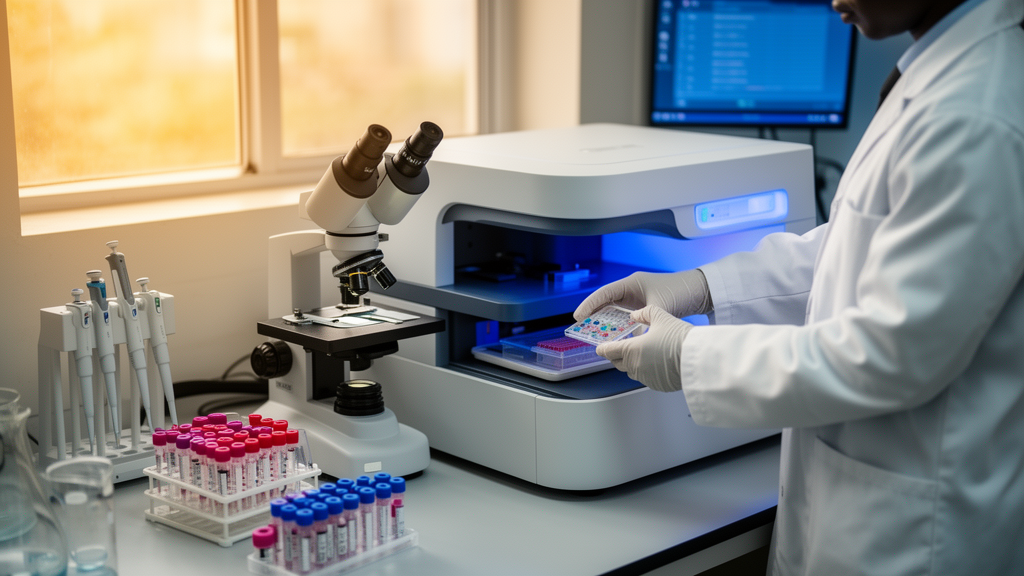
Nigeria has for the first time established sequencing-based surveillance for drug-resistant tuberculosis (DR-TB), a pilot program that used DNA analysis to uncover resistance that routine drug susceptibility tests had missed. The program, described in a recent study in Frontiers in Tuberculosis, was built on the country’s existing HIV drug-resistance sequencing infrastructure, creating a nationally coordinated referral network that linked tuberculosis reference laboratories with sequencing facilities already operating for other diseases.
The scale of the problem is considerable. Globally, an estimated 13 percent of deaths attributed to antimicrobial resistance are due to drug-resistant tuberculosis, much of which remains undetected. In 2024, roughly 390,000 people were estimated to have developed rifampicin-resistant or multidrug-resistant TB, defined as resistance to both rifampicin and isoniazid, the two most critical first-line anti-TB drugs. Missed or erroneous detection of resistance creates gaps in surveillance and can lead to mismanagement of treatment, perpetuating transmission and driving the epidemic.
For decades, culture-based phenotypic drug susceptibility testing has been considered the gold standard for detecting resistance, but the method has known limitations, including inaccuracy in detecting particular cases of resistance to rifampicin. Genotypic tests, such as the Xpert MTB/RIF assay and line probe assays, have accelerated the turnaround time for confirming drug-resistant TB, but they interrogate only narrow regions within a limited number of resistance-associated genes. Sequencing-based detection offers a more comprehensive approach and is included in global guidance for programmatic implementation, yet practical barriers related to cost, laboratory infrastructure, and technical expertise have hindered adoption in many high-burden countries.
Nigeria, a high HIV/TB and multidrug-resistant TB burden country, prioritized addressing DR-TB in its National Strategic Plan for 2021 to 2025. Under the leadership of the National Tuberculosis and Leprosy Control Programme, and with support from the U.S. Centers for Disease Control and Prevention, the country established its first sequencing model for DR-TB surveillance in 2022. The approach deliberately leveraged sequencing laboratories previously established for HIV drug-resistance monitoring, integrating services for these pathogens for the first time and demonstrating how limited resources can be stretched through a multi-disease platform.
The technical workflow began at zonal and national TB reference laboratories, where clinical sputum specimens from health facilities across the country are routinely subjected to genotypic tests. Drug-resistant isolates are then referred for phenotypic testing using the automated BACTEC MGIT 960 system. For the sequencing pilot, 49 Mycobacterium tuberculosis isolates previously identified as resistant to rifampicin and/or isoniazid were selected proportionately across all six geopolitical zones. Mycobacterial cultures were inactivated using heat at 95 degrees Celsius for 20 minutes and ultrasonication for 15 minutes, and genomic DNA was extracted on site before being shipped through a courier-based referral pathway to sequencing laboratories, where quality and quantity were assessed using spectrophotometry and fluorometry.
Rather than sequencing whole genomes, the team designed a targeted Sanger sequencing algorithm covering eight genomic regions associated with resistance to six anti-TB drugs, a strategy intended to maximize programmatic value while keeping costs manageable. The rpoB gene, linked to rifampicin resistance, was sequenced for all isolates to confirm results or identify resistance missed by other tests. Rv0678 and atpE, associated with resistance to the newer drugs bedaquiline and clofazimine, were also sequenced for all isolates. Genes including gyrA, gyrB, katG, the inhA promoter, and rrs were sequenced conditionally, only for isolates determined to be susceptible to the corresponding drug classes, in order to detect mutations not targeted by line probe assays. Identified mutations were cross-referenced with the World Health Organization’s global catalogue of resistance-associated mutations.
Implementation proceeded in four phases over two years: planning, validation of the new method, rollout, and data analysis for programmatic use. Laboratory staff received training, standard operating procedures were developed, and sequencing-specific quality control measures and performance indicators were established. Validation was successful at all participating laboratories, which exceeded established acceptance criteria. Of the 49 isolates selected, genomic DNA suitable for sequencing was extracted from 96 percent, adherence to the sequencing algorithm reached 100 percent, and high-quality results were obtained for 623 of 642 sequencing reactions, or 97 percent.
The results demonstrated the added value of sequencing in striking terms. While sequencing largely confirmed resistance reported by routine tests, it identified additional rifampicin resistance in 5 of 47 isolates, or 11 percent, and additional isoniazid resistance in 1 isolate, or 2 percent, that had been missed by phenotypic or genotypic testing. Discordance between the two routine methods was also notable, observed for rifampicin in 9 percent of isolates, isoniazid in 15 percent, fluoroquinolones in 9 percent, and second-line injectables in 6 percent. In several cases, sequencing settled these disagreements, confirming rpoB mutations that one method had detected and the other had not.
Particularly significant were nine borderline mutations in rpoB associated with low-level rifampicin resistance, identified in isolates from all geopolitical zones. Phenotypic testing can fail to detect these clinically relevant variants, which may fuel transmission of resistance if left undiagnosed. The study found that phenotypic testing missed rifampicin resistance in two isolates with confirmed borderline mutations, L452P and L430P, findings consistent with comparative studies from other high-burden settings. The analysis also revealed the limits of automated bioinformatics software: one potential instance of rifampicin heteroresistance, indicated by a double chromatogram peak, and a unique insertion mutation in rpoB were missed by automated tools, which are often restricted to a database of defined mutations.
Not every result favored sequencing. No additional resistance was detected in genes associated with fluoroquinolone or second-line injectable resistance among isolates deemed susceptible by routine tests, and no mutations were found in Rv0678 or atpE even among the small number of isolates phenotypically resistant to bedaquiline or clofazimine, underscoring that phenotypic testing remains essential for newer drugs whose resistance mechanisms are not yet fully understood. The authors also acknowledge limitations, including the small sample size and algorithm constraints that restrict generalizability, and the inability to repeat phenotypic testing due to resource restrictions.
Following the analysis, the National Tuberculosis and Leprosy Control Programme convened a stakeholder meeting to review lessons learned and chart the path forward. Leveraging existing laboratory infrastructure and workforce expertise, along with the targeted algorithm design, supported cost-effective implementation. Building on the pilot’s success, the program is now transitioning from Sanger sequencing at HIV laboratories to targeted next-generation sequencing at the Nigeria Centre for Disease Control and Prevention’s multi-disease testing laboratory. Next-generation sequencing offers higher throughput and improved sensitivity for detecting heteroresistance at lower frequencies, and commercially available end-to-end solutions with automated bioinformatic pipelines may expand uptake. The work demonstrates feasibility and provides a practical model for operationalizing DR-TB sequencing in a national program setting, offering an example for other high-burden countries seeking to strengthen genomic surveillance, improve drug selection and treatment for TB patients, and guide testing policies as new treatment regimens are scaled up.
Subject of Research: Implementation of DNA sequencing-based surveillance for drug-resistant tuberculosis in Nigeria
Article Title: Implementation of sequencing-based surveillance for drug-resistant tuberculosis in Nigeria
Article References: McLaughlin, H. P., Audu, I., Tola, M., Onwuamah, C. K., Ogwu, J., Atoe, K., Kunle-Ope, C. N., Ahmadu, I., Gowon, J., Meshak, D. B., Iwakun, M., Ude, C. E., Abiona, M., Momoh, A. E., Ore, T., Ogbu, C. A., Abiodun, T. A., Dawson, J., Hall-Eidson, P., … Chukwuma, A. (2026). Implementation of sequencing-based surveillance for drug-resistant tuberculosis in Nigeria. Frontiers in Tuberculosis, 4, Article 1855903. https://doi.org/10.3389/ftubr.2026.1855903
Image Credits: AI Generated
DOI: 10.3389/ftubr.2026.1855903
Keywords: tuberculosis, drug resistance, genomic surveillance, Sanger sequencing, Nigeria, Mycobacterium tuberculosis, rifampicin, isoniazid, drug susceptibility testing, next-generation sequencing, public health, antimicrobial resistance
Cite Scienmag News
Juliet Wilcox. (October 16, 2026). Nigeria launches DNA sequencing surveillance to catch drug-resistant tuberculosis missed by routine tests. Scienmag. https://scienmag.com/nigeria-launches-dna-sequencing-surveillance-to-catch-drug-resistant-tuberculosis-missed-by-routine-tests/
Juliet Wilcox. "Nigeria launches DNA sequencing surveillance to catch drug-resistant tuberculosis missed by routine tests." Scienmag, 16 October 2026, https://scienmag.com/nigeria-launches-dna-sequencing-surveillance-to-catch-drug-resistant-tuberculosis-missed-by-routine-tests/. Accessed 16 October 2026.
Juliet Wilcox. "Nigeria launches DNA sequencing surveillance to catch drug-resistant tuberculosis missed by routine tests." Scienmag. October 16, 2026. https://scienmag.com/nigeria-launches-dna-sequencing-surveillance-to-catch-drug-resistant-tuberculosis-missed-by-routine-tests/


