


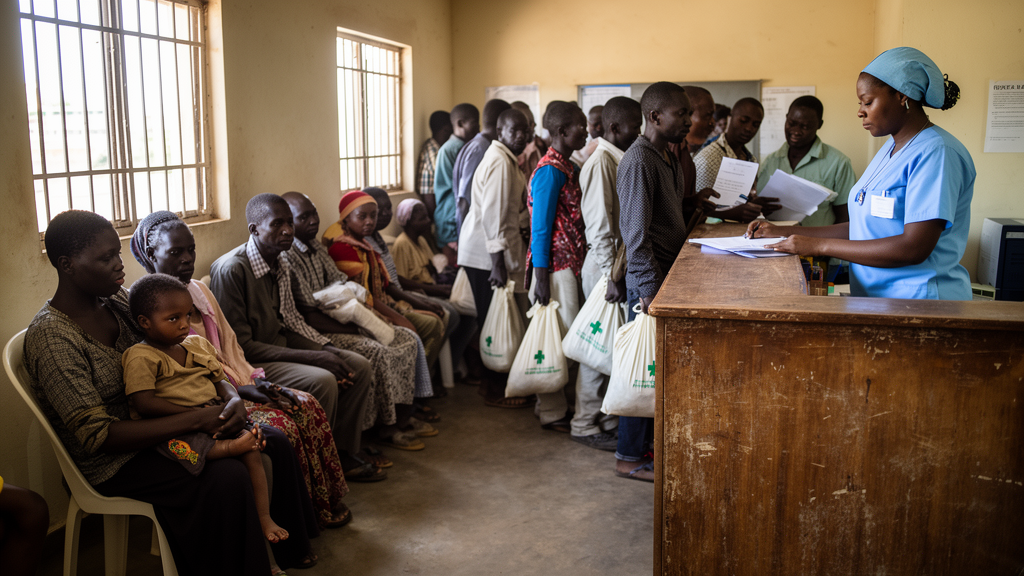
More than 120 million people were forcibly displaced worldwide by the end of 2024, according to the United Nations Refugee Agency, and roughly three quarters of international refugees now live in low- and middle-income countries (LMICs). Yet a new scoping review published in Public Health Reviews reveals that the discrimination these people experience inside clinics, hospitals and maternity wards in the very countries that host them has been strikingly understudied. The review, led by Kerstin M. Grosheintz-Laval, Patrick Kwizera and Mirko S. Winkler of the Swiss Tropical and Public Health Institute and the University of Basel, is the first to systematically map peer-reviewed research on discrimination in medical settings as perceived by forcibly displaced people in LMICs, and its findings paint a sobering picture of a barrier to care that is both widespread and poorly measured.
The research team searched PubMed and Web of Science for peer-reviewed original studies published between March 2010 and March 2025, following the PRISMA guidelines for scoping reviews. From an initial pool of 2,463 papers, the screening process narrowed the field to just 31 studies that met the inclusion criteria. To qualify, studies had to report data on discrimination in medical settings as perceived by forcibly displaced people in LMICs, aim to investigate discrimination in healthcare or barriers to healthcare access, and be available in English. Studies were excluded if they reported discrimination from the perspective of healthcare workers rather than migrants, if results were not separated from other migrant or non-migrant groups, or if they were conducted in high-income countries.
The geographical footprint of the included studies was narrow. South Africa led with eight studies, followed by Lebanon with five, while Colombia, Ecuador, Peru, Türkiye and Uganda each contributed three. Brazil, Iran, Jordan and Kenya each had two studies, and Nepal, Pakistan, the Philippines and Rwanda each had one. Notably, when the researchers cross-referenced their findings against the UNHCR’s list of the top ten refugee-hosting countries between 2010 and 2024, only five of those countries—Colombia, Iran, Jordan, Pakistan and Türkiye—were represented in the literature. Major hosts such as Afghanistan, the Democratic Republic of Congo, Ethiopia, Iraq, Nigeria, Somalia, South Sudan, Sudan, Ukraine and Yemen had no studies meeting the inclusion criteria at all.
The populations studied were similarly concentrated. Refugees from Syria were the most frequently studied group, appearing in ten studies, followed by refugees from the Democratic Republic of Congo in eight. People displaced from Rwanda, Venezuela, Burundi, Somalia, Zimbabwe and Afghanistan also featured prominently, while refugees from countries including the Central African Republic, Myanmar and Yemen were entirely absent from the evidence base. Perhaps most strikingly, the review identified no studies at all on internally displaced people, even though they account for nearly 60 percent of all forcibly displaced people worldwide—a gap the authors describe as especially striking given the scale of internal displacement.
Methodologically, the evidence base is dominated by qualitative work. Twenty-six of the 31 studies used qualitative methods, primarily interviews and focus group discussions, and only five used quantitative approaches. None of the quantitative studies employed standardized instruments such as the Discrimination in Medical Settings Scale, which limits the comparability of findings across studies and settings. Only four studies had discrimination against forcibly displaced people in healthcare as their single main objective; the rest explored it as one barrier among many in broader investigations of healthcare access. This methodological imbalance means that robust, generalizable data on the prevalence and context of discrimination in LMICs remain scarce.
Despite these limitations, the quantitative findings that do exist are consistent in direction. Across the studies reporting numerical data, between 10 and 44 percent of refugees reported experiencing discrimination while seeking healthcare. In South Africa, Kibiribiri and colleagues found that 39.2 percent of African refugee women would not return to the same facility if pregnant again due to staff attitudes and neglect, 43.6 percent perceived xenophobia, and 42.3 percent reported carelessness. In Uganda, Rustad and colleagues found that the risk of perceived discrimination among Sudanese refugee mothers rose from 4 percent among host-community women to 10 percent among refugees, attributed mainly to refugee status or language barriers. In Colombia, Unternaher and colleagues found that 12 to 15 percent of displaced Venezuelan women reported experiencing or witnessing discrimination during prenatal care, which was associated with a 42.8 percent lower likelihood of completing at least four prenatal visits. In Jordan, Ay and colleagues found that 40.8 percent of non-camp Syrian refugees reported discrimination by health personnel as a barrier to access, and 29.1 percent expressed distrust in healthcare providers.
The qualitative evidence, while harder to aggregate, is often more visceral. Refugees across multiple studies described being yelled at, treated as though they were unintelligent, denied information, blamed for expressing pain, questioned about their right to bear children in the host country, threatened, accused of burdening the health system, or told to go back to their country of origin. Some reported physical abuse by healthcare providers. Discrimination was also perceived in subtler forms—in the tone and wording of questions about nationality, in longer waiting times, in exclusion from services, in neglect, misdiagnosis, inadequate pain management, and in higher healthcare costs charged on the basis of country of origin. These experiences were frequently identified as barriers to accessing care, leading refugees to delay seeking treatment until their condition had reached a critical stage, to avoid specific facilities altogether, or to disengage from care entirely.
The consequences extend beyond missed appointments. The review found that experiences of stigma and mistreatment contributed to mistrust of health systems and confidentiality concerns, and that refugees reported feelings of worthlessness, heightened stress and trauma, and compromised emotional wellbeing as a result of discriminatory treatment. These findings align with the broader literature on discrimination as a social determinant of health. As the authors note, drawing on the Lancet Series on Racism, Xenophobia, Discrimination and Health, discrimination adversely affects all key elements of adequate care—availability, acceptability, accessibility and quality—and is associated with poorer physical and mental health outcomes, increased mortality and reduced life expectancy.
Why does this discrimination occur? The review found that the underlying reasons often remain unclear in the existing literature. In many cases it was not possible to distinguish whether perceived unfair treatment reflected actual discrimination based on personal characteristics or a more general mistreatment affecting all patients, such as staff shortages or resource scarcity. Some studies that included healthcare providers’ perspectives pointed to contributing factors including resentment toward refugees, work overload, general scarcity of resources, discriminatory policies and language barriers. But study designs rarely allowed direct comparison or objectification of these explanations. The authors argue that understanding the underlying reasons is essential for developing effective strategies, even if the effect on health-seeking behavior is likely to be the same regardless of whether the discriminatory acts can be objectively verified.
Based on the evidence, the review identifies four broad avenues for reducing discrimination in healthcare. First, healthcare providers need training to recognize the specific needs and barriers faced by refugees, including education in cultural diversity, anti-discrimination strategies and legal healthcare entitlements. Second, health systems must be strengthened with adequate staffing, infrastructure, information systems and supply chains, alongside the use of professional interpreters, trained refugee healthcare workers and telemedicine to reduce miscommunication and build trust. Third, inclusive policies are needed that remove legal barriers, ensure access to healthcare regardless of legal status, protect migrants from violence and deportation, and translate global health commitments into national and local frameworks supporting Universal Health Coverage. Fourth, further research is needed—research that uses validated measures of self-reported discrimination, clearly defines study populations, includes appropriate control groups, and examines where, when, why and against whom discrimination occurs. The authors emphasize that improving healthcare alone will not be sufficient: discrimination must ultimately be addressed as a fundamental social determinant of health, requiring action on the deeper systems of categorization, marginalization and oppression that underpin racism and xenophobia in all their forms.
Subject of Research: Perceived discrimination against forcibly displaced people in healthcare settings in low- and middle-income countries
Article Title: Discrimination in medical settings as perceived by forcibly displaced people within low- and middle-income countries: a scoping literature review
Article References: Grosheintz-Laval, K. M., Kwizera, P., & Winkler, M. S. (2026). Discrimination in medical settings as perceived by forcibly displaced people within low- and middle-income countries: a scoping literature review. Public Health Reviews, 47, Article 1609595. https://doi.org/10.3389/phrs.2026.1609595
Image Credits: AI Generated
DOI: 10.3389/phrs.2026.1609595
Keywords: refugees, forcibly displaced people, healthcare discrimination, low- and middle-income countries, scoping review, health equity, xenophobia, maternal health, health systems, migrant health, PRISMA, public health
Cite Scienmag News
Phoebe Ingram. (October 16, 2026). Refugees in Low- and Middle-Income Countries Report Widespread Discrimination in Healthcare, Review Finds. Scienmag. https://scienmag.com/refugees-in-low-and-middle-income-countries-report-widespread-discrimination-in-healthcare-review-finds/
Phoebe Ingram. "Refugees in Low- and Middle-Income Countries Report Widespread Discrimination in Healthcare, Review Finds." Scienmag, 16 October 2026, https://scienmag.com/refugees-in-low-and-middle-income-countries-report-widespread-discrimination-in-healthcare-review-finds/. Accessed 16 October 2026.
Phoebe Ingram. "Refugees in Low- and Middle-Income Countries Report Widespread Discrimination in Healthcare, Review Finds." Scienmag. October 16, 2026. https://scienmag.com/refugees-in-low-and-middle-income-countries-report-widespread-discrimination-in-healthcare-review-finds/


