


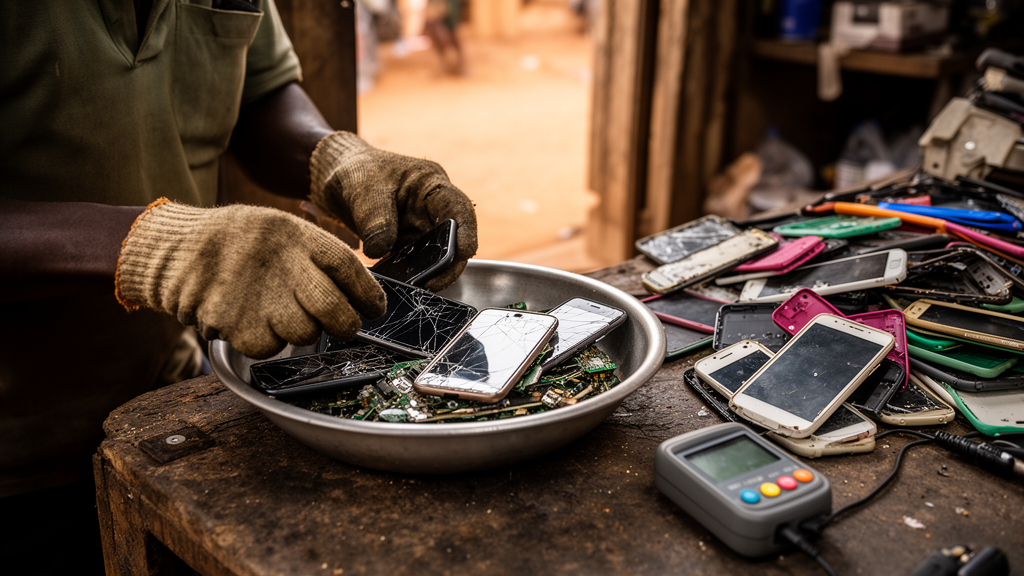
Every year, more than 1.43 billion mobile phones are sold worldwide, and Nigeria alone accounted for roughly 170 million mobile subscriptions in 2023. When these devices reach the end of their lives, they join the fastest-growing waste stream on the planet: electronic waste, which is expanding three times faster than general municipal solid waste. While much attention has focused on the metal-rich printed wiring boards inside phones, a new study has turned the spotlight on something far less glamorous but equally consequential: the plastic casings and internal plastic parts that end up in dumps, landfills, and informal recycling yards across the developing world.
Researchers Solomon C. Onuchukwu, Innocent C. Nnorom, and Jude I. Ogubuike set out to measure the concentrations of four toxic metals—silver (Ag), cadmium (Cd), nickel (Ni), and lead (Pb)—in the plastic components of discarded mobile phones commonly used in Nigeria. Their findings, published in Discover Chemistry, reveal a complex and sometimes alarming picture. Across all brands, mean concentrations were 9.2 ± 1.9 mg/kg for silver, 46.2 ± 12.5 mg/kg for cadmium, 738 ± 1072 mg/kg for nickel, and 62.4 ± 32.0 mg/kg for lead. Most strikingly, nickel levels in certain samples were unexpectedly high, with one brand exceeding the total threshold limit concentration (TTLC) regulatory limit of 2,000 mg/kg, reaching a maximum of approximately 2,983 mg/kg.
The team collected twenty-five obsolete mobile phones representing five major brands—Tecno, Infinix, Itel, Samsung, and Apple—from repair workshops in Uyo, the capital of Akwa Ibom State in southeastern Nigeria. Five units of each brand were selected, with devices spanning production years from approximately 2015 to 2022. Repair shops were chosen deliberately because they serve as major aggregation points for discarded, damaged, or obsolete devices awaiting repair or disposal. To reduce selection bias, the researchers gathered phones from multiple independent repair shops, selecting devices based on availability and physical condition rather than brand preference or performance.
Once collected, each phone was partially disassembled using stainless steel screwdrivers and pliers, then separated into its major components: printed wiring boards, liquid crystal displays, and plastics. The plastic parts were covered with clean cloth to prevent cross-contamination, crushed with a standard hammer, and then reduced in size by cutting with stainless steel scissors. All tools were thoroughly cleaned with ethanol and lint-free wipes between samples, and each component was stored in labeled containers to avoid mixing materials from different devices. Crucially, the samples were analyzed in their unwashed state—a deliberate choice designed to reflect the real-world contamination levels of discarded e-waste plastics as they actually enter the waste stream.
Approximately 0.5 grams of each sample was digested using EPA Method 3050B, a standardized acid digestion procedure employing 65% nitric acid, 35% hydrochloric acid, and 30% hydrogen peroxide in a 1:1:1 ratio. The samples were heated to 90°C and then taken to near dryness before being resolubilized in deionized water and filtered. The resulting digest was analyzed for Pb, Cd, Ni, and Ag using an Agilent 720-ES Inductively Coupled Plasma Optical Emission Spectrometer (ICP-OES), with emission intensities recorded at the most sensitive wavelengths for each target metal: 328.068 nm for silver, 214.439 nm for cadmium, 231.604 nm for nickel, and 220.353 nm for lead. Quality control procedures included multi-point calibration curves with linearity of R² ≥ 0.995, spike recovery studies yielding recoveries between 80% and 100%, procedural blanks, and replicate analyses performed in triplicate.
Statistical analysis using one-way ANOVA at a 95% confidence level revealed significant inter-brand differences for silver, nickel, and lead, with nickel and lead showing particularly strong brand-related variation. Brand C and brand E frequently stood out from the pack. The distribution patterns were equally revealing: cadmium concentrations were below 50 mg/kg in approximately 75% of samples, silver remained below this threshold in all samples, but nickel stayed below 50 mg/kg in only 20% of samples. Furthermore, 40% of samples exceeded 500 mg/kg for nickel—a level far above what would be expected from the plastic polymer matrix alone. Lead levels fell below 50 mg/kg in 55% of samples, with 20% falling in the elevated 100–500 mg/kg range.
The researchers attribute the elevated nickel concentrations to several possible sources. Nickel-containing components such as connectors, contacts, and plated parts located within electronic assemblies may be enclosed by or attached to plastic housings, allowing metal fragments to transfer onto plastic surfaces during dismantling and mechanical processing. Contamination from mixed electronic waste streams, residual fluxes, oxidation products, tool abrasion during disassembly, and metal-laden fumes generated during soldering and repair work may all contribute to the observed variability. This interpretation is consistent with earlier studies reporting wide ranges of nickel levels in waste mobile phone plastics, with occasional high outliers linked to heterogeneous material composition and exogenous contamination.
When the measured concentrations were compared with TTLC regulatory limits—standards developed by the Department of Toxic Substances Control to determine total concentrations of specific components in a sample—most metals were generally below their respective thresholds, suggesting that the plastic components do not pose an immediate critical risk under standard disposal scenarios. The predominantly sub-threshold levels may reflect the impact of regulatory efforts such as the European Union’s Restriction of Hazardous Substances (RoHS) Directive, which has restricted the use of toxic metals in consumer electronics since the mid-2000s. Earlier European Community directives, including the Packaging Directive (EC Directive 94/62/EEC) and Directive 91/338/EC, had already set limits of 100 mg/kg for cadmium and total metals in plastic materials.
However, the nickel exceedance in brand C samples, combined with the persistent nature of these metals and their potential for leaching under landfill or incineration conditions, raises significant concerns about long-term environmental contamination. The authors emphasize that TTLC values reflect total elemental concentrations and do not directly evaluate the mobility or leaching potential of metals under environmental conditions. Toxicity Characteristic Leaching Procedure (TCLP) tests, which simulate contaminant release under landfill conditions, would provide a more direct assessment of environmental risk. Previous studies have shown that roughly 50% of TCLP extracts for lead from end-of-life mobile phone components surpassed 5 mg/L, indicating widespread non-compliance, while another investigation reported lead leachate values ranging from 7.21 to 84.38 mg/L in plastic housings and printed wiring boards.
The broader implications extend far beyond laboratory measurements. In Nigeria and similar developing countries, e-waste management is often informal and unregulated, with an estimated 100,000 individuals employed in manually collecting and dismantling electronic waste to recover valuable components. These workers face direct exposure to toxic substances, including lead, which can damage the liver, kidneys, and nervous system and impair cognitive development, and nickel, which is associated with dermatitis and bronchial asthma. According to the World Health Organization, more than 18 million children and adolescents are now active in scavenging for e-waste, often without any protective equipment. Once released into the environment through improper disposal pathways such as open dumping, landfill leaching, or uncontrolled burning, toxic metals can migrate into soil, surface water, and groundwater systems, entering ecological and human exposure pathways through ingestion of contaminated food crops, inhalation of contaminated dust, or dermal contact with polluted soils. The findings underscore the urgent need for improved end-of-life management strategies, formal recycling infrastructure, and stronger regulatory oversight to minimize the environmental and public health impacts of discarded mobile phone components in developing regions.
Subject of Research: Concentrations of toxic metals in plastic components of discarded mobile phones from five brands commonly used in Nigeria
Article Title: Evaluation of toxic metals in plastic components of discarded mobile phones commonly used in Nigeria
Article References: Onuchukwu, S. C., Nnorom, I. C., & Ogubuike, J. I. (2026). Evaluation of toxic metals in plastic components of discarded mobile phones commonly used in Nigeria. Discover Chemistry, 3(1), Article 432. https://doi.org/10.1007/s44371-026-00892-2
Image Credits: AI Generated
DOI: 10.1007/s44371-026-00892-2
Keywords: e-waste, mobile phones, toxic metals, nickel, lead, cadmium, silver, plastic components, Nigeria, ICP-OES, TTLC, informal recycling
Cite Scienmag News
Bethany Barker. (October 16, 2026). Toxic metals lurk in discarded phone plastics from Nigeria, with nickel breaching safety limits. Scienmag. https://scienmag.com/toxic-metals-lurk-in-discarded-phone-plastics-from-nigeria-with-nickel-breaching-safety-limits/
Bethany Barker. "Toxic metals lurk in discarded phone plastics from Nigeria, with nickel breaching safety limits." Scienmag, 16 October 2026, https://scienmag.com/toxic-metals-lurk-in-discarded-phone-plastics-from-nigeria-with-nickel-breaching-safety-limits/. Accessed 16 October 2026.
Bethany Barker. "Toxic metals lurk in discarded phone plastics from Nigeria, with nickel breaching safety limits." Scienmag. October 16, 2026. https://scienmag.com/toxic-metals-lurk-in-discarded-phone-plastics-from-nigeria-with-nickel-breaching-safety-limits/


