


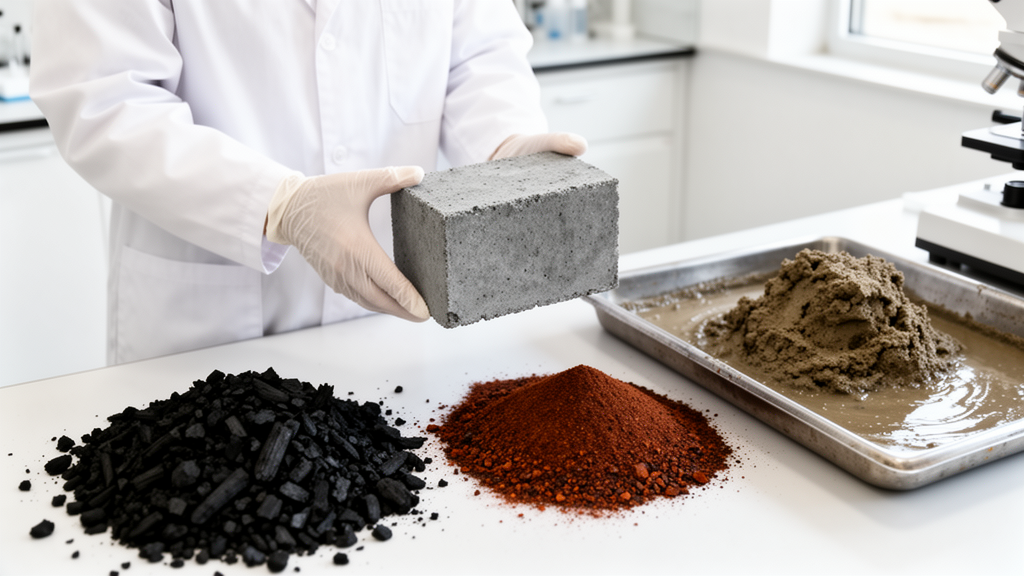
Every year, cities dredge enormous quantities of silt from rivers, canals, and drainage channels to keep water flowing and flood defenses intact. The dredged material is usually a liability: it is waterlogged, weakly bonded, and prone to disintegrating when wet, which makes it unsuitable for roadbeds, embankments, or any other infrastructure use without treatment. A research team working between Shandong Jiaotong University in China and the University of Texas at Austin now reports that this problematic sediment can be transformed into a load-bearing geomaterial using a binder made almost entirely from industrial and agricultural waste, with performance that rivals ordinary Portland cement in standardized shear tests.
The binder, described in a study published in Frontiers in Materials, combines three unlikely ingredients: ground granulated blast-furnace slag (GGBS), a glassy by-product of iron manufacturing; carbide slag, a calcium-rich residue from acetylene production; and biochar made by pyrolyzing corn straw at 500 degrees Celsius. The researchers call the mixture a biochar-modified alkali-activated slag, or BAS, binder. Unlike conventional cement, it contains no clinker, the calcium-silicate ingredient whose production accounts for a substantial share of global carbon dioxide emissions from limestone calcination and fuel combustion. Because dredged silt treatment involves large volumes of relatively low-value material, replacing clinker in this application could have an outsized environmental payoff.
To find the best formulation, the team used response surface methodology, a statistical optimization technique that models how multiple variables interact to influence an outcome. They ran a 17-experiment Box-Behnken design varying the GGBS content between 5 and 15 percent, the carbide slag between 4 and 10 percent, and the biochar between 0 and 10 percent of total specimen mass, measuring unconfined compressive strength at 7 and 28 days. The resulting quadratic models fit the data remarkably well, with R-squared values of 0.9905 for the 7-day strength and 0.9962 for the 28-day strength. Among the linear terms, GGBS dominated, followed by carbide slag and then biochar, indicating that the reactive slag precursor drives most of the strength development.
The optimization module recommended 13.26 percent GGBS, 8.25 percent carbide slag, and 4.30 percent biochar by total specimen mass, predicting an unconfined compressive strength of 6.32 megapascals at 28 days. A confirmation test measured 6.25 megapascals, a relative error of just 1.12 percent. When the three dosages were normalized, they produced an internal dry-mass ratio of 51.38 parts GGBS to 31.96 parts carbide slag to 16.66 parts biochar, which the team then held constant across all subsequent tri-axial experiments. This two-stage approach, screening the composition by unconfined strength and then testing the optimized blend under confinement, is what distinguishes the study from earlier work that stopped at simple strength measurements.
The chemistry behind the binder is straightforward in principle. In calcium-rich precursors like GGBS, alkaline activation dissolves reactive glassy phases and promotes the precipitation of calcium-silicate-hydrate and calcium-aluminosilicate-hydrate gels. These products coat mineral particles, bridge particle contacts, and refine the pore network, which increases both the bonded component of strength, captured as cohesion, and the frictional resistance between particles. Carbide slag, dominated by portlandite and calcite, supplies both the alkalinity and the calcium needed for this reaction without requiring concentrated sodium hydroxide or sodium silicate solutions, making it more practical for large-volume earthwork.
The biochar plays a subtler role. Its porous structure, surface functional groups, and water-retention capacity can modify particle packing and the internal moisture environment during hydration. Previous studies have shown that biochar’s effect on cementitious composites depends heavily on particle size, dosage, and dispersion, with excessive amounts diluting the cementitious phase or introducing weak porous inclusions. The optimized 4.30 percent dosage appears to sit in a productive middle range, though the researchers note that their data do not isolate the biochar contribution directly.
For the tri-axial testing program, the team prepared cylindrical specimens 39.1 millimeters in diameter and 80 millimeters tall from dredged silt collected at a river-channel construction site in Jinan, China. The silt, classified as a low-liquid-limit clay with a natural water content of 48.5 percent, was dried, sieved, and homogenized before mixing. Specimens were cured at 20 degrees Celsius and at least 95 percent relative humidity, then vacuum-saturated and immersed in water for 12 hours before testing, a deliberately harsh conditioning that simulates field exposure. Consolidated undrained tri-axial tests were run at confining pressures of 50, 100, and 150 kilopascals, and the results were interpreted using the Mohr-Coulomb failure criterion to extract cohesion and internal friction angle as total-stress parameters.
The results show a clear dosage response. At 18 percent water content and 28 days of curing, cohesion rose from 169.4 kilopascals at 5 percent BAS to 181.9 kilopascals at 10 percent and 195.2 kilopascals at 15 percent, while the friction angle increased from 38.5 to 42.3 to 42.5 degrees. Notably, the friction angle gained most of its improvement between 5 and 10 percent dosage and then plateaued, while cohesion continued climbing, suggesting diminishing returns on the frictional component at higher binder contents. Water content produced a non-monotonic response, with both parameters peaking at 18 percent, close to the 18.1 percent compaction optimum measured for the center-point mixture, and declining at both 15 and 21 percent. This inverted-U pattern likely reflects competing effects of wetting, ion mobility, compaction efficiency, and pore-solution dilution.
Curing age told a story of front-loaded strength gain. BAS cohesion increased from 190.2 kilopascals at 7 days to 195.2, 196.4, and 196.8 kilopascals at 28, 60, and 120 days, with roughly nine-tenths of the total change complete by 60 days. The friction angle followed the same trajectory, rising from 41.5 to 43.3 degrees over the same period. Compared with ordinary Portland cement tested under identical conditions, BAS performed remarkably well: at 15 percent dosage, BAS achieved 195.2 kilopascals cohesion and 42.5 degrees friction angle versus 191.7 kilopascals and 42.1 degrees for cement, arithmetic differences of under 3 percent. Against alkali-activated slag without biochar, BAS cohesion was 16.40 percent higher and the friction angle 12.73 percent higher; against lime, the gaps widened to 23.62 percent and 17.40 percent respectively.
The authors are careful to frame their conclusions within the boundaries of what was actually measured. The reported parameters are total-stress values applicable to the tested silt, preparation procedure, and confining-pressure range, not general design parameters, and pore-water pressures were not measured, so effective stresses were never calculated. No life-cycle assessment, carbon accounting, leaching testing, or microstructural analysis was performed, meaning no net environmental benefit can be quantified from this study alone. Untreated silt could not serve as a tri-axial control because it disintegrated during immersion. Still, the demonstration that a clinker-free binder built from steel slag, carbide residue, and corn straw can match cement in saturated shear performance marks a meaningful step toward converting two waste streams and an agricultural residue into lower-carbon geomaterials for infrastructure, pending the durability and environmental validation that future work must provide.
Subject of Research: Biochar-modified alkali-activated slag stabilization of urban dredged silt for infrastructure reuse
Article Title: Tri-axial shear performance of urban dredged silt stabilized with a biochar-modified alkali-activated slag binder
Article References: Wen, K., Zhan, Y., Feng, Q., Wei, M., Tang, Z., Wei, Z., & Zhao, Y. (2026). Tri-axial shear performance of urban dredged silt stabilized with a biochar-modified alkali-activated slag binder. Frontiers in Materials, 13, Article 1955304. https://doi.org/10.3389/fmats.2026.1955304
Image Credits: AI Generated
DOI: 10.3389/fmats.2026.1955304
Keywords: dredged silt, alkali-activated slag, biochar, soil stabilization, tri-axial shear strength, GGBS, carbide slag, clinker-free binder, geotechnical engineering, response surface methodology, sustainable construction, Mohr-Coulomb
Cite Scienmag News
Denise Maddox. (October 16, 2026). Corn Straw Biochar and Steel Slag Turn Dredged River Silt Into a Cement-Free Construction Material. Scienmag. https://scienmag.com/corn-straw-biochar-and-steel-slag-turn-dredged-river-silt-into-a-cement-free-construction-material/
Denise Maddox. "Corn Straw Biochar and Steel Slag Turn Dredged River Silt Into a Cement-Free Construction Material." Scienmag, 16 October 2026, https://scienmag.com/corn-straw-biochar-and-steel-slag-turn-dredged-river-silt-into-a-cement-free-construction-material/. Accessed 16 October 2026.
Denise Maddox. "Corn Straw Biochar and Steel Slag Turn Dredged River Silt Into a Cement-Free Construction Material." Scienmag. October 16, 2026. https://scienmag.com/corn-straw-biochar-and-steel-slag-turn-dredged-river-silt-into-a-cement-free-construction-material/


