


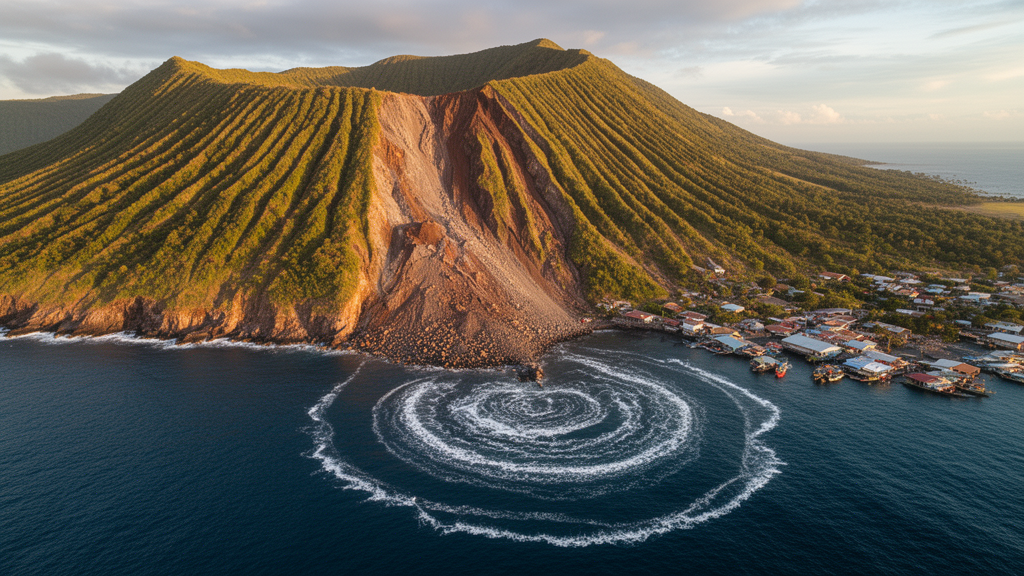
Along the rugged coastlines of Indonesia’s Flores Sea, a silent danger may be lurking beneath the waves—one that doesn’t require a massive undersea earthquake to unleash devastating tsunami waves. New research published in the journal Natural Hazards reveals that non-tectonic tsunami hazards, triggered by earthquakes and landslide-induced geomorphic changes on coastal cliffs, could pose a significant and previously underappreciated threat to communities across the eastern Indonesian region.
The study, led by Wiko Setyonegoro of Indonesia’s National Research and Innovation Agency (BRIN), examines a cascading chain of geological events that has received surprisingly little scientific attention. Rather than focusing solely on the classic scenario of a large undersea earthquake directly generating a tsunami, the researchers investigated how seismic events can act as triggers for secondary disasters—specifically, landslides and flank collapses along coastal cliffs—which in turn generate destructive tsunami waves. This cascading sequence, the authors argue, represents a critical gap in tsunami hazard assessments for the region.
The Flores Sea region has a sobering history of tsunami disasters. The research team evaluated three historical events that shaped their understanding of the region’s hazard potential: an 1820 earthquake of magnitude 7.5 that caused approximately 500 fatalities, the devastating 1992 earthquake of magnitude 7.8 that generated tsunami waves reaching 25 meters in height and claimed approximately 2,500 lives, and the more recent 2021 magnitude 7.3 earthquake that triggered tsunami warnings across the region. Each of these events, the researchers note, was influenced by mass failures such as flank collapses or landslides, suggesting that non-tectonic mechanisms may play a more significant role in tsunami generation than previously recognized.
Central to the team’s findings is the identification of the Kalaotoa Fault, a newly recognized geological structure that intersects the Flores Back-Arc Thrust Fault in the Flores Sea. According to the study, this fault acts as a seismic trigger for earthquakes that subsequently induce geomorphic disasters—including landslides—followed by destructive tsunamis. The interaction between these two fault systems creates a complex tectonic environment where earthquake shaking can destabilize steep coastal slopes, setting the stage for catastrophic mass failures that displace enormous volumes of water.
To build their tsunami scenario models, the researchers employed a sophisticated nesting grid system designed to improve model resolution across the study area. This computational approach allows scientists to simulate tsunami propagation at varying levels of detail, capturing both the broad regional patterns of wave movement and the fine-scale coastal effects that determine how high waves will run up on shore. The team integrated their modeling framework with high-resolution field data, conducting a 50-meter bathymetry survey using the single-beam method to verify and refine the existing 185-meter BATNAS bathymetric dataset maintained by Indonesian geospatial authorities.
The researchers also incorporated 30-meter resolution digital terrain model (DTM) topographic data from FABDEM—Forest and Buildings removed Copernicus DEM—to accurately represent the coastal topography that influences tsunami inundation. By combining these diverse data sources, the team was able to construct detailed scenario models that account for both the submarine and subaerial components of potential landslide-generated tsunamis. The modeling approach draws on established tsunami simulation tools, including the COMCOT (Cornell Multi-grid Coupled Tsunami Model) framework, which has been widely validated against historical tsunami events worldwide.
What makes this research particularly compelling is its focus on the geomorphic dimension of tsunami hazard. While most tsunami studies concentrate on seafloor displacement caused by earthquake rupture, the Flores Sea study highlights how the shaking from earthquakes can trigger secondary failures—landslides, rockfalls, and flank collapses—that generate their own tsunami waves. These non-tectonic tsunami sources are notoriously difficult to predict because they depend on the specific conditions of individual coastal slopes, including their geological composition, structural integrity, and degree of saturation. The 2018 Anak Krakatau flank collapse, which generated a deadly tsunami in the Sunda Strait, serves as a stark reminder of how quickly such events can unfold and how devastating their consequences can be.
The implications for disaster preparedness in eastern Indonesia are significant. The region is home to numerous coastal communities, including popular tourist destinations such as Labuan Bajo, the gateway to Komodo National Park. The study’s findings suggest that current tsunami hazard assessments, which may focus primarily on earthquake-generated tsunamis, could be underestimating the full spectrum of tsunami risk facing these communities. By incorporating non-tectonic tsunami scenarios into hazard models, emergency managers and urban planners can develop more comprehensive evacuation strategies and building codes that account for the unique characteristics of landslide-generated waves, which can arrive with little warning and produce highly localized but extremely destructive inundation.
The research also contributes to a broader scientific conversation about the role of cascading hazards in disaster risk. Rather than viewing earthquakes, landslides, and tsunamis as isolated events, the Flores Sea study demonstrates how these phenomena can be linked in a chain of cause and effect, with each stage amplifying the overall hazard. This cascading perspective is increasingly recognized as essential for accurate risk assessment in geologically active regions around the world, where the interaction between multiple hazard processes can produce outcomes far worse than any single event alone.
As climate change and human development continue to reshape coastlines across Southeast Asia, understanding the full range of tsunami-generating mechanisms becomes ever more urgent. The Flores Sea study represents an important step forward in this effort, providing both a conceptual framework for evaluating non-tectonic tsunami hazards and a detailed case study of how earthquake-triggered landslides can contribute to tsunami risk in one of the world’s most geologically dynamic regions. For the communities that line the shores of the Flores Sea, the research offers a sobering but valuable message: the next tsunami may not come from the fault lines alone, but from the crumbling cliffs above them.
Subject of Research: Earthquake-triggered landslide tsunami hazards along the Flores Sea coast, Indonesia
Article Title: Non-tectonic tsunami hazards potentially triggered by earthquakes and landslide-induced geomorphic changes on coastal cliffs along the Flores Sea, Indonesia
Article References: Non-tectonic tsunami hazards potentially triggered by earthquakes and landslide-induced geomorphic changes on coastal cliffs along the Flores Sea, Indonesia. (n.d.). https://doi.org/10.1007/s11069-026-08461-7
Image Credits: AI Generated
DOI: 10.1007/s11069-026-08461-7
Keywords: tsunami, Flores Sea, landslides, Indonesia, Kalaotoa Fault, Flores Back-Arc Thrust, coastal hazards, geomorphic disasters, submarine mass failure, disaster preparedness, natural hazards, seismic triggering
Cite Scienmag News
Violet Maxwell. (October 16, 2026). Hidden Tsunami Threat: How Earthquakes Could Trigger Deadly Landslides Along Indonesia’s Flores Sea. Scienmag. https://scienmag.com/hidden-tsunami-threat-how-earthquakes-could-trigger-deadly-landslides-along-indonesias-flores-sea/
Violet Maxwell. "Hidden Tsunami Threat: How Earthquakes Could Trigger Deadly Landslides Along Indonesia’s Flores Sea." Scienmag, 16 October 2026, https://scienmag.com/hidden-tsunami-threat-how-earthquakes-could-trigger-deadly-landslides-along-indonesias-flores-sea/. Accessed 16 October 2026.
Violet Maxwell. "Hidden Tsunami Threat: How Earthquakes Could Trigger Deadly Landslides Along Indonesia’s Flores Sea." Scienmag. October 16, 2026. https://scienmag.com/hidden-tsunami-threat-how-earthquakes-could-trigger-deadly-landslides-along-indonesias-flores-sea/


