


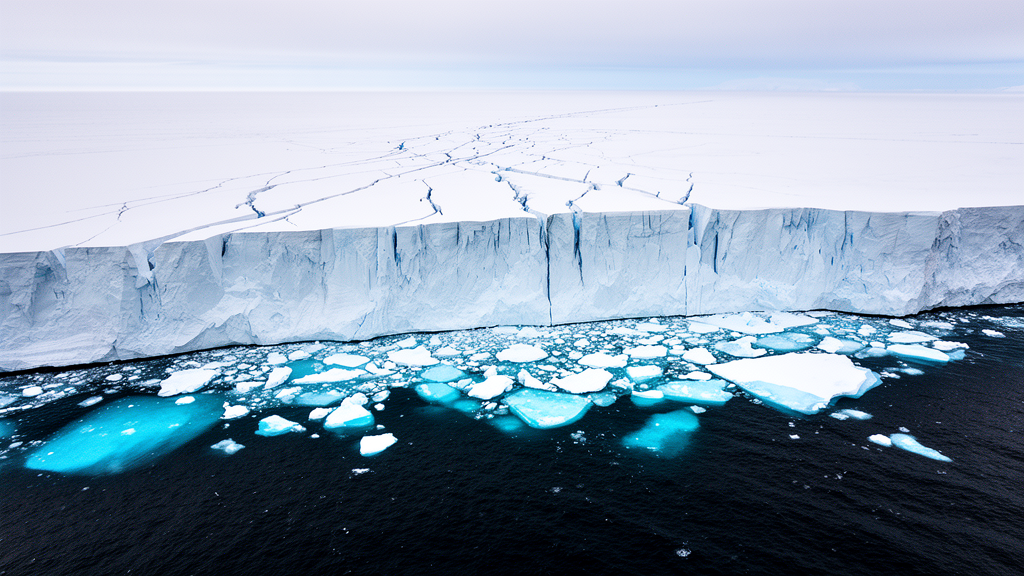
Antarctica’s icy edges are shrinking at record pace. As warming air and water thin the floating ice shelves that buttress the continent’s vast ice sheet, sheer walls of solid ice are being exposed to the ocean. The stability of these towering ice cliffs matters far beyond the polar south: if they collapse in a runaway chain, Antarctica could dump enough ice into the sea to reshape projections of global sea level rise. A new study published in Science suggests that reality is more complicated — and, in some ways, less alarming — than the worst-case theories have assumed.
For decades, glaciologists have worked with a hypothesis known as marine ice cliff instability, or MICI. The idea is elegantly simple: an ice cliff taller than roughly 100 meters — about the height of the Statue of Liberty — cannot support its own weight and should collapse. When it does, it exposes an even taller cliff further inland, which should then collapse in turn, triggering a cascading retreat that progressively dismantles the ice sheet behind it. Previous studies built this picture mainly from physical models of ice mechanics, scaled up to cliff dimensions and anchored by only a handful of real-world observations.
Researchers at the Massachusetts Institute of Technology and the Woods Hole Oceanographic Institution decided to test that assumption at scale. Graduate student Caroline Needell, together with Catherine Walker of WHOI and Jeremy Bassis of the University of Michigan, analyzed satellite measurements of more than 15,000 ice cliffs around Antarctica, tracked over four years from 2019 to 2023. Their data came from NASA’s Ice, Cloud, and Land Elevation Satellite-2, or ICESat-2, which sweeps over the polar regions and uses a laser altimeter to measure the height of ice sheets, glaciers, sea ice, and the surrounding ocean surface. Quarterly measurements allowed the team to watch individual cliffs grow, collapse, and recover through time.
The first surprise was height. The proposed critical threshold for cliff collapse sits at about 100 meters, yet the average Antarctic ice cliff in the dataset measured only about 30 meters tall. Cliffs exceeding the theoretical limit turned out to be rare. That finding alone suggests the preconditions for runaway collapse are less widespread than models had implied, because most of the ice front simply never reaches the height at which instability is supposed to begin.
But the team did not stop at static snapshots. They zoomed in on the four regions where ICESat-2 recorded the tallest cliffs, each roughly 100 meters high, including one that stood 127 meters above the water. Tracking these giants every three months over four years, they found that the tallest cliffs did collapse, and the ice sheet behind them retreated — but at a pace faster than MICI models had predicted. Rapid loss of ice, in isolation, would translate into greater contributions to sea level rise than anticipated.
The second surprise was what happened next. The retreat did not cascade. Instead, it was short-lived, and the glaciers in every region eventually stabilized, with ice spreading back out toward the ocean. “We found that when the cliffs were retreating, they were doing so faster than what has been modeled, which would mean more ice loss and higher contributions of sea level rise,” Needell said. “But because we found that the retreat was short-lived, and all the glaciers eventually stabilized, that would suggest that things won’t be so bad. We don’t see this runaway effect.”
What stops the cascade? The study points to stabilizing mechanisms that height-only models ignore. One is mélange — the slushy mixture of broken icebergs and sea ice that packs together against the front of a cliff. The researchers measured mélange height and found that taller cliffs are backed by thicker mélange, which appears to act as a built-in buttress, propping up the ice wall and absorbing the stress that would otherwise drive further calving. Cliffs that held their position over time were consistently those with the most substantial mélange cover.
Water depth plays a role as well. The satellite data showed that the height of the surrounding ocean can stabilize a cliff: the deeper the water, the more it buoys and pushes back against the ice face, resisting collapse. In effect, the ocean itself can act as a support structure, a counterintuitive result given that deep water is usually associated with faster glacier retreat through undercutting and melting.
Beneath the ice, another safeguard emerged. The shape of the land under the ice sheet — the bed topography — can function as a literal speed bump. Where the underlying terrain is flat, the slope of the overlying ice reflects its true thickness. But where the bed rises, the ice sitting over that bump is thinner than it appears from the surface. Thinner ice means shorter, more stable cliffs, less likely to fail. When the researchers compared cliff behavior with topographic measurements of Antarctica, they found that ice cliffs indeed stabilized around regions where the land rose upward. The team also observed that the taller a cliff is, the faster it thins out: as collapsing cliffs settle into shorter, more stable configurations, the process naturally arrests itself rather than accelerating.
“It’s this rapid retreat, punctuated by periods of stabilization,” Needell said, describing the pattern that initially puzzled the team. The resolution, she explained, was to consider everything that affects cliff height rather than height alone. “Now we know what to look for,” she said. “We really need to know the bed topography, and we need to know the ice thinning rate, in order to get ice cliff instability right, because this value really matters in the context of projecting sea level rise.” The message for modelers is clear: predictive ice-sheet models that treat cliff height as the only variable — triggering runaway retreat once the 100-meter threshold is crossed — are missing the feedbacks that nature apparently provides. The work was supported in part by NASA, the U.S. National Science Foundation, and the DOMINOS project, a component of the International Thwaites Glacier Collaboration. By grounding MICI theory in more than 15,000 real cliffs observed over four years, the study replaces a frightening but poorly tested hypothesis with a more nuanced picture: Antarctic ice cliffs can fail dramatically and quickly, but the ice sheet behind them has more ways to catch its breath than scientists once believed.
Subject of Research: Marine ice cliff instability and the stability of Antarctic ice sheet margins observed by satellite altimetry
Article Title: Satellite data reveal how Antarctica’s ice cliffs behave over time
Article References: Satellite data reveal how Antarctica’s ice cliffs behave over time. (n.d.). Original publication
Image Credits: AI Generated
DOI: Not provided
Keywords: Antarctica, ice cliffs, marine ice cliff instability, ICESat-2, sea level rise, ice shelves, glaciology, mélange, bed topography, MIT, Woods Hole Oceanographic Institution, Science
Cite Scienmag News
Russell Cooper. (October 16, 2026). Satellites show Antarctic ice cliffs collapse fast but then stabilize. Scienmag. https://scienmag.com/satellites-show-antarctic-ice-cliffs-collapse-fast-but-then-stabilize/
Russell Cooper. "Satellites show Antarctic ice cliffs collapse fast but then stabilize." Scienmag, 16 October 2026, https://scienmag.com/satellites-show-antarctic-ice-cliffs-collapse-fast-but-then-stabilize/. Accessed 16 October 2026.
Russell Cooper. "Satellites show Antarctic ice cliffs collapse fast but then stabilize." Scienmag. October 16, 2026. https://scienmag.com/satellites-show-antarctic-ice-cliffs-collapse-fast-but-then-stabilize/


