


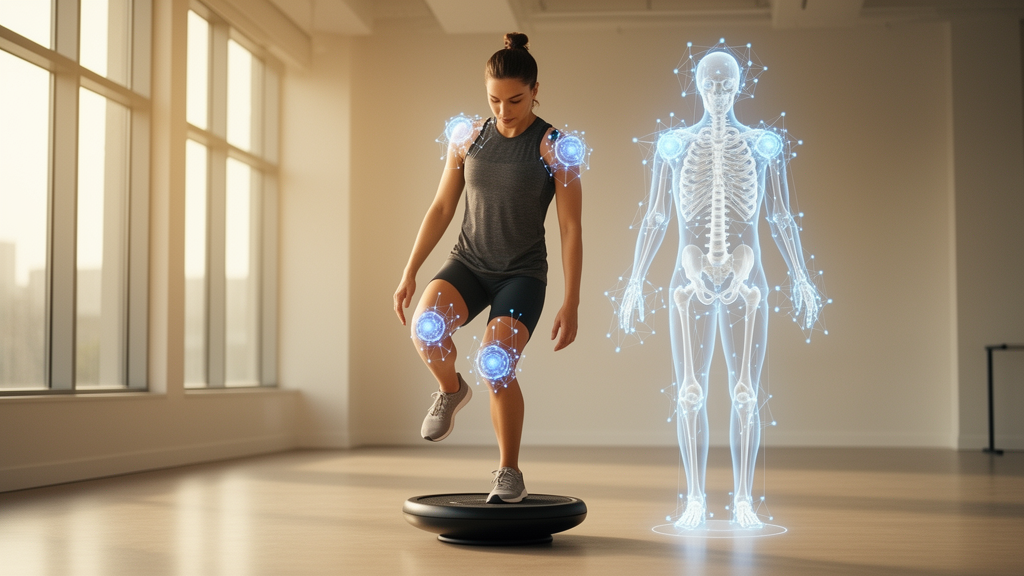
Artificial intelligence systems that grade your yoga pose or squat form are becoming common in fitness apps, but most of them share a dangerous blind spot: they never admit doubt. A new study published in Frontiers in Neurorobotics tackles that problem head-on with a framework that not only scores posture quality but also knows when its own judgment is too shaky to trust. The system, called LNNBI for Liquid Neural Network with Bayesian Inference, was developed by Yuhua Mu of Shaoxing Institute of Technology together with Mingliang Zhu of Chongqing Polytechnic Institute and Zhi Tao of Factory Vocational and Technical School in Guangzhou. Their central argument is provocative: in safety-sensitive settings, an AI that confidently delivers a wrong score is not merely inaccurate, it is actively hazardous.
The stakes are not theoretical. The researchers cite clinical evidence showing what happens when people practice unsupervised with poor form. One documented case involved a 45-year-old man with no prior spinal problems who developed severe lumbopelvic pain, rated 8.5 out of 10 on a pain scale, after regularly performing unsupervised stretching with improper technique; he needed 45 days of supervised physiotherapy to recover. Larger-scale data point in the same direction. An international survey of 3,668 users of a bodyweight training app, where all instruction is delivered without professional supervision, found that 24 percent of participants sustained at least one injury over nine months, an incidence rate of 4.57 injuries per 1,000 training hours. Muscle strains accounted for 28.5 percent of reported conditions, and critically, 35 percent of injured respondents believed better technique could have prevented their injury.
Biomechanics research adds a further layer of concern. Analyses of squatting have shown that altered knee kinematics, such as excessive valgus collapse, can increase medial compartment contact forces by more than 50 percent compared with correct sagittal-plane alignment. Poorly calibrated automated feedback may also narrow a learner’s attentional focus, encourage score-chasing over genuine movement quality, and foster dependence on external cues at the expense of intrinsic body awareness. Against this backdrop, the authors argue that reliability deserves equal standing with accuracy in any automated posture assessment system, and that predictive uncertainty should be explicitly modeled and reported rather than hidden inside a single number.
The technical heart of the solution is the liquid neural network, a relatively new architecture that departs from conventional recurrent networks such as LSTM or GRU in a crucial way. Instead of operating at fixed discrete time steps, liquid networks are governed by continuous-time dynamics with input-dependent time constants. In practice, this means the network automatically adjusts its temporal resolution to the signal it receives, responding faster during rapid transitions and staying stable during slow, sustained postural holds, without heuristic downsampling or interpolation. Unlike Neural ODEs, which apply globally shared dynamics across all inputs, liquid networks modulate their state evolution based on incoming sensory signals, providing context-aware temporal representation. That flexibility matters for human motion, which exhibits highly variable speeds, irregular rhythms, and multi-scale temporal structures that challenge both discrete-step recurrent models and input-independent continuous-time models.
On top of this dynamic backbone, the researchers layered Bayesian variational inference. Rather than treating network weights as fixed numbers, the Bayesian formulation treats all parameters as probability distributions, with priors over weights, biases, observation noise, and even the time constants themselves, which follow a log-normal distribution to guarantee positive values. Because the true posterior is analytically intractable for such a nonlinear model, the team optimized an Evidence Lower Bound using stochastic gradient variational Bayes with the Adam optimizer, the reparameterization trick, and mini-batch training. The payoff is a full posterior predictive distribution for every test sample, from which the model derives both a predicted quality score on a 0 to 100 scale and a principled uncertainty measure in the form of the posterior predictive standard deviation.
The uncertainty estimate then powers the framework’s most distinctive feature: a rejection mechanism. When predictive uncertainty exceeds a predefined threshold, the model abstains from making a prediction and instead flags the sample for human verification. This serves two purposes. First, it acts as a safety layer, preventing potentially harmful incorrect predictions from reaching users without qualification. Second, it creates an efficient human-in-the-loop workflow, directing instructor attention to the cases that would benefit most from expert review. The threshold is adjustable to risk tolerance: stricter settings maximize safety in high-stakes rehabilitation contexts, while lenient settings maximize automated coverage in routine practice.
To validate the approach, the team built a longitudinal dataset of 50 university students, 32 female and 18 male, aged 18 to 26 with a mean age of 20.8 years, tracked over 200 consecutive days. Four fundamental postures representing distinct biomechanical demands, including spinal extension, spinal flexion with elongation, unilateral loading, and single-limb balance, were decomposed into seven performance indicators: spinal alignment and elongation, shoulder girdle stability and positioning, core muscle engagement, pelvic position and neutrality, lower-body joint alignment and stability, foot foundation and weight distribution, and breathing rhythm and coordination. Three certified instructors with 5 to 10 years of teaching experience independently scored video recordings from three camera angles, and inter-rater reliability measured by intraclass correlation coefficients ranged from 0.82 to 0.91, indicating good to excellent agreement.
The pipeline from raw video to score is a study in engineering pragmatism. Recordings at 30 frames per second are processed with MediaPipe or OpenPose to extract 33 skeletal keypoints per frame. Joint angles, segment orientations, and body positions are then translated into quantitative indicator scores using geometric formulas, for example computing pelvic tilt relative to the horizontal plane or spinal curvature deviation from an ideal neutral curve. Two indicators deserve special mention because they are inherently internal states: core muscle engagement is inferred from trunk kinematic stability, and breathing rhythm is estimated from the periodic expansion of the chest bounding box, filtered with zero-phase Butterworth filters and peak detection to reject motion artifacts. The authors are candid that these are proxies rather than ground-truth measurements, and they flag multimodal sensor integration, such as surface electromyography and respiratory plethysmography, as a key direction for future work.
The results are striking. LNNBI achieved an accuracy of 0.8715 and a precision of 0.9105, outperforming LSTM, MC-GRU, TSGCN, and YoNet baselines adapted to the same seven-dimensional input. Most importantly, uncertainty analysis revealed a strong correlation between prediction error and uncertainty, with Pearson’s r equal to 0.73, confirming that the model reliably identifies its own low-confidence predictions. At a moderate rejection threshold, the model abstains on about 15 percent of test samples while achieving an effective accuracy of 0.923 on the accepted predictions, consistently beating MC-GRU with Monte Carlo Dropout at comparable rejection rates. Correlation analysis across indicators identified pelvic position and neutrality as the most influential factor, with r equal to 0.682, followed by spinal alignment at 0.595, findings that align with established biomechanical principles that the pelvis serves as the body’s foundation for spinal and lower-limb alignment.
Deployment feasibility looks promising but not unlimited. The model, with roughly 47,892 parameters and 2.34 million floating-point operations per forward pass, achieves 4.2 milliseconds of inference latency on an NVIDIA RTX 3090 GPU, fast enough for real-time single-user applications, while CPU-only inference at 28.7 milliseconds per sample would need further optimization for concurrent multi-user or mobile scenarios. An ablation study on the discrete integration step size showed the framework remains robust, maintaining accuracy above 0.85 even at suboptimal settings. The authors acknowledge limitations, including a young, homogeneous participant pool and a focus on static postures rather than movement transitions, but the core contribution stands: a reliability-first perspective on automated posture assessment, in which knowing when not to answer is treated as a feature as vital as the answer itself.
Subject of Research: A Bayesian liquid neural network framework that provides uncertainty-aware posture quality assessment with a rejection mechanism for safe automated movement feedback.
Article Title: Uncertainty-aware posture quality assessment with Bayesian liquid neural networks
Article References: Uncertainty-aware posture quality assessment with Bayesian liquid neural networks. (n.d.). https://doi.org/10.3389/fnbot.2026.1958419
Image Credits: AI Generated
DOI: 10.3389/fnbot.2026.1958419
Keywords: Bayesian deep learning, liquid neural networks, posture quality assessment, uncertainty quantification, rejection mechanism, biomechanical indicators, variational inference, human pose estimation, health technology, reliability, machine learning, movement analysis
Cite Scienmag News
Blake Davidson. (October 16, 2026). AI That Knows When It Doesn’t Know: Bayesian Liquid Network Brings Safer Posture Coaching. Scienmag. https://scienmag.com/ai-that-knows-when-it-doesnt-know-bayesian-liquid-network-brings-safer-posture-coaching/
Blake Davidson. "AI That Knows When It Doesn’t Know: Bayesian Liquid Network Brings Safer Posture Coaching." Scienmag, 16 October 2026, https://scienmag.com/ai-that-knows-when-it-doesnt-know-bayesian-liquid-network-brings-safer-posture-coaching/. Accessed 16 October 2026.
Blake Davidson. "AI That Knows When It Doesn’t Know: Bayesian Liquid Network Brings Safer Posture Coaching." Scienmag. October 16, 2026. https://scienmag.com/ai-that-knows-when-it-doesnt-know-bayesian-liquid-network-brings-safer-posture-coaching/


