


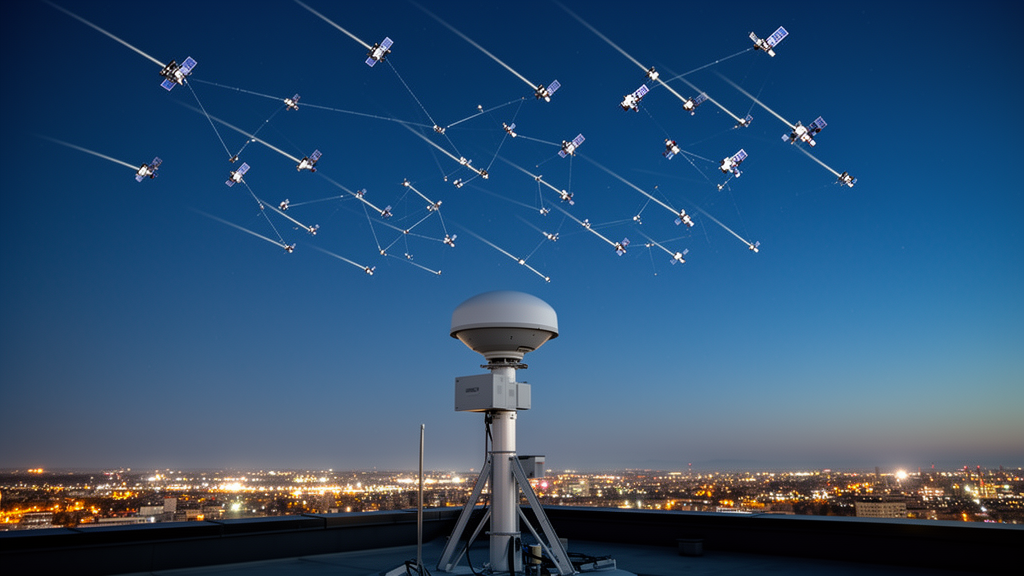
Time is the invisible infrastructure of modern civilization. Communication networks, power grids, financial transactions, and scientific metrology all depend on clocks at different locations agreeing with one another to within billionths of a second. For decades, the gold standard for comparing clocks across continents has been precise point positioning, or PPP, a technique that uses precise satellite orbit and clock products to estimate a receiver’s clock offset without needing a local network of reference stations. The International Bureau of Weights and Measures has adopted PPP for computing the time links that contribute to International Atomic Time, the backbone of global timekeeping. Now, a new study published in Frontiers in Astronomy and Space Sciences reveals a surprising twist in how a proposed fleet of low Earth orbit satellites could improve this critical technology, and the answer depends on how much of the sky you can actually see.
A team of researchers from Nanjing Normal University, the National University of Defense Technology, and the 36th Research Institute of China Electronics Technology Group Corporation set out to answer a question that has lingered in the satellite navigation community: when you augment multi-GNSS PPP time transfer with observations from low Earth orbit satellites, does the benefit behave the same way for both how quickly a time link converges and how stable it remains afterward? The intuitive assumption might be yes, but the data tells a more nuanced story, one that could shape how future navigation constellations are designed and deployed.
The researchers constructed two processing schemes using five days of real observations from the Multi-GNSS Experiment network. The first scheme, dubbed GCE, combined GPS, BDS-3, and Galileo observations from seven MGEX stations equipped with high-performance external atomic frequency standards. The reference station, BRUX in Brussels, carries an external hydrogen maser, while the remote stations in Boulder, Maspalomas, Usuda, Krugersdorp, Malargue, and Parkes form six inter-station time links with baseline lengths ranging from roughly 3,034 to 12,250 kilometers. The second scheme, GCE plus LEO, added simulated observations from a Walker 288/24/1 constellation of 288 low Earth orbit satellites flying at approximately 850 kilometers altitude with a 55-degree inclination.
To isolate the effect of observation constraints, the team systematically varied the elevation cutoff angle from 10 degrees to 40 degrees, applying the same cutoff to both GNSS and LEO observations. As the cutoff angle increased, the mean number of visible GNSS satellites plummeted from 26.06 to 11.42, while the time dilution of precision, a geometric indicator of timing quality, surged from 0.547 to 3.482. Adding LEO observations increased satellite visibility by 17.2 to 44.9 percent and reduced TDOP by 14.6 to 27.6 percent across all four cutoff angles, confirming that the fast-moving LEO satellites provide additional line-of-sight directions that strengthen the geometry available for receiver-clock estimation.
The convergence results were striking. Across all 24 link-cutoff combinations, the LEO-augmented solution satisfied the adopted stability criterion earlier than the GNSS-only solution. The six-link median convergence-time reductions were 16.4 percent, 25.0 percent, 22.2 percent, and 31.6 percent at cutoff angles of 10, 20, 30, and 40 degrees respectively. The benefit generally grew larger under more restrictive observing conditions, with absolute median reductions reaching approximately 6.3 minutes at the 40-degree cutoff. Individual links showed dramatic improvements, with MAS1-BRUX and PARK-BRUX converging 11.5 and 12.5 minutes faster at 40 degrees compared to the GNSS-only solution.
But the steady-state results painted a completely different picture. At the 10-degree cutoff, all six links exhibited reductions in steady-state standard deviation, with a median link-wise relative reduction of 22.7 percent. Yet at 20 and 30 degrees, the median changes were both approximately negative 1.5 percent, with some links showing slight increases of only a few percent. At 40 degrees, the median change was a mere 0.2 percent, indicating essentially no difference between the two schemes. The systematic steady-state benefit of LEO augmentation was therefore concentrated almost entirely at the lowest cutoff angle.
Frequency stability told a similar story. At an averaging time of 3,000 seconds, the six-link median modified Allan deviation reduction decreased from 48.9 percent at 10 degrees to 30.5 percent at 20 degrees, 13.9 percent at 30 degrees, and just 2.1 percent at 40 degrees. The improvement in medium-to-long-term frequency stability provided by LEO augmentation was strongest under the least restrictive observation conditions and progressively weakened as the cutoff angle increased. At short averaging times of 30 and 300 seconds, the two schemes performed similarly regardless of cutoff angle.
The explanation lies in the fundamentally different roles that LEO observations play during initialization versus steady-state operation. When the elevation cutoff is high, GNSS satellite availability and sky coverage shrink dramatically, leaving less geometric information available for separating the receiver clock from other estimated parameters such as tropospheric delays, inter-system biases, and carrier-phase ambiguities. Under these conditions, the rapidly changing LEO line-of-sight directions provide crucial additional time-varying geometry that accelerates convergence. However, raising the cutoff also removes an increasing fraction of LEO observations and shortens their continuous tracking arcs, reducing the additional information available during steady-state operation and explaining the progressive weakening of the dispersion and frequency-stability benefits.
The reconvergence experiments, which simulated a complete 10-minute observation outage at each remote station, showed shorter recovery times with LEO augmentation at both 10 and 40 degrees, with median relative reductions of approximately 27 percent and 21 percent respectively. However, the magnitude of the recovery benefit depended more strongly on the individual time link and the instantaneous geometry available when observations resumed, making the reconvergence response less systematic than the cold-start behavior.
These findings carry significant implications for how the effectiveness of LEO augmentation in satellite timing should be assessed. The study demonstrates that LEO augmentation of multi-GNSS PPP time transfer exhibits a distinctly stage-dependent response to elevation cutoff angle. Under restrictive observing conditions, its primary benefit is accelerating the establishment and recovery of a usable time link, whereas under more favorable conditions where LEO observations remain continuously available, the benefit shifts toward improving steady-state dispersion and medium-to-long-term frequency stability. The researchers emphasize that the overall effectiveness of LEO augmentation cannot be adequately characterized by a single performance metric, and future assessments should jointly evaluate convergence and steady-state perspectives. While the results are based on simulated LEO observations under idealized product conditions, they provide a controlled foundation for understanding how proposed LEO navigation constellations could complement existing GNSS infrastructure for the ultra-precise timekeeping that underpins modern science and technology.
Subject of Research: Satellite Navigation and Time Transfer
Article Title: Elevation-cutoff-dependent convergence and steady-state performance of LEO-augmented multi-GNSS PPP time transfer
Article References: Elevation-cutoff-dependent convergence and steady-state performance of LEO-augmented multi-GNSS PPP time transfer. (n.d.). https://doi.org/10.3389/fspas.2026.1969705
Image Credits: AI Generated
DOI: 10.3389/fspas.2026.1969705
Keywords: LEO satellites, PPP time transfer, GNSS, elevation cutoff, convergence, frequency stability, satellite navigation, atomic clocks, Elevation-cutoff-dependent, steady-state, performance, LEO-augmented
Cite Scienmag News
Denise Maddox. (October 16, 2026). LEO Satellites Supercharge GPS Time Transfer, but Only When the Sky Gets Tight. Scienmag. https://scienmag.com/leo-satellites-supercharge-gps-time-transfer-but-only-when-the-sky-gets-tight/
Denise Maddox. "LEO Satellites Supercharge GPS Time Transfer, but Only When the Sky Gets Tight." Scienmag, 16 October 2026, https://scienmag.com/leo-satellites-supercharge-gps-time-transfer-but-only-when-the-sky-gets-tight/. Accessed 16 October 2026.
Denise Maddox. "LEO Satellites Supercharge GPS Time Transfer, but Only When the Sky Gets Tight." Scienmag. October 16, 2026. https://scienmag.com/leo-satellites-supercharge-gps-time-transfer-but-only-when-the-sky-gets-tight/


