


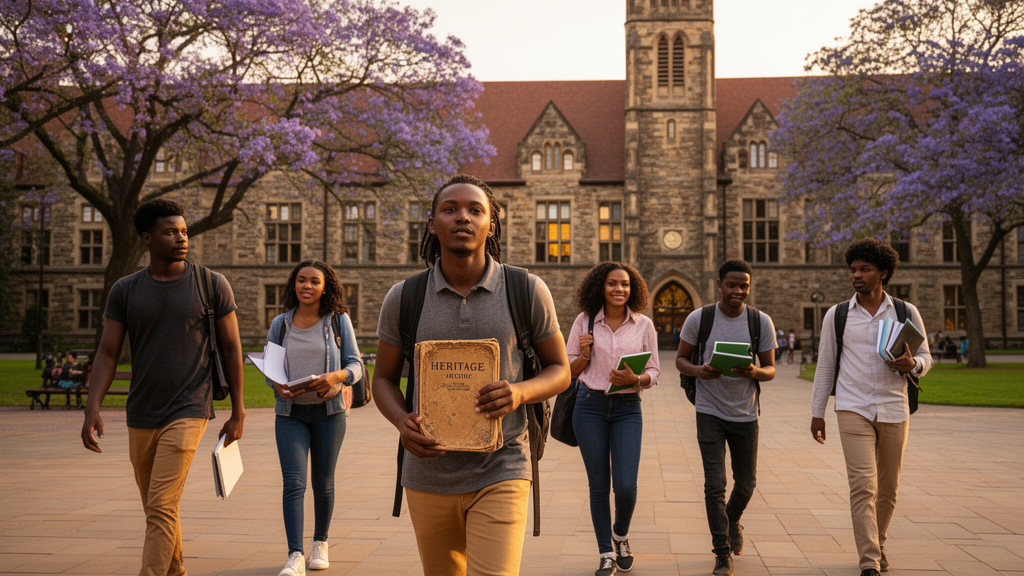
More than three decades after South Africa’s first democratic elections, the country’s universities still carry the intellectual fingerprints of colonialism and apartheid. A new conceptual study published in Frontiers in Political Science argues that the missing ingredient in curriculum reform may be hiding in plain sight: the liberation heritage that defines South Africa’s political identity. Medwin Dikwanyane Sepadi of the University of Limpopo’s Education Studies department analyzed how liberation narratives are invoked in higher education and concluded that they are being used symbolically rather than substantively, allowing colonial epistemologies to survive beneath a veneer of transformation.
The research addresses a paradox that has defined post-apartheid higher education since 1994. Universities have adopted transformation policies, embraced the language of decolonization and Africanization, and established frameworks for curriculum reform. Yet Eurocentric curricula persist, Black academics remain underrepresented in senior positions, and Indigenous Knowledge Systems continue to be marginalized. As the Council on Higher Education observed in 2016, decolonizing the curriculum is not merely about replacing content but about fundamentally rethinking the epistemological foundations upon which knowledge is produced and validated.
Sepadi’s central argument is that liberation heritage performs a dual function in contemporary curriculum discourse. On one hand, it operates as a symbolic resource for identity formation and political legitimacy, giving universities a way to signal commitment to transformation. On the other hand, it functions as a contested political discourse, invoked by different actors for different ends. Student activists draw on the legacy of the 1976 Soweto uprising to demand radical change, while university management and the state appropriate the same language to legitimate existing arrangements. This contestation reflects broader tensions between the ideals of liberation and the realities of neoliberal governance.
The theoretical engine of the study is Paulo Freire’s critical pedagogy, particularly his 1970 work Pedagogy of the Oppressed. Freire’s distinction between the banking model of education, in which teachers deposit information into passive students, and problem-posing education, which challenges students to critically engage with their reality, provides the analytical lens. Sepadi argues that South African curricula often treat students as empty vessels to be filled with Western knowledge disconnected from their lived experiences, reproducing precisely the student-teacher contradiction Freire identified as upholding oppression.
Freire’s concepts of conscientization, dialogue, and praxis form the mediating mechanisms in Sepadi’s conceptual framework. Conscientization, the process by which individuals develop the ability to perceive social, political, and economic contradictions and act against them, would enable students to understand how colonial and apartheid legacies shape knowledge production and how curricula privilege certain ways of knowing while marginalizing others. Dialogue and praxis, the combination of reflection and action upon the world to transform it, would turn classrooms into spaces of co-creation rather than transmission.
The study traces Freire’s deep roots in South African educational thought. From the late 1960s, Freire’s work profoundly influenced the Black Consciousness movement, with activists trained by Freirean facilitators who were clear that their role was not to tell people what to think. This tradition of People’s Education, rooted in mass democratic struggles against apartheid, has increasingly been eroded or disappeared in the post-apartheid period as higher education has been reshaped by neoliberal imperatives, according to education scholar Salim Vally’s work cited in the study.
The #FeesMustFall movement of 2015 and 2016 serves as a critical juncture in the analysis. Student activists demanded not only the removal of financial barriers but also the transformation of curricula that remained stubbornly Eurocentric. Sepadi interprets the movement as a rejection of what Freire would call false generosity, gestures that appear to address oppression while maintaining existing power relations. When institutions deploy the language of decolonization while keeping colonial epistemological structures intact, they co-opt liberation discourse and neutralize its transformative potential, creating an illusion of progress that may actually impede genuine change.
The analysis identifies formidable barriers to epistemic transformation operating at institutional, structural, and conceptual levels. Neoliberalism has reshaped universities with an emphasis on efficiency, measurable outcomes, and global rankings, creating pressure to conform to international standards that may conflict with decolonization. The emphasis on publication in international journals and citation metrics privileges Western research paradigms. Bureaucratic inertia, faculty resistance, and entrenched institutional cultures further impede reform. Conceptual confusion compounds the problem: Pillay’s 2024 work cited in the study distinguishes decolonization, deracialization, and Africanization as distinct but interdependent imperatives, and conflating them undermines the transformative potential of each.
The study also draws comparative lessons from across the African continent. Kenyan universities have faced pressure to Africanize curricula while Western epistemological frameworks persist, particularly in sciences and professional programmes. Tanzania’s post-independence emphasis on education for self-reliance shares conceptual parallels with Freirean pedagogy, yet implementation has been constrained by neoliberal reforms. Nigeria and Ghana have pursued indigenization policies requiring universities to incorporate local languages and knowledge systems, but symbolic commitments often outpace substantive change. Sepadi argues that South Africa’s specific liberation heritage, the anti-apartheid struggle and the tradition of People’s Education, provides a distinctive resource for transformation if mobilized substantively rather than symbolically.
The study’s recommendations span curriculum content, pedagogical practice, institutional culture, and policy. Universities should integrate African heritage and Indigenous Knowledge Systems across all disciplines, decolonize reading lists to include African and Global South scholars, and implement problem-posing education through professional development in critical pedagogy. The Know Your Own Continent course at the University of Cape Town, though never part of the official academic programme, offers a working model: it positioned students as co-creators of knowledge, incorporated community voices, and connected academic learning to broader social struggles while disrupting what its practitioners called the languages and practices of power in the classroom. Ultimately, Sepadi concludes, liberation is not a gift to be bestowed but a practice to be collectively constructed, and the challenge for South African higher education is to move beyond the rhetoric of liberation toward the practice of it.
Subject of Research: The role of liberation heritage and Freirean critical pedagogy in decolonizing university curricula in South African higher education
Article Title: The politics of curriculum transformation in South African higher education
Article References: The politics of curriculum transformation in South African higher education. (n.d.). https://doi.org/10.3389/fpos.2026.1933369
Image Credits: AI Generated
DOI: 10.3389/fpos.2026.1933369
Keywords: South Africa, higher education, curriculum transformation, decolonization, liberation heritage, Paulo Freire, critical pedagogy, FeesMustFall, Indigenous Knowledge Systems, epistemic justice, Africanization, neoliberalism
Cite Scienmag News
Courtney Benton. (October 16, 2026). Liberation Heritage Alone Cannot Decolonize South Africa’s Universities, Study Argues. Scienmag. https://scienmag.com/liberation-heritage-alone-cannot-decolonize-south-africas-universities-study-argues/
Courtney Benton. "Liberation Heritage Alone Cannot Decolonize South Africa’s Universities, Study Argues." Scienmag, 16 October 2026, https://scienmag.com/liberation-heritage-alone-cannot-decolonize-south-africas-universities-study-argues/. Accessed 16 October 2026.
Courtney Benton. "Liberation Heritage Alone Cannot Decolonize South Africa’s Universities, Study Argues." Scienmag. October 16, 2026. https://scienmag.com/liberation-heritage-alone-cannot-decolonize-south-africas-universities-study-argues/


