


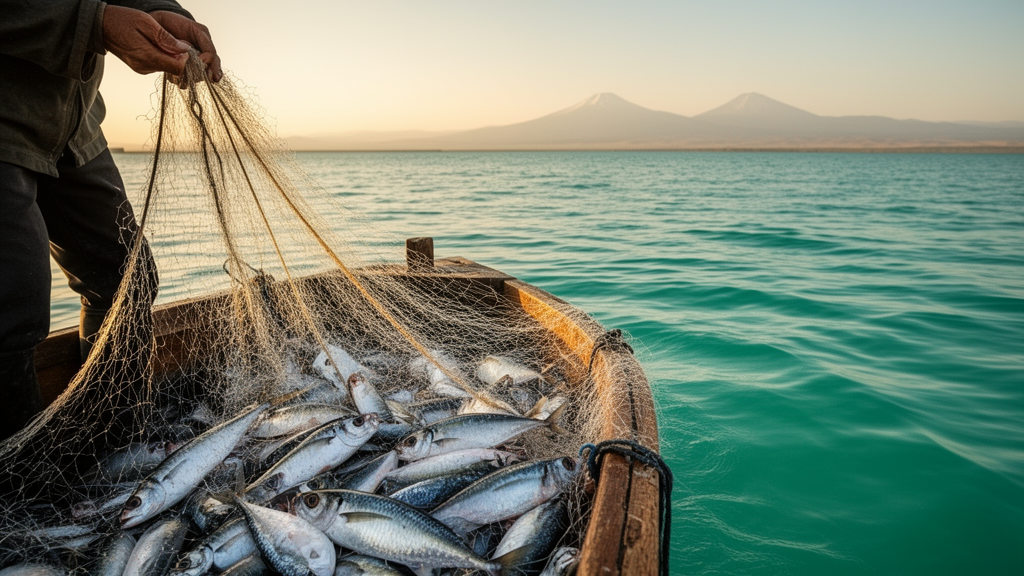
High in the mountains of eastern Türkiye sits Lake Van, the largest soda lake on Earth and home to a single commercially valuable fish: the pearl mullet, Alburnus tarichi. This silvery endemic cyprinid accounts for nearly a quarter of Türkiye’s annual inland fish catch, sustaining the livelihoods of more than 15,000 people in the surrounding basin. Yet the gear used to catch it has never been rigorously compared. A new study published in Acta Ichthyologica et Piscatoria provides the first head-to-head test of monofilament and multifilament gillnets in the lake, and the verdict is strikingly one-sided: nylon monofilament nets caught roughly three times as much fish per unit of effort, while a 24 mm mesh size emerged as the biologically and economically optimal choice for the fishery.
The stakes extend beyond catch statistics. Pearl mullet landings total around 9,925 tonnes each year out of 33,140 tonnes of inland fish caught nationally in Türkiye. Because trawls and purse seines are banned in Turkish inland waters, the entire fishery depends on passive gear—gillnets and trammel nets—whose selectivity determines which size classes of fish are removed from the stock. Monofilament gillnets are prohibited in marine waters across the country, but their use in Lake Van is permitted under Fisheries Regulation Notice No. 5/1, with the decision left largely to local authorities. Should regulators ever extend the ban to inland waters, fishers would need a viable alternative, and no study had ever tested multifilament gillnets in the lake before now.
The research team, working between September 2022 and April 2023, constructed experimental fleets from six 100-meter net panels: monofilament and multifilament gillnets in three mesh sizes each—22, 23, and 24 mm bar length, measured as the distance between consecutive knots and verified with a digital caliper on wet nets according to international standards. The monofilament panels used 0.20 mm diameter twine, while the multifilament panels were built from R24 tex (220 denier, 2-ply) material; both types shared a hanging ratio of 0.50 and a depth of 100 meshes. Critically, the order of the six panels within each 600-meter fleet was randomized by drawing lots before each of the 45 fishing operations, eliminating any bias that might arise from a panel’s position along depth gradients or distance from shore.
Fishing took place on muddy and sandy bottoms between Edremit Harbour and the Dağönü fishing shelter, at depths ranging from 4 to 60 meters. Nets were typically set between 07:00 and 09:00 and hauled at the same hour the following day, deployed manually by crew aboard a hired commercial vessel and retrieved with a winch. Because commercial landings were enormous—monofilament nets alone captured 636.8, 792.1, and 910.2 kilograms of fish at the 22, 23, and 24 mm mesh sizes respectively, against 203.9, 262.8, and 304 kilograms for the corresponding multifilament panels—measuring every individual was impossible. Instead, the researchers randomly subsampled roughly 200 fish per panel for length and weight measurements, yielding subsamples of 199 to 222 individuals per mesh size for analysis.
Selectivity was assessed with the SELECT method—Share Each Length’s Catch Total—implemented in PasGear 2 software. The method fits five competing models (normal location, normal scale, lognormal, gamma, and bimodal) to the length distributions of fish caught across mesh sizes, estimating parameters by maximum likelihood under an assumption that catches follow a Poisson distribution. The model with the lowest deviation, a goodness-of-fit statistic, was selected as the best fit. For monofilament nets, the normal scale model won; for multifilament nets, the lognormal model fit best. The bimodal model performed poorly in both cases, with deviation values of 56.9 and 82.7 and near-zero p-values, indicating a statistically inadequate description of the data.
The resulting optimum capture lengths—the lengths at which retention probability peaks at 100 percent—told a consistent story. Monofilament nets caught pearl mullet at modal lengths of 22.29, 22.75, and 23.18 cm for the 22, 23, and 24 mm meshes, while multifilament nets peaked at 21.01, 21.99, and 22.24 cm. In both net types, larger mesh caught larger fish, as expected from the geometric similarity principle underlying gillnet selectivity theory: fish wedge their heads into the mesh and are retained at the gills when the mesh circumference matches their body dimensions. Notably, the monofilament nets showed narrower spreads at the two larger mesh sizes, meaning their size selection was more precise—another point in favor of the material fishers already prefer.
Catch per unit of effort sealed the comparison. Averaged across the season, monofilament nets achieved a mean CPUE of 18.53 kg/100 m/day versus just 5.98 for multifilament nets, a difference confirmed as highly significant by a Wilcoxon signed-rank test (p < 0.001). The seasonal pattern was dramatic in both materials: CPUE peaked in April, reaching 83.32 kg/100 m/day in the 24 mm monofilament panel and 27.83 in the equivalent multifilament net, coinciding with the pre-spawning migration when pearl mullet form massive schools near shore. December was the weakest month, with monofilament CPUE bottoming out at 3.00 kg/100 m/day; the multifilament nets caught nothing at all that month because they became heavily tangled. The authors attribute the multifilament nets’ poor performance largely to this tangling: suspended in mid-water, the softer twine twists and knots under the influence of currents and waves, so the nets simply do not fish effectively—a problem that could perhaps be engineered away with modified float and sinker rigging.
From a conservation standpoint, the 24 mm recommendation rests on a clear biological margin. Pearl mullet reach first sexual maturity at around 15.93 cm fork length for males and 16.04 cm for females, and management guidance holds that fish smaller than 18 cm should not be caught. The optimum capture lengths of the 24 mm mesh—23.18 cm in monofilament and 22.24 cm in multifilament—sit comfortably above these thresholds, meaning the gear targets fish that have already reproduced at least once. Choosing smaller meshes might raise the raw number of fish landed in the short term, but it would shift fishing mortality onto immature cohorts, risking recruitment overfishing and eroding the spawning stock biomass that underpins the fishery’s future. The modest numerical loss from letting smaller fish slip through is repaid, the authors argue, by a more resilient and therefore more profitable stock over time.
The study also offers lessons for adaptive management in a changing climate. The April peak in catch rates aligns with the current fishing closure, which runs from 15 April to 15 July to protect river-spawning fish, but the researchers caution that if warming shifts the timing of migrations, the closure dates may need dynamic adjustment based on multi-year monitoring. Comparisons with earlier work in Lake Van—such as optimum lengths of 15.5 to 20.6 cm reported in the 1990s, when overfishing had driven down average body size—underscore how strongly selectivity findings depend on the state of the stock. For now, the practical guidance is straightforward: 24 mm monofilament gillnets deliver the best combination of efficiency, selectivity, and sustainability for the pearl mullet fishery, while multifilament nets remain a legitimate fallback should restrictions tighten, provided their rigging is redesigned to keep them fishing as intended.
Subject of Research: Comparative gillnet selectivity for the endemic pearl mullet fishery in Lake Van
Article Title: Comparative selectivity of monofilament and multifilament gillnets for pearl mullet, Alburnus tarichi ( Actinopterygii , Cypriniformes , Alburninae ), in Lake Van
Article References: Bozaoğlu, A. S., Akoglu, E., & Ateş, E. (2026). Comparative selectivity of monofilament and multifilament gillnets for pearl mullet, Alburnus tarichi (Actinopterygii, Cypriniformes, Alburninae), in Lake Van. Acta Ichthyologica et Piscatoria, 56, 347-357. https://doi.org/10.3897/aiep.56.194083
Image Credits: AI Generated
Keywords: pearl mullet, Lake Van, gillnet selectivity, monofilament, multifilament, CPUE, SELECT method, mesh size, fisheries management, endemic species, sustainable fishing, Türkiye
Cite Scienmag News
Margaret Porter. (October 16, 2026). Rigging the Right Net: Monofilament Beats Multifilament in Lake Van’s Pearl Mullet Fishery. Scienmag. https://scienmag.com/rigging-the-right-net-monofilament-beats-multifilament-in-lake-vans-pearl-mullet-fishery/
Margaret Porter. "Rigging the Right Net: Monofilament Beats Multifilament in Lake Van’s Pearl Mullet Fishery." Scienmag, 16 October 2026, https://scienmag.com/rigging-the-right-net-monofilament-beats-multifilament-in-lake-vans-pearl-mullet-fishery/. Accessed 16 October 2026.
Margaret Porter. "Rigging the Right Net: Monofilament Beats Multifilament in Lake Van’s Pearl Mullet Fishery." Scienmag. October 16, 2026. https://scienmag.com/rigging-the-right-net-monofilament-beats-multifilament-in-lake-vans-pearl-mullet-fishery/


