


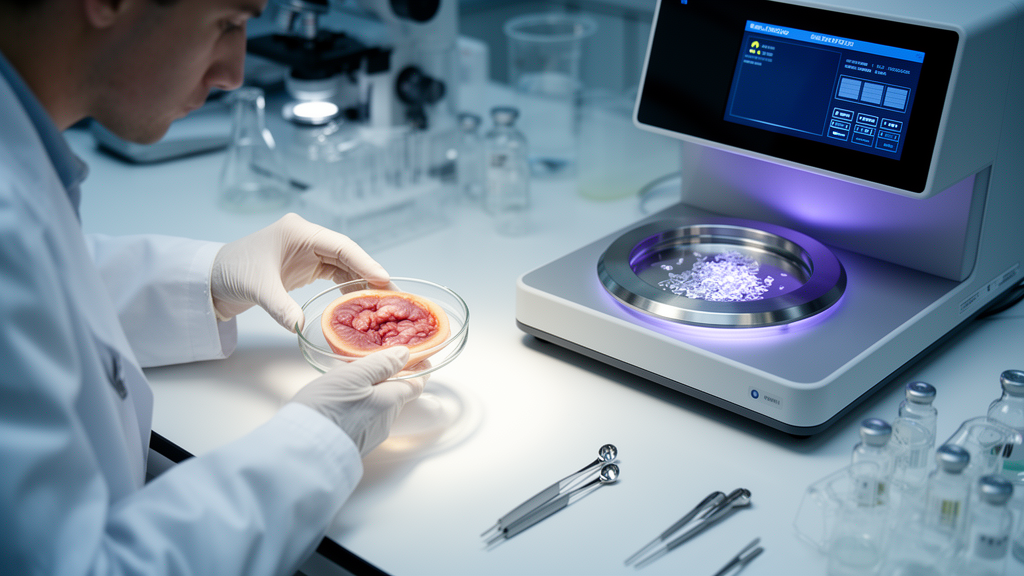
Microplastics have now been detected in human lungs, liver, testes, and blood, and since 2021 they have been repeatedly found in the placenta — the organ that sustains every developing fetus. But a persistent analytical problem has haunted this emerging field: when researchers try to measure plastics in fatty biological tissue, the lipids in the sample can masquerade as plastic, inflating the numbers and undermining confidence in the results. Now a team of Canadian chemists and obstetricians has applied a sophisticated mass spectrometry technique to human placental tissue that can separate genuine polymer signal from biological interference, and their findings offer some of the most carefully vetted measurements of micro- and nanoplastics in this critical organ to date.
The study, published in Frontiers in Analytical Science, analyzed placentas from 46 pregnant individuals recruited in Newfoundland and Labrador, Canada, between March and July 2024. Using a technique called pyrolysis gas chromatography x cyclic ion mobility mass spectrometry, or Py-GCxcIMS, the researchers targeted three of the world’s most widely produced plastics: polyethylene, polypropylene, and polystyrene. They found micro- and nanoplastics in 26 percent of the 92 placental tissue samples analyzed and in 41 percent of the participants, with total polymer concentrations ranging from 0.1 to 12.3 micrograms per gram of tissue and a mean of 0.5 micrograms per gram when non-detectable values were assigned zero.
The analytical challenge the team set out to solve is fundamental to the field. Placental tissue is rich in lipids, and when lipids are heated during pyrolysis — the process that breaks polymers into characteristic fragments for identification — they produce hydrocarbon signals that closely resemble those from polyethylene. Conventional pyrolysis gas chromatography mass spectrometry, or Py-GC/MS, struggles to distinguish these two sources, leading to false positive detections. The addition of cyclic ion mobility to the mass spectrometer changes this. Ion mobility separates ions by the time they take to drift through a neutral gas under an electric field, and this drift time reflects the collision cross section — the effective area over which an ion collides with gas molecules. Because genuine polymer fragments and lipid-derived fragments have different shapes and sizes, they acquire different collision cross section values, allowing the instrument to discriminate between them.
The power of this approach is illustrated by the team’s own data. In one example, an extracted ion chromatogram displayed a peak at the exact mass expected for a polyethylene fragment, which could easily have been mistaken for genuine plastic detection. But when the researchers examined the same signal in the ion mobility dimension, its drift time and collision cross section deviated significantly from the values of an authentic polyethylene standard — revealing it as matrix interference rather than real plastic. Overall, 25 percent of the polyethylene detections in placental tissue were identified as false positives and removed from the reported concentrations. The team also monitored the full pyrogram, confirming that the ratios between neighboring long-chain hydrocarbon homologues from C30 to C55 matched expected values within 20 percent, further supporting genuine detection of polyethylene and polypropylene.
Sample collection followed a strict plastic-free protocol designed to minimize contamination. After delivery, placentas were transferred directly into sterile stainless-steel dishes, and two full-depth 10-millimeter biopsy punch samples were collected from macroscopically normal mid-placental areas, avoiding the umbilical cord insertion. Samples were stored at minus 80 degrees Celsius in glass scintillation vials with silver foil liners. Procedural blanks collected during sampling showed non-detectable levels of micro- and nanoplastics after blank correction, and method blanks — one per participant — were used to correct the final concentrations. The tissue was digested in 10 percent potassium hydroxide for 48 hours, then filtered through pre-cleaned glass fiber filters with a pore size of 0.7 micrometers.
Among the three polymers quantified, polypropylene was the most frequently detected, appearing above the limit of detection in 15 percent of samples, followed by polyethylene at 10 percent and polystyrene at 8 percent. Polystyrene, despite being only the sixth most produced plastic worldwide, showed the highest mean concentration at 2.41 micrograms per gram when only detectable values were included. The researchers attribute polypropylene’s prevalence to its enormous global production scale and its extensive applications in packaging, textiles, automotive components, construction, and biomedical devices, all of which increase the likelihood of the polymer entering the environment and, ultimately, the human body.
One of the most striking findings was the variability in plastic concentrations between duplicate samples taken from the same placenta. The range of total micro- and nanoplastic concentrations across all samples spanned 0.1 to 12.3 micrograms per gram, and polymer type and concentration differed between samples from the same participant. This heterogeneity mirrors the natural structural variability of the placenta itself and underscores the importance of collecting multiple samples from each organ for accurate exposure assessment. The placenta is not a uniform filter but a complex, spatially heterogeneous tissue, and single-site sampling could easily overestimate or underestimate the true plastic burden.
When the researchers compared total plastic concentrations with pregnancy outcomes — neonatal birth weight, placental weight, and the feto-placental weight ratio, a measure of placental efficiency — they found no statistically significant associations. Total plastic concentration was also not significantly different between normal pregnancies and the nine pregnancies classified as complicated. However, an exploratory analysis stratified by fetal sex revealed a trend toward significance: total plastic concentration was elevated in male neonates from complicated pregnancies compared to normal pregnancies, with a p-value of 0.071, while no such trend appeared in females. The researchers emphasize that this is an exploratory finding from a small cohort and does not establish causation, but it aligns with a broader pattern in the toxicology literature. Male fetuses are known to be more vulnerable to environmental pollutants including per- and polyfluoroalkyl substances, heavy metals, and pesticides, and placental responses to in utero environmental changes have been shown to depend on fetal sex. Micro- and nanoplastics and their additive chemicals have endocrine-disrupting effects, which could partially explain a sex-specific association.
Animal studies provide context for what these findings might mean for fetal development. In pregnant mice, polystyrene nanoparticles delivered by oral gavage accumulate in the decidua and labyrinth zone of the placenta and can cross the placental barrier to reach the fetal brain. Maternal exposure to polystyrene through drinking water has been linked to fetal growth restriction, early embryo loss, altered placental blood flow, abnormal placental and fetal brain metabolism, and postnatal structural brain abnormalities in offspring. Polypropylene nanoparticles have been shown to cross the placental barrier in mice, impairing neuronal differentiation and proliferation and causing lasting behavioral changes. Polyethylene exposure has been associated with abnormal placental function. These animal findings are indirectly supported by the detection of micro- and nanoplastics in human meconium — the first stool of newborns — suggesting that particles have traversed the placental barrier in utero.
The concentrations reported in this study are notably lower than those from the only other Py-GC/MS study of placental tissue, which reported a mean of 126.8 micrograms per gram driven largely by polyethylene. The Canadian team’s mean was 1.8 micrograms per gram when only detectable values were included, with polyethylene at just 0.35 micrograms per gram. The researchers suggest that differences in sample collection, preparation, analytical methods, and quality control procedures — rather than true differences in tissue burden alone — likely explain much of the variability between studies. They also note that their study is limited to particles retained by 0.7-micrometer filters, potentially excluding smaller, more abundant nanoparticles, although previous work has shown that particles as small as 0.4 micrometers can be captured on such filters due to aggregation or matrix interactions. The cohort of 46 participants, with only nine complicated pregnancies, is too small to draw firm conclusions about health impacts, and no lifestyle data were collected to explore links between daily habits and plastic burden. Still, the team hopes their work will motivate larger human cohort studies and continued development of robust analytical methods to better understand the potential impact of micro- and nanoplastics on pregnancy and fetal health.
Subject of Research: Micro- and nanoplastics in human placental tissue characterized by pyrolysis gas chromatography x cyclic ion mobility mass spectrometry
Article Title: Characterization of micro- and nanoplastics in human placental tissue by pyrolysis gas chromatographic ion mobility mass spectrometry
Article References: Harvey, N. E., Bissonnette, J. R., Lambe, S., Burry, T. N., Sled, J. G., Kingdom, J. C., Baschat, A. A., Simpson, A. J., Cahill, L. S., & Jobst, K. J. (2026). Characterization of micro- and nanoplastics in human placental tissue by pyrolysis gas chromatographic ion mobility mass spectrometry. Frontiers in Analytical Science, 6, Article 1881804. https://doi.org/10.3389/frans.2026.1881804
Image Credits: AI Generated
DOI: 10.3389/frans.2026.1881804
Keywords: microplastics, nanoplastics, placenta, mass spectrometry, ion mobility, pregnancy, fetal health, environmental analysis, Characterization, micro-, human, placental
Cite Scienmag News
Harold Sullivan. (October 16, 2026). Microplastics Found in Human Placentas: New Mass Spectrometry Method Separates Real Signal From Lipid Interference. Scienmag. https://scienmag.com/microplastics-found-in-human-placentas-new-mass-spectrometry-method-separates-real-signal-from-lipid-interference/
Harold Sullivan. "Microplastics Found in Human Placentas: New Mass Spectrometry Method Separates Real Signal From Lipid Interference." Scienmag, 16 October 2026, https://scienmag.com/microplastics-found-in-human-placentas-new-mass-spectrometry-method-separates-real-signal-from-lipid-interference/. Accessed 16 October 2026.
Harold Sullivan. "Microplastics Found in Human Placentas: New Mass Spectrometry Method Separates Real Signal From Lipid Interference." Scienmag. October 16, 2026. https://scienmag.com/microplastics-found-in-human-placentas-new-mass-spectrometry-method-separates-real-signal-from-lipid-interference/


