


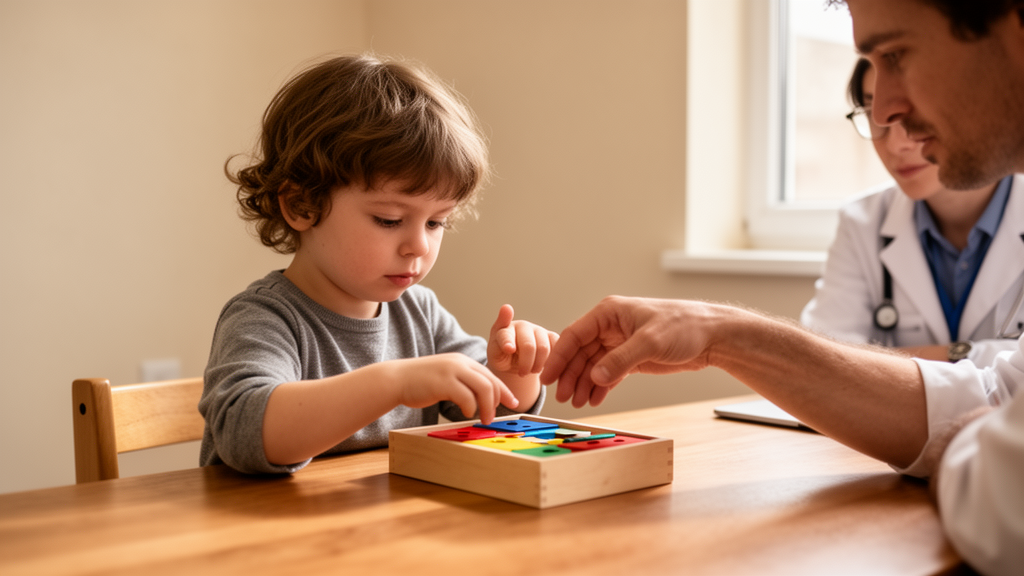
For nearly two decades, one of the most tantalizing findings in developmental psychology has been that children copy even the pointless parts of what adults do. Show a child how to open a puzzle box by tapping its top three times, sliding a flap, and pulling out a hidden toy, and the child will often reproduce every step, including the taps that do nothing to help retrieve the prize. This phenomenon, known as overimitation, has been championed as a key engine of cultural transmission, a window into human cognitive evolution, and evidence that children are wired to learn not just what works, but what is socially expected. Yet according to a new perspective article published in Frontiers in Psychology, the field’s boldest conclusions may rest on shakier ground than most textbooks suggest.
The article, written by Ashley B. Marin and Rebekah A. Richert of the University of California, Riverside, and Frankie T. K. Fong of Victoria University of Wellington and the Max Planck Institute for Evolutionary Anthropology, argues that methodological inconsistencies across studies have made it difficult to draw broad conclusions about the nature and function of overimitation. The authors do not dispute that children faithfully reproduce causally irrelevant actions. Instead, they contend that subtle, often unintentional choices in experimental design may be quietly shaping the behaviors researchers observe, leaving alternative explanations underexamined and making it hard to know whether results reflect genuine developmental processes or artifacts of how the behavior is elicited, operationalized, and measured.
The concern echoes a classic problem in psychology. In 1968, Rosenthal and Jacobson famously showed in Pygmalion in the Classroom that teachers’ expectations could subtly influence student performance, and in 1962, Martin Orne described how demand characteristics, the implicit cues of a research setting, can guide participants toward what they believe the experimenter wants. In 2019, a landmark review by Stefanie Hoehl and colleagues formally flagged hidden sources of experimental variation in overimitation research. Marin and her colleagues build on that foundation, focusing on three dimensions of experimental design where variation and ambiguity persist: the structure of the tasks themselves, the coding schemes used to score children’s behavior, and the way experiments are set up.
Consider first the tasks. The vast majority of overimitation studies rely on the puzzlebox paradigm, in which children watch a demonstrator perform causally irrelevant actions, such as tapping the top of a box three times, followed by a causally relevant action, such as opening a door flap, to retrieve an object inside. The paradigm has proven remarkably productive, but the authors point out that it almost always features a visually evident end goal. Many real activities children engage in do have observable outcomes; Yucatec Mayan children, for example, help with cleaning, construction, and preparing poultry, where success is plainly visible. But few, if any, experimental paradigms capture action sequences that produce no tangible product or reward at all, the kind of sequences that permeate cultural and religious rituals. Nauhua children, for instance, help prepare bread offerings for the Day of the Dead, an activity that resembles cooking but serves a spiritual purpose, welcoming the spirits of ancestors, that is not physically observable. If overimitation is meant to illuminate cultural evolution, the authors argue, researchers need tasks with non-observable outcomes to capture this dimension of human learning.
The second task-related question is who demonstrates the behavior. Most studies use unfamiliar adult experimenters, but a growing body of work has examined children learning from parents, puppets, robots, and familiar teachers. The findings are mixed: some studies report greater overimitation of familiar models, while others show a preference for unfamiliar or non-human demonstrators. Collectively, the authors note, these results reaffirm that children’s overimitation is context-dependent and influenced by their relationship to and assumptions about the model, suggesting that model-based biases function as evolutionarily adaptive shortcuts for acquiring useful information. This matters especially in communities where learning is distributed across multiple caregivers. In Mexican and Central American immigrant families in the United States, for example, older siblings and grandparents routinely support children’s academic and cultural competence through daily homework help and the scaffolding of traditions. And in the current historical moment, the authors add, children’s environments increasingly include artificial intelligence, media-based, and robotic agents, with families reporting the use of AI-based tools for homework support, raising new questions about how novel anthropomorphic models shape social learning.
Even the experimenter’s identity introduces complications. Theorists have speculated that perceived similarity signals that another person’s behaviors are especially relevant within a shared group identity, and researchers have begun examining identity cues such as gender, race, shared language, and minimal group markers like shirt color. But the authors highlight a subtler issue: the level of rapport established between demonstrator and participant before the study begins. Initial shared interactions may allow children to perceive similarity along dimensions the research team never considered, and these pre-task interactions vary considerably across studies and are rarely described in methods sections. With so many possible dimensions along which similarity can form, it is often unclear which aspects are most salient to the children being studied.
The coding schemes used to evaluate overimitation raise a second set of concerns. A typical scheme focuses on whether an action is replicated at all, irrespective of the specific method used. If a demonstrator uses three fingers to hold the middle of a stick and tap the side of a box three times, a child would likely be coded as overimitating even if they use their whole hand to grasp a different part of the stick, as long as they tap. Participants who reproduce an action once, three times, or five times receive identical scores under binary coding schemes, and many approaches ignore action order entirely, so children who produce the same set of actions in substantially different sequences may score the same. Marin and colleagues suggest these cases may be a form of what Cecilia Heyes calls process emulation, in which the process is replicated but not by the exact same means. Coding decisions, they argue, may also reflect implicit assumptions about what counts as successful overimitation, including whether imitation is defined in terms of actions, outcomes, or broader processes, and whether approximate attempts or precise replication is valued.
This matters because many cultural practices place a premium on precision, repetition, and sequence. In Japan, the degree of a bow depends on the context and the person involved, and the exact spatial organization of eating utensils is critical in many settings. Prayer practices can involve structured repetition and ordered sequences, performed a specified number of times per day and preceded by preparatory acts of spiritual purification. These nuances cannot be accommodated by coding techniques that merely score the presence or absence of actions. Capturing precision, repetition, and sequence reliably requires more fine-grained observational protocols, and whether the dimensions reflect limits in children’s competencies or differences in how children attend to and reproduce observed actions remains largely unexplored. Understanding when and why children incorporate these features, the authors argue, is critical for connecting experimental work to the lived contexts in which overimitation actually functions.
The third dimension, experimental setup, contains its own sources of variation. Some findings appear robust: considerable evidence shows that exploration or familiarity with an apparatus does not eliminate overimitation. But the authors pinpoint three aspects of setup where ambiguity remains. First, children’s questions are almost inevitable in these experiments, and while most studies use standardized prompts such as do it however you want or go ahead and try it out, other forms of participant input are comparatively underreported. Researchers have documented cases of children attempting to correct the model during experiments, and different kinds of input may produce different experimenter responses, unintentionally creating feedback loops in which children’s input shapes experimenter behavior that in turn shapes the child’s behavior. Second, rewards, whether consumable treats, stickers, or toys, may influence motivation, attention, and the interpretation of task goals, and ambiguity about whether children may keep materials or whether acquisition depends on task success may support extrinsic motivation, meaning overimitation scores could partly reflect extrinsic motivation rather than purely social or affiliative influences. Rewards do reflect real-world learning, as caregivers often structure incentives for chores, and Hadza children in Tanzania commonly consume gathered foods immediately after foraging, but the timing, nature, and transparency of rewards vary widely across cultures and studies.
The authors are careful to note that the field has begun to address these concerns. Recent work has diversified task paradigms, incorporated unobservable end-goal features, varied the type of demonstrator, and moved coding practices beyond binary classification toward proportion-based scoring that distinguishes approximate from exact reproductions. Researchers have also developed controls for reward effects, such as re-storage components at the end of imitation tasks and systematic assessment of reward preferences. To accelerate this progress, Marin and her colleagues propose an IMITATE reflective guide and an accompanying experimental checklist designed to increase methodological coherence across the literature by encouraging transparency in methodological decisions and helping researchers consider the fit between experimental designs and participants’ ecological contexts. The stakes, they argue, extend well beyond the laboratory: a more granular approach is needed to understand how overimitation functions across children’s daily living contexts, from religious and non-religious rituals to home and school ecologies, and how it serves as an efficient strategy for rapidly acquiring instrumental knowledge such as language and problem-solving methods. With socially interactive technologies increasingly present in children’s everyday environments, ongoing methodological refinements promise to further unveil the psychological mechanisms that underpin cultural evolution across diverse childhood ecologies, provided researchers attend to the quiet ways their own design choices shape what children do.
Subject of Research: Methodological limitations in experimental research on children's overimitation and cultural learning
Article Title: Methodological concerns restrict generalizations about children’s overimitation
Article References: Marin, A. B., Richert, R. A., & Fong, F. T. K. (2026). Methodological concerns restrict generalizations about children’s overimitation. Frontiers in Psychology, 17, Article 1909142. https://doi.org/10.3389/fpsyg.2026.1909142
Image Credits: AI Generated
DOI: 10.3389/fpsyg.2026.1909142
Keywords: overimitation, social learning, cultural transmission, child development, experimental methods, puzzlebox paradigm, coding schemes, ecological validity, rituals, demand characteristics, rewards, cross-cultural psychology
Cite Scienmag News
Glenn Wilkins. (October 16, 2026). Why the Fine Print of Overimitation Experiments May Be Shaping What We Think Children Learn. Scienmag. https://scienmag.com/why-the-fine-print-of-overimitation-experiments-may-be-shaping-what-we-think-children-learn/
Glenn Wilkins. "Why the Fine Print of Overimitation Experiments May Be Shaping What We Think Children Learn." Scienmag, 16 October 2026, https://scienmag.com/why-the-fine-print-of-overimitation-experiments-may-be-shaping-what-we-think-children-learn/. Accessed 16 October 2026.
Glenn Wilkins. "Why the Fine Print of Overimitation Experiments May Be Shaping What We Think Children Learn." Scienmag. October 16, 2026. https://scienmag.com/why-the-fine-print-of-overimitation-experiments-may-be-shaping-what-we-think-children-learn/


