


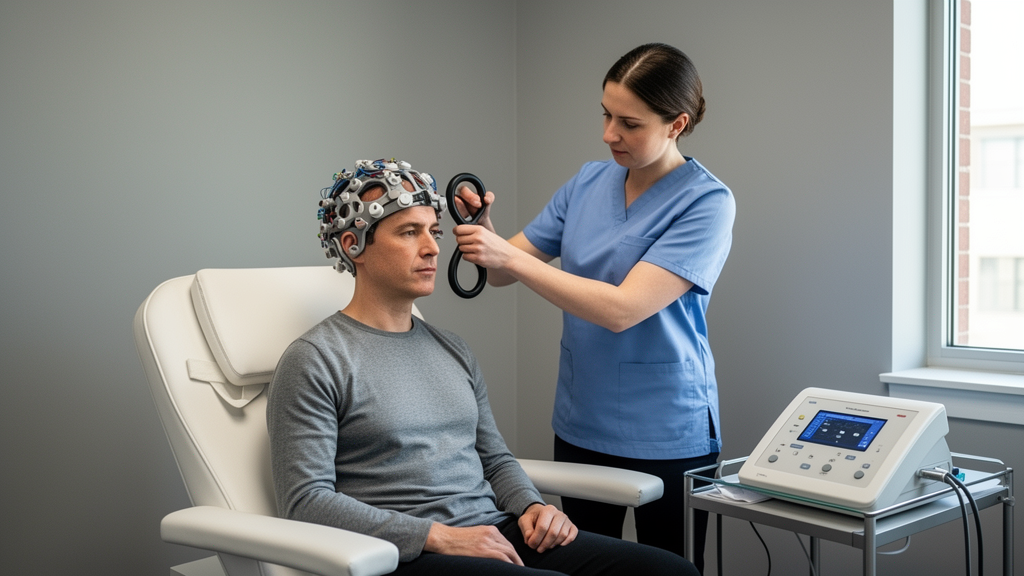
For the roughly 10 to 15 percent of people worldwide who live with chronic subjective tinnitus, the phantom ringing or hissing in their ears is not simply a loud sound but a network-wide problem of the brain. A new systematic review published in Frontiers in Audiology and Otology has taken the most detailed look yet at whether repetitive transcranial magnetic stimulation, or rTMS, a non-invasive technique that uses rapidly changing magnetic fields to induce electrical currents in the outer layers of the cortex, can reliably quiet that phantom perception. The verdict is sobering: although the technique clearly biological activity in the brain, no specific stimulation protocol currently earns support for routine clinical use.
The review, conducted by researchers at Nazareth Hospital in Shillong, the Ali Yavar Jung National Institute of Speech and Hearing Disabilities in Kolkata, and North-Eastern Hill University, followed PRISMA 2020 reporting guidelines and prespecified eligibility criteria. The team searched PubMed/MEDLINE, Embase, the Cochrane Library and Web of Science, screening 210 records down to 28 studies for the primary qualitative synthesis. Because the trials differed so drastically in population, stimulation target, frequency, dose, localization, comparator design and outcome measures, the authors synthesized findings qualitatively rather than pooling them statistically, and formally assessed risk of bias using validated tools including RoB 2 for randomized trials and ROBINS-I for non-randomized comparative studies.
Understanding why rTMS is considered at all requires a look at how tinnitus arises. It typically begins with reduced or distorted auditory input caused by noise exposure, age-related hearing loss, ototoxicity or cochlear synaptopathy. In response, the central auditory system may crank up its neuronal gain to compensate for the missing input. What starts as an adaptive compensation can become maladaptive, producing decreased inhibition, increased spontaneous firing, abnormal spike timing and heightened neuronal synchrony in the dorsal cochlear nucleus, inferior colliculus, medial geniculate body and auditory cortex. The brain’s own noise-generating machinery then becomes audible as sound.
A further layer of dysfunction, described by the thalamocortical dysrhythmia model, may explain how this aberrant activity reaches conscious awareness. Auditory deafferentation hyperpolarizes thalamic relay neurons, shifting them from normal tonic transmission into pathological low-frequency bursting. Increased theta activity combined with reduced alpha-mediated inhibition weakens sensory gating, while gamma activity at the borders of dysrhythmic regions, the so-called edge effect, may bind the abnormal signal into a vivid percept. With chronicity, the maladaptive activity also recruits non-auditory networks, including the dorsolateral prefrontal cortex, anterior cingulate cortex, insula, temporoparietal junction, limbic regions and salience systems. Impaired limbic-auditory gating may block habituation, which is why tinnitus distress often correlates poorly with loudness: two patients with identical sensory activity can experience profoundly different suffering.
Against this backdrop, rTMS offers a mechanistically plausible intervention. Low-frequency stimulation at or below 1 hertz is generally linked to inhibitory, long-term depression-like modulation, and has been used to try to damp down auditory cortical hyperactivity. High-frequency stimulation above 5 hertz can transiently increase cortical activity or act as a virtual lesion that disrupts ongoing pathological processing, while high-frequency stimulation of the prefrontal cortex is intended to strengthen top-down attentional and emotional control rather than suppress auditory activity directly. These effects are not absolute; they depend on cortical state, coil orientation, intensity, dosage and individual neurobiology.
The most heavily studied approach was low-frequency 1-hertz stimulation of the auditory or temporoparietal cortex, typically delivered at 100 to 110 percent of the resting motor threshold with 1,500 to 4,000 pulses per session over 5 to 10 sessions. Early neuronavigated case series reported striking benefits, sometimes lasting months, and one trial found that patients with tinnitus duration under three years and normal hearing responded best. But the larger sham-controlled evidence was inconsistent. Folmer and colleagues found responder rates of 56 percent with active bilateral temporal stimulation versus 22 percent with sham, with benefit persisting to 26 weeks, yet Hoekstra, Roland, Sahlsten and a large multicenter trial of 163 patients by Landgrebe and colleagues all failed to show consistent superiority over sham. Notably, one study found no clear advantage of MRI navigation over simple EEG-based positioning, suggesting anatomical precision alone does not guarantee clinical success.
High-frequency temporal stimulation told a different story. In small single-session experiments, 10-hertz trains over the left temporoparietal cortex produced transient tinnitus suppression consistent with a location-specific virtual lesion, sometimes within seconds and sometimes lasting minutes to days. But these proof-of-concept effects never translated into durable therapeutic improvement, indicating that brief disruption of ongoing pathological activity is not the same as lasting neural reorganization.
The most intriguing findings came from combined and multisite protocols designed to engage both the sensory-perceptual and cognitive-emotional components of the tinnitus network. In one pilot study, only the combined prefrontal-auditory protocol produced benefit sustained at three months, while auditory cortex stimulation alone did not. Two trials of dual-site stimulation of the left auditory cortex and dorsolateral prefrontal cortex found more sustained improvements in tinnitus handicap scores than sham or auditory-only treatment. Yet other multisite comparisons, including a triple-site protocol, failed to show significant superiority over single-site stimulation, suggesting that the biological significance of chosen targets, their sequence and the state of the network matters more than simply adding stimulation locations.
Methodological problems complicate the picture. Sham conditions varied from angled coils that preserve the clicking sound but may leave residual stimulation, to sound-only simulations prone to unblinding, to purpose-built shielded coils. One study found only about 71 percent of participants were effectively blinded, and the credibility of the sham was often assumed rather than verified. Outcome measures were also treated as distinct domains in the review: the Tinnitus Handicap Inventory, the Tinnitus Questionnaire and perceptual loudness ratings capture different aspects of the condition, so improvements in handicap scores do not necessarily reflect reduced loudness, and transient perceptual suppression does not imply lasting functional relief. Responder definitions and follow-up durations varied widely across trials.
Safety findings were cautiously reassuring. Where reported, rTMS was generally feasible and well-tolerated, though transient worsening of tinnitus and treatment-related withdrawals occurred in some studies, and adverse-event reporting was too inconsistent to estimate side-effect frequencies reliably. The authors conclude that rTMS should remain an exploratory neuromodulatory treatment, used within registered trials alongside established care such as counseling, hearing rehabilitation and cognitive-behavioral therapy. Future progress, they argue, depends on standardized protocol reporting, credible sensory-matched sham conditions, clearly defined outcome domains, systematic phenotyping of hearing status and tinnitus type, and emerging biomarker-guided approaches using EEG or MEG signals, connectivity-informed targeting and even digital twin brain models. Until a protocol demonstrates persistent and substantial superiority over sham and standard therapy, the quest to tune out tinnitus with magnets remains an open scientific challenge.
Subject of Research: Repetitive transcranial magnetic stimulation protocols for chronic subjective tinnitus
Article Title: Towards optimizing repetitive transcranial magnetic stimulation protocols for chronic subjective tinnitus
Article References: Towards optimizing repetitive transcranial magnetic stimulation protocols for chronic subjective tinnitus. (n.d.). https://doi.org/10.3389/fauot.2026.1955517
Image Credits: AI Generated
DOI: 10.3389/fauot.2026.1955517
Keywords: tinnitus, rTMS, transcranial magnetic stimulation, neuromodulation, auditory cortex, dorsolateral prefrontal cortex, systematic review, thalamocortical dysrhythmia, neuroplasticity, temporoparietal junction, sham-controlled trials, Towards
Cite Scienmag News
Cassandra Pierce. (October 16, 2026). Magnetic Brain Stimulation for Tinnitus Still Lacks a Winning Protocol, Review Finds. Scienmag. https://scienmag.com/magnetic-brain-stimulation-for-tinnitus-still-lacks-a-winning-protocol-review-finds/
Cassandra Pierce. "Magnetic Brain Stimulation for Tinnitus Still Lacks a Winning Protocol, Review Finds." Scienmag, 16 October 2026, https://scienmag.com/magnetic-brain-stimulation-for-tinnitus-still-lacks-a-winning-protocol-review-finds/. Accessed 16 October 2026.
Cassandra Pierce. "Magnetic Brain Stimulation for Tinnitus Still Lacks a Winning Protocol, Review Finds." Scienmag. October 16, 2026. https://scienmag.com/magnetic-brain-stimulation-for-tinnitus-still-lacks-a-winning-protocol-review-finds/


