


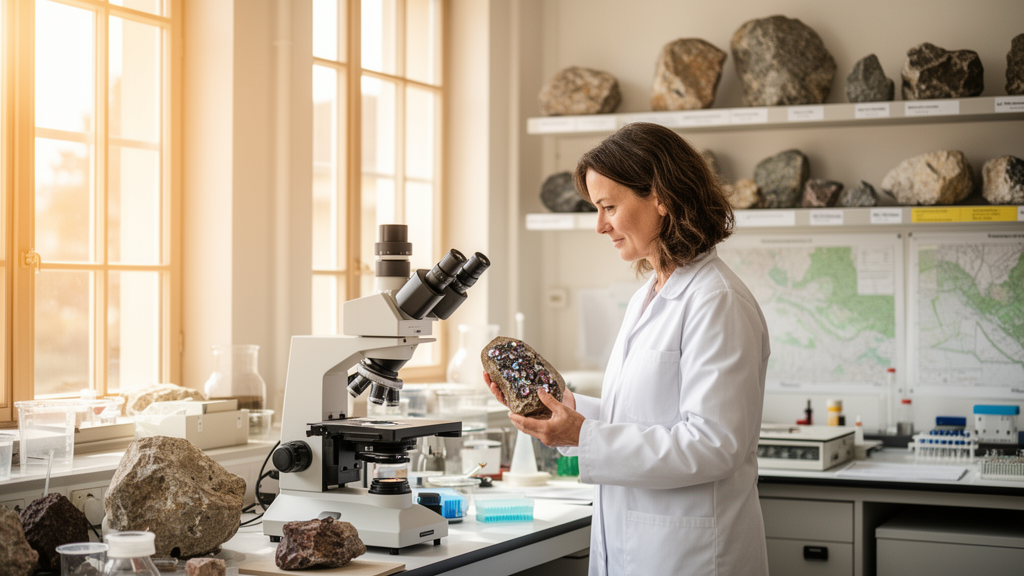
The Paul Niggli Foundation has awarded its 2025 medal to Dr Lisa Eberhard, a Swiss-trained experimental petrologist now based at the University of Bremen, in recognition of her novel, rigorous and versatile approach to quantifying how fluids move mass and redox budget through subduction zones. The decision was taken by the Foundation Board at its session on 6 June 2025 and announced in the Swiss Journal of Geosciences, where the award citation and Eberhard’s response were published together. The medal is Switzerland’s most prestigious honour for young Earth scientists who have made outstanding contributions in mineralogy, geochemistry, petrology, resource geology or solid-Earth geophysics, and it is reserved for researchers who are either Swiss citizens or who obtained at least two of their academic degrees in the Swiss university system, typically a bachelor’s or master’s degree and usually a doctorate as well.
The award citation, written by Thomas Pettke of the University of Bern, traces a career that began in 2012, when Eberhard started her undergraduate studies in Bern. Her bachelor thesis, completed in 2015, dealt with the crystal-chemical characterisation of the barite-celestine solid-solution series, a system in which barium and strontium sulfate minerals substitute for one another in a continuous crystal lattice, a classic problem in mineral chemistry that requires precise control of composition and structure. For her master’s thesis she turned to a question that would shape much of her later work: the petrochemical fate of ophicarbonate, a rock mixture of serpentinite and carbonate, as it is progressively heated in the contact aureole of the Bergell Pluton in Valmalenco, Italy. Contact aureoles are the metamorphic halos that surround igneous intrusions, and they provide natural laboratories in which the thermal transformation of hydrated and carbonated rocks can be studied directly in the field. Her master’s work earned the University of Bern Faculty of Science Award for the best MSc thesis in the geosciences in 2017.
From Bern, Eberhard moved to the Bavarian Research Institute of Experimental Geochemistry and Geophysics in Bayreuth, where she carried out her doctoral research under the supervision of Dan Frost. Pettke’s citation notes that she arrived without prior experimental experience, yet went on to devise a series of multi-anvil experiments, the high-pressure apparatus in which a sample is squeezed between opposing tungsten carbide anvils to reproduce conditions deep within the Earth. Her experiments were designed to derive thermodynamic parameters for the ferric iron and aluminium endmembers of the serpentine minerals antigorite and lizardite, thereby quantifying the relationship between the oxidation state of iron in serpentinite and the oxygen fugacity of the system. Oxygen fugacity, the effective partial pressure of oxygen, is a master variable in geochemistry because it controls which elements change valence and therefore how much redox budget a rock can carry or release.
A second line of doctoral work quantified the effect of carbon-bearing phases on fluid release in subducted serpentinite. Serpentinites form when seawater alters mantle rocks at the ocean floor, binding enormous quantities of water and, where carbonation occurs, carbon dioxide into their crystal structures. As these rocks are dragged down subduction zones, heating drives dehydration and decarbonation reactions that release fluids into the overlying mantle wedge, triggering the melting that feeds arc volcanoes. A third, novel experimental approach allowed Eberhard to constrain how permeability evolves in natural serpentinite as it dehydrates at high pressures and temperatures, addressing one of the central uncertainties in subduction geophysics: how quickly and along which pathways fluids can escape from the descending slab. Taken together, Pettke writes, her findings offer prominent and quantitative insights into redox budget cycling from the subducting slab to the sources of arc magmas.
After completing her doctorate in 2020, Eberhard pursued postdoctoral research, first in Bayreuth and then in Utrecht in the group of Oliver Plümper. There she diversified her research into the complex interplay between rock deformation, prograde mineral reactions and fluid migration, working both as an independent lead scientist and as an active collaborator. Prograde reactions are those that proceed as temperature and pressure rise during burial, and their rates and pathways are strongly modulated by deformation, which creates new surface area, opens fluid pathways and can drive reaction overprint. The results of this quantitative work, according to the citation, already prominently advance the understanding of how deformation affects petrology and, conversely, how petrochemical processes influence rock mechanics, a coupling that remains one of the hardest problems in solid-Earth science because it spans scales from atomic diffusion to plate tectonics.
The Foundation’s citation also highlights Eberhard’s service to the scientific community. She was instrumental in revitalising scientific exchange in the serpentinite research community after the COVID-19 pandemic, launching and running the monthly webinar series SerpentineDays together with colleagues, and co-organising the SerpentineDays international conference in Granada, Spain, in 2024. Pettke describes her as a dedicated teacher and mentor who offers inspiration, sound knowledge and hands-on support to the next student generation, and credits her catching enthusiasm, scientific curiosity, rigour and independent, highly creative mindset as forces already shaping innovative research directions.
In her response, Eberhard expressed deep gratitude to the Foundation and to Pettke, who nominated her and supervised her master’s work a decade ago. She recalled how he introduced her to metamorphic petrology and the geochemistry of carbonated serpentinites in Val Malenco during two field campaigns, and how he encouraged her ideas with the Swiss German phrase Mach mou, meaning go for it, whenever she shyly asked whether a question was worth pursuing. She noted that he supported her long after she left Switzerland, and joked that in German the terms Doktorvater and Doktormutter for doctoral advisers should be extended in her case to include Mastervater as well.
She thanked Dan Frost for introducing her to experimental petrology and for helping her continue the serpentine-carbonate phase relations work that grew out of her master’s thesis, admitting that experimental work proved far harder than she had naively imagined and crediting his persistent questions with teaching her to evaluate her own results critically. At Bayreuth she also collaborated with Catherine McCammon, a Mössbauer spectroscopy specialist whose methods are central to determining iron oxidation states in minerals, and with geodynamicist Gregor Golabek, collaborations she says shaped both her research and her career. Her subsequent move to Oliver Plümper’s group in Utrecht gave her the scientific freedom to develop new research questions and test them experimentally, and she has now returned to work with him at the University of Bremen.
Eberhard’s international training included six months at Tohoku University in Sendai, Japan, during her doctorate as part of a research training group funded by the German Research Foundation, and research stays at the Institute of Earth Sciences in Orléans, France, where she learned from Holger Stünitz how to develop, run and interpret deformation experiments. Science, she reflected, is certainly not a one-woman show, and without the help of so many people she could not have achieved so much. Among the lessons of eight years of experimental research, she singled out the fact that experiments often do not work out as planned, and that the knowledge gained from failed experiments is invaluable, provided one keeps the curiosity and creativity to try again with a different approach. She closed by looking forward to exploring new ideas and to becoming a good mentor herself, bringing the fascination of science to the next generation.
The Paul Niggli Medal, named for the pioneering Swiss mineralogist and petrologist after whom the foundation is also named, continues to serve its founding purpose of honouring and supporting young ambassadors of Swiss geoscience as they build international careers. Eberhard’s trajectory, from a bachelor thesis on solid-solution crystal chemistry in Bern to high-pressure experiments that constrain the redox and fluid budget of the world’s subduction zones, exemplifies the kind of quantitative, experimentally grounded petrology the medal was created to recognise, and her combination of laboratory rigour, field grounding and community leadership marks her as one of the most versatile early-career Earth scientists the Swiss system has produced in recent years.
Subject of Research: Award of the 2025 Paul Niggli Medal to experimental petrologist Lisa Eberhard for research on fluid and redox budget transfer in subduction zones
Article Title: Lisa Eberhard receives the 2025 Paul Niggli Medal
Article References: Schönbächler, M., Pettke, T., & Eberhard, L. (2026). Lisa Eberhard receives the 2025 Paul Niggli Medal. Swiss Journal of Geosciences, 119, 61-63. https://doi.org/10.3897/sjg.119.183296
Image Credits: AI Generated
Keywords: Paul Niggli Medal, Lisa Eberhard, subduction zones, serpentinite, experimental petrology, geochemistry, redox budget, fluid release, multi-anvil experiments, Swiss Journal of Geosciences, University of Bremen, metamorphic petrology
Cite Scienmag News
Violet Maxwell. (October 16, 2026). Swiss Geoscience Honours Lisa Eberhard With 2025 Paul Niggli Medal. Scienmag. https://scienmag.com/swiss-geoscience-honours-lisa-eberhard-with-2025-paul-niggli-medal/
Violet Maxwell. "Swiss Geoscience Honours Lisa Eberhard With 2025 Paul Niggli Medal." Scienmag, 16 October 2026, https://scienmag.com/swiss-geoscience-honours-lisa-eberhard-with-2025-paul-niggli-medal/. Accessed 16 October 2026.
Violet Maxwell. "Swiss Geoscience Honours Lisa Eberhard With 2025 Paul Niggli Medal." Scienmag. October 16, 2026. https://scienmag.com/swiss-geoscience-honours-lisa-eberhard-with-2025-paul-niggli-medal/


