


For decades, the metal implants that hold broken bones together or replace worn-out joints have been engineered with a single-minded focus: make them strong. But strength, it turns out, is only half the story. A comprehensive new review published in Frontiers in Mechanical Engineering argues that the future of metallic implants lies not in any single breakthrough, but in treating the entire implant as an integrated system — where the choice of alloy, the geometry of internal pores, the 3D-printing process itself, and the chemistry of the surface all interact in ways that can make or break clinical success.
The review, authored by M. Mutharasu and J. Joel at the School of Mechanical Engineering, Vellore Institute of Technology in India, synthesizes a sprawling body of literature on additive manufacturing (AM) of metallic implants and proposes a unified design framework. Rather than optimizing biomaterials, architectures, printing processes, and bioactive coatings as separate silos — a fragmentation the authors identify as a persistent weakness in the field — the framework links patient anatomy, material selection, architected porosity, AM technology, and hybrid surface engineering into a single development pathway. The stakes are high: implants that are too stiff relative to bone can trigger stress shielding, a phenomenon in which the metal carries so much of the load that the surrounding bone resorbs and weakens over time, ultimately leading to loosening and revision surgery.
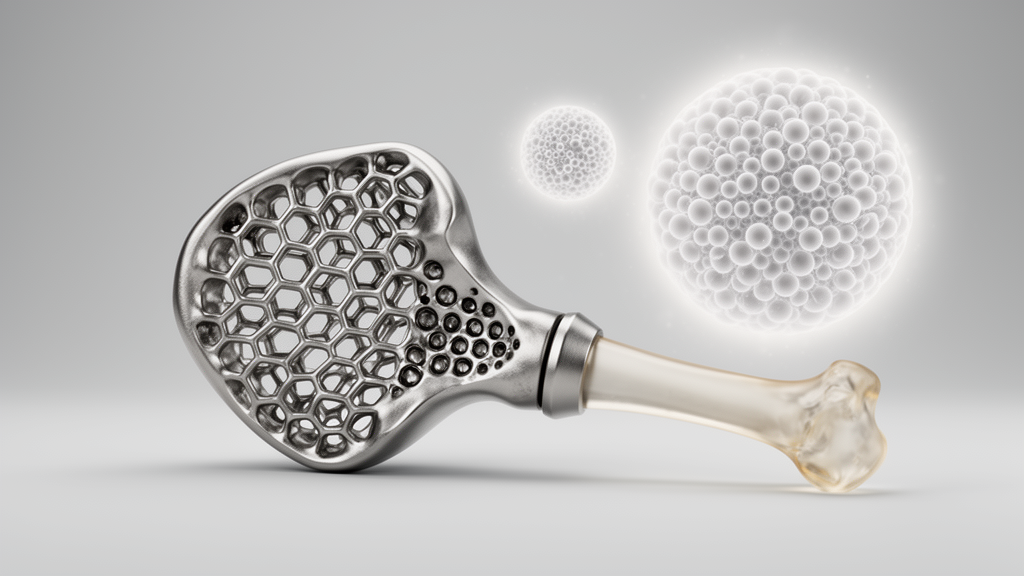
At the heart of the review is a deceptively simple engineering problem. Human bone is not a uniform material. Cortical bone, the dense outer shell, has an elastic modulus of roughly 15 to 20 gigapascals, while trabecular bone, the spongy interior, sits far lower at around 0.01 to 3 gigapascals. Fatigue strength follows a similar split, with cortical bone tolerating roughly 40 to 60 megapascals and trabecular bone only about 0.3 to 3 megapascals. Conventional dense metallic implants — titanium alloys, cobalt-chromium, stainless steel — are dramatically stiffer than any of these. Ti-6Al-4V, the workhorse of the industry, has an elastic modulus of approximately 130 gigapascals, more than six times that of cortical bone. The review’s proposed solution is to use topology-optimized lattice structures, printed via powder bed fusion, to bring the effective stiffness of the implant down into the physiological range of 0.01 to 20 gigapascals, targeting volumetric porosity levels between 50 and 85 percent.
But the review is candid about the trade-offs. Increasing porosity does reduce effective modulus and can improve tissue ingrowth, yet it simultaneously erodes fatigue resistance. At high porosity levels, the lattice relies on ultra-thin struts that shift the primary failure mechanism from bulk compression to localized elastoplastic bending. Under cyclic loading, micro-defects at nodal junctions act as severe stress concentrators, leading to rapid crack initiation, progressive strut rupture, and sudden macroscopic fatigue collapse long before the theoretical yield strength is reached. Retaining fatigue strength above the cortical bone threshold of 40 to 60 megapascals while simultaneously achieving bone-matching stiffness remains, in the authors’ assessment, a profound manufacturing challenge. The review emphasizes that compressive strength alone is insufficient to establish the mechanical suitability of a lattice implant; fatigue behavior is governed by a complex interplay of porosity, pore morphology, strut thickness, surface roughness, residual stress, internal defects, and loading mode.
The material landscape itself is evolving. Titanium alloys remain the most studied, prized for their low density, high specific strength, and corrosion resistance, but the review highlights a shift toward novel beta-phase titanium compositions engineered with non-toxic stabilizers such as niobium, tantalum, zirconium, and molybdenum. These alloys can drive the elastic modulus down toward 50 to 60 gigapascals without any porous structuring at all, and compositions like Ti-25Nb reach as low as 19 gigapascals — approaching cortical bone directly. Copper-containing titanium alloys, such as Ti-0.3Cu, add antibacterial functionality alongside high tensile strength. Cobalt-chromium-molybdenum alloys, meanwhile, remain the gold standard for wear resistance in articulating environments, thanks to high hardness and stable passive oxide films, though their high stiffness and susceptibility to micro-galvanic corrosion at grain boundaries present their own challenges. 316L stainless steel, when printed via laser powder bed fusion, develops a refined sub-micron cellular austenitic microstructure with dense dislocation networks that breaks the traditional strength-ductility tradeoff — a property the review notes is particularly valuable for porous scaffolds that must dissipate physiological loads through progressive plastic bending rather than catastrophic brittle fracture.
Magnesium alloys occupy a different niche entirely. Unlike titanium or cobalt-chromium, magnesium is biodegradable: it dissolves in the body over months to years, potentially eliminating the need for secondary removal surgery. The review catalogs a growing clinical portfolio, from BIOmag coronary stents launched in 2024 to WE43 bone screws and high-purity magnesium vascular closure devices. But the same reactivity that makes magnesium attractive also makes it dangerous. Rapid corrosion generates hydrogen gas faster than the body can transport it away, and accumulation can produce local cavities, alter tissue-implant contact, and interfere with healing. The review cites a frequently discussed reference level of approximately 0.01 milliliters per square centimeter per day for tolerable hydrogen evolution, while cautioning that this is not a universal clinical threshold — tolerance depends on anatomical site, vascularization, implant geometry, and degradation kinetics.
Surface engineering emerges as the third pillar of the integrated framework. Hydroxyapatite, a calcium phosphate ceramic that closely mimics the mineral component of natural bone, has long been the go-to bioactive coating, but the review details its limitations: inherent brittleness, thermal expansion mismatch with metallic substrates that causes residual stress and microcracking, and dissolution behavior that varies with crystalline phase. Ion-substituted variants — incorporating zinc, magnesium, or strontium — offer improved antibacterial properties, corrosion resistance, and osteogenic activity. Bioactive glasses, both silicate-based and the newer borate compositions, release therapeutic ions that promote bone regeneration; borate glasses like 13-93B3 can degrade 85 percent within 7 to 14 days, far outpacing silicate counterparts, though this rapid dissolution risks compromising mechanical integrity before bone has fully healed. Hybrid hierarchical coatings that combine ceramic, polymeric, and biomolecular layers — such as polydopamine, zinc oxide nanoparticles, chitosan, and nanocrystalline hydroxyapatite — represent the current frontier, achieving adhesion strengths exceeding 50 megapascals in some configurations.
The review also confronts a manufacturing reality that is easy to overlook: the machines themselves wear out. In directed energy deposition systems, the continuous flow of abrasive metallic powders induces significant wear on entry nozzles, altering powder focus and causing spatial inaccuracies in the melt pool. In laser powder bed fusion, abrasive wear of the re-coater blade against the powder bed can induce subtle variations in layer thickness. This machine-level tribological degradation translates directly into metallurgical defects, heterogeneous porosity, and diminished fatigue life in the final biomedical component — a feedback loop that the authors argue must be accounted for in any robust quality-control framework.
On the clinical side, the pathway from computed tomography or magnetic resonance imaging scans to a printed, patient-specific implant involves segmentation, computer-aided design, finite element analysis, and build preparation. The review notes that patient-specific implants currently cost five to ten times more than conventional standard implants, a premium driven by imaging software, prolonged CAD processing, specialized machine usage, and tailored post-processing. This economic reality confines their routine use to complex revision procedures, cancer resections, or critical trauma where conventional implants would fundamentally fail. Regulatory qualification, manufacturing reproducibility, and coating durability on complex lattice geometries are identified as the leading barriers to broader clinical translation.
Ultimately, the review’s central message is that no single material-architecture-coating combination can be considered universally optimal. The authors argue that implant performance emerges from the combined effects of alloy properties, architectural design, manufacturing-induced defects, surface characteristics, and post-processing conditions — and that future research must simultaneously consider mechanical compatibility, fatigue performance, corrosion and degradation, coating durability, biological response, powder removal from complex architectures, and economic and regulatory requirements. The era of treating the implant as a monolithic object, they suggest, is over; what replaces it is a design philosophy in which every layer, from the atomic arrangement of the alloy to the nanometer-scale chemistry of the outermost surface, is treated as a coupled variable in a single, interconnected system.
Subject of Research: Additive manufacturing of metallic implants integrating material selection, porous lattice architecture, and hybrid surface engineering
Article Title: Additive manufacturing of metallic implants: a comprehensive review of material selection, porous architecture, and hybrid surface engineering
Article References: Mutharasu, M., & Joel, J. (2026). Additive manufacturing of metallic implants: a comprehensive review of material selection, porous architecture, and hybrid surface engineering. Frontiers in Mechanical Engineering, 12, Article 1978898. https://doi.org/10.3389/fmech.2026.1978898
Image Credits: AI Generated
DOI: 10.3389/fmech.2026.1978898
Keywords: additive manufacturing, metallic implants, porous lattice, stress shielding, titanium alloys, cobalt-chromium, magnesium alloys, hydroxyapatite, bioactive glass, surface engineering, powder bed fusion, biodegradable implants
Cite Scienmag News
Denise Maddox. (October 16, 2026). 3D-Printed Metal Implants Get Smarter: New Review Maps the Path to Bone-Matching Prosthetics. Scienmag. https://scienmag.com/3d-printed-metal-implants-get-smarter-new-review-maps-the-path-to-bone-matching-prosthetics/
Denise Maddox. "3D-Printed Metal Implants Get Smarter: New Review Maps the Path to Bone-Matching Prosthetics." Scienmag, 16 October 2026, https://scienmag.com/3d-printed-metal-implants-get-smarter-new-review-maps-the-path-to-bone-matching-prosthetics/. Accessed 16 October 2026.
Denise Maddox. "3D-Printed Metal Implants Get Smarter: New Review Maps the Path to Bone-Matching Prosthetics." Scienmag. October 16, 2026. https://scienmag.com/3d-printed-metal-implants-get-smarter-new-review-maps-the-path-to-bone-matching-prosthetics/


