


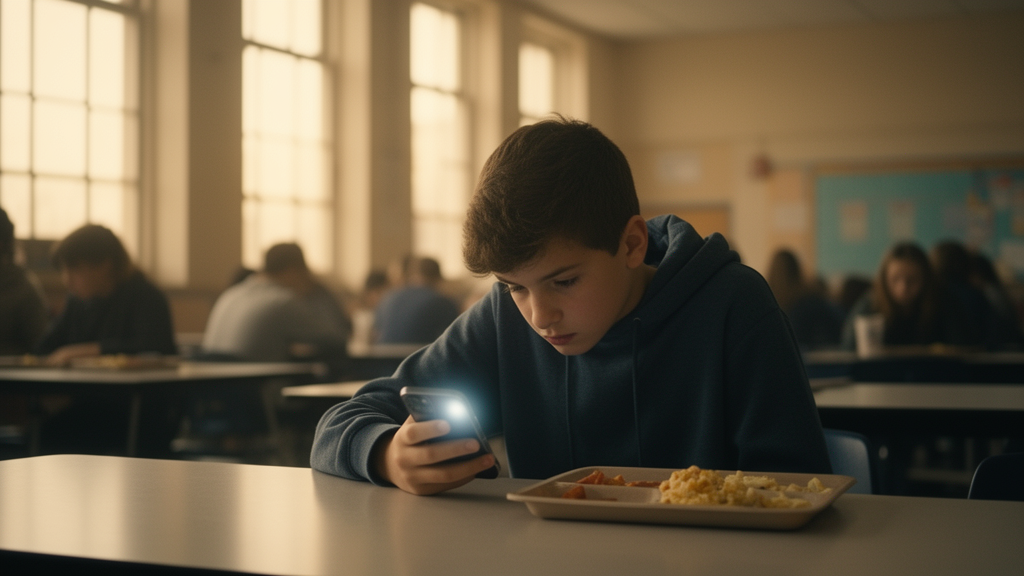
A large new study from China suggests that the weight of social stigma may not just wound students’ feelings; it may quietly drain the mental fuel they need to resist their phones. Researchers surveyed 1,352 students at Chinese higher vocational colleges and found that those who internalized society’s low opinion of their educational track reported more of an enduring state called self-regulatory fatigue, and that this fatigue, in turn, was linked to more problematic smartphone use. The work, published in Frontiers in Psychology, offers one of the clearest pictures yet of how a devalued social identity can surface in everyday self-control failures that seem, on the surface, to have nothing to do with stigma at all.
Problematic smartphone use is a term researchers prefer to the more sensational “smartphone addiction,” precisely because scientists still debate whether the behavior qualifies as a true addictive disorder. What is not debated are its costs. The pattern, defined as smartphone engagement that is difficult to control and interferes with study, sleep, work, or relationships, has risen steadily among young people over the past decade and co-occurs with depression, anxiety, stress, and poor sleep. Most research into why some people develop this pattern has focused on traits of the individual or passing emotional states: weak self-control, academic anxiety, low self-esteem, fear of missing out. What has received far less attention is discomfort rooted in a person’s social position, the kind that cannot simply be shaken off at the classroom door.
The population at the heart of the new study is particularly suited to testing that idea. In China, vocational education is widely regarded as a compensatory track ranking below academic education. Students whose scores on the national college entrance examination fall short of undergraduate programs are commonly channeled into vocational colleges, and a stereotype casting them as academic failures is reproduced in everyday interactions, inside the colleges themselves, and even among junior high school students who may later enroll. This penalty persists despite a revised Vocational Education Law declaring vocational and general education to be of equal importance, and similar low standing of vocational tracks has been documented across many national systems. Students in such tracks report being looked down upon because of their program, a perception that predicts a sense of futility beyond what their ability or background would explain.
The researchers drew on two well-established psychological frameworks to make a specific prediction. According to the staged model of self-stigma, members of a devalued group first become aware of public stereotypes, then come to agree with them, and finally apply them to themselves. According to the identity threat model, people with a stigmatized identity repeatedly appraise whether situations threaten that identity, and those threat appraisals trigger involuntary stress responses along with effortful coping. Because the cues that prompt these appraisals recur wherever the identity is known, the demands on self-regulation recur too. Laboratory work has shown that being targeted by prejudice, witnessing bias, or merely anticipating it impairs self-control in domains unrelated to the prejudice itself. The study’s authors proposed that chronic vocational self-stigma would be associated with a lasting state of diminished self-regulatory capacity, which they measured with items describing difficulty sustaining attention, lacking the energy to finish tasks, and abandoning tasks partway.
One nuance matters here. The famous “strength model” of self-control, which treats self-regulation as a limited resource depleted by use, has struggled in recent years: large multilaboratory replications found little evidence of the acute depletion effect in its classic laboratory paradigm. But the construct used in this study is different. Self-regulatory fatigue, as assessed by questionnaire, refers to an enduring state of diminished cognitive, emotional, and behavioral self-regulatory capacity, originally developed with people living with chronic illness whose regulatory demands persist for months or years. The chronic demands that define it resemble those imposed by a lasting devalued identity, making it a fitting bridge between stigma and behavior.
The data told a consistent story. Vocational self-stigma was positively associated with problematic smartphone use, and self-regulatory fatigue statistically accounted for a substantial share of that association. The indirect effect through fatigue was estimated at 0.127, with a 95 percent confidence interval of 0.099 to 0.157, and it amounted to roughly half of the total association. Crucially, the finding survived an unusually thorough battery of robustness checks spanning twelve analytic specifications. It held when the fatigue scale was shortened, when the self-stigma scale was restricted to items about self-devaluation alone or awareness of public devaluation alone, when additional covariates such as daily smartphone use time, family economic circumstances, and career planning were added, when fast or inattentive responders were removed, and when the sample was restricted to first-year students. When the researchers modeled measurement error in a latent-variable version of the model, the standardized indirect effect actually grew larger, from 0.154 to 0.199.
The most intriguing result concerned what might buffer this pathway. The researchers hypothesized that professional identity, a clear and valued sense of one’s future occupation, might weaken the link between stigma and fatigue, or between fatigue and problematic use, or both. The answer was surprising in its specificity. Professional identity did essentially nothing to the first stage: the interaction between self-stigma and identity was close to zero, at −0.008, a value the researchers could statistically reject as meaningful using equivalence bounds. But it clearly moderated the second stage. The association between fatigue and problematic use weakened as professional identity increased, with an interaction coefficient of −0.142. Students one standard deviation above the mean on identity showed a fatigue-to-use association of 0.346, compared with 0.542 for those one standard deviation below.
A finer-grained analysis sharpened the picture. The Johnson-Neyman technique, which traces a conditional effect across the entire range of a moderator, showed that the fatigue-to-problematic-use association remained statistically significant at every attainable professional identity score below the scale maximum, a range covering 98.9 percent of the sample. In other words, professional identity softens the pathway but does not sever it; even students with a strong sense of occupational direction remained vulnerable when their self-regulation was strained. The indirect effect through fatigue was smaller at high identity (0.085) than at low identity (0.139), and the difference between those estimates was itself statistically significant.
The authors offer two plausible readings of why identity buffers behavior but not the generation of fatigue. Students who care most about a domain are, paradoxically, the most vulnerable to stereotypes about it, so heightened sensitivity among invested students may offset any buffering. Alternatively, awareness of devaluation may rest on collective representations, shared knowledge of how society regards the category, which personal commitment to a field does little to change. Either way, the practical implication is that professional identity appears to shape how regulatory strain is expressed in behavior, rather than how much strain a stigmatized identity produces in the first place. A parallel finding with academic anxiety and mindfulness points to a broader hypothesis: personal resources may matter more for the expression of strain than for its connection to the stressor.
The study has clear limits, which the authors acknowledge candidly. The data are cross-sectional and self-reported, so the pathway describes statistical associations rather than proven causal sequences; a model with the order of variables reversed also fit. The measures were abbreviated short forms, and more than a quarter of respondents chose the scale midpoint on every identity item, though removing those responders strengthened rather than weakened the pattern. Respondents outside Zhejiang province reported more self-stigma and more problematic use, and holding city of response constant reduced but did not eliminate the indirect effect. What remains is a provocative reframing: a devalued social identity may impose a chronic regulatory tax, and the smartphone, offering immediate relief at any moment, is exactly the temptation a taxed regulator struggles to resist. Whether interventions that strengthen professional identity, reduce the devaluation of vocational education, or support self-regulation directly can interrupt the pathway is now a question for longitudinal and experimental work.
Subject of Research: The association between vocational self-stigma, self-regulatory fatigue, and problematic smartphone use among Chinese higher vocational college students
Article Title: Vocational self-stigma and problematic smartphone use: self-regulatory fatigue as an indirect pathway and professional identity as a second-stage moderator
Article References: Chen, Y., Zheng, X., & Yan, Y. (2026). Vocational self-stigma and problematic smartphone use: self-regulatory fatigue as an indirect pathway and professional identity as a second-stage moderator. Frontiers in Psychology, 17, Article 1942617. https://doi.org/10.3389/fpsyg.2026.1942617
Image Credits: AI Generated
DOI: 10.3389/fpsyg.2026.1942617
Keywords: vocational self-stigma, problematic smartphone use, self-regulatory fatigue, professional identity, moderated mediation, Chinese vocational education, identity threat, self-regulation, ego depletion, stigma, college students, psychology
Cite Scienmag News
Glenn Wilkins. (October 15, 2026). Feeling Looked Down On Drains Students’ Self-Control and Fuels Smartphone Overuse. Scienmag. https://scienmag.com/feeling-looked-down-on-drains-students-self-control-and-fuels-smartphone-overuse/
Glenn Wilkins. "Feeling Looked Down On Drains Students’ Self-Control and Fuels Smartphone Overuse." Scienmag, 15 October 2026, https://scienmag.com/feeling-looked-down-on-drains-students-self-control-and-fuels-smartphone-overuse/. Accessed 15 October 2026.
Glenn Wilkins. "Feeling Looked Down On Drains Students’ Self-Control and Fuels Smartphone Overuse." Scienmag. October 15, 2026. https://scienmag.com/feeling-looked-down-on-drains-students-self-control-and-fuels-smartphone-overuse/


