


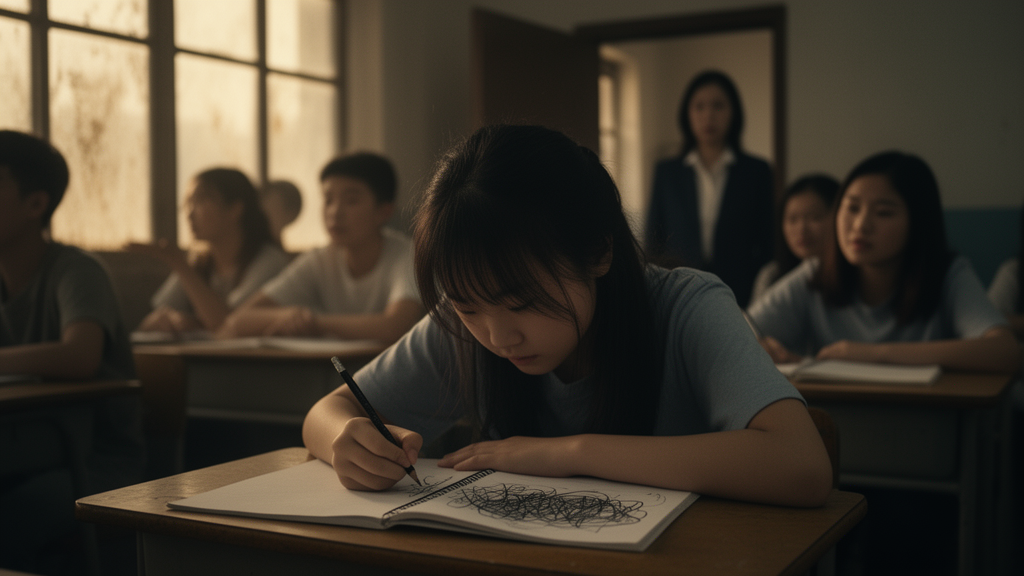
A new qualitative study from Beijing offers an unusually intimate look at how Chinese adolescents experience psychological distress, how they try to cope with it, and why the adults around them so often fail to notice what is happening. Published in BMC Psychology by a team based at Peking University Huilongguan Clinical Medical School and Beijing Huilongguan Hospital, the research interviewed 27 participants, including 11 adolescents aged 12 to 18 who had been diagnosed with affective disorders such as major depressive disorder or bipolar disorder, their 11 parents, and 5 healthy school-attending adolescents. Rather than measuring symptoms with questionnaires, the researchers used semi-structured interviews and inductive thematic analysis to reconstruct the lived sequence of distress: how it first appears, how it is interpreted, and how support either arrives or falls away.
The central finding is deceptively simple but clinically consequential: emotional and behavioural changes in adolescents were not always recognised as possible signs of psychological distress. Recognition, the authors found, depended on three interacting factors. The first was the meaning that adults assigned to a teenager’s changes in mood or behaviour. The second was the adolescent’s own ability and willingness to communicate what they were experiencing. The third was the response they received when they did try to speak. If any link in that chain failed, the distress could deepen quietly, sometimes for years, before anyone intervened.
This framing matters because adolescent mental health problems in China, as elsewhere, are frequently detected late. By the time many young people reach specialist services, their difficulties have already crystallised into diagnosable conditions. The study’s design deliberately recruited both sides of the recognition problem: adolescents who had lived through affective disorders, and the parents who were closest to them when the early signs appeared. Including healthy school-attending adolescents added a comparison perspective on how distress is perceived from the outside, when it has not yet become a clinical crisis.
Methodologically, the researchers employed purposive sampling to select participants who could speak with direct experience of the phenomena under study. The interviews were semi-structured, meaning the researchers prepared guiding questions but allowed participants to elaborate in their own words, surfacing themes the investigators had not anticipated. Analysis proceeded primarily through inductive thematic analysis, a technique in which codes and themes are built up from the data itself rather than imposed from a pre-existing theory. Only after the themes had been identified did the team apply the modifiable biopsychosocial model of health and well-being as a sensitising framework, a lens used to organise and interpret what the interviews had already revealed rather than to dictate what they should find.
The modifiable biopsychosocial model is the study’s conceptual backbone, and its emphasis on modifiability is what gives the findings their practical force. Instead of cataloguing fixed risk factors, the model directs attention to domains that can actually be changed. The researchers organised their results into four such domains: healthy environments, developmental competencies, a sense of belonging, and coping. Each domain represents a lever that families, schools, and clinicians can pull to alter the trajectory of distress before it becomes entrenched.
Healthy environments, in this framework, refer to the surroundings in which adolescents live and study, including the emotional climate at home and the pressures and supports present at school. Developmental competencies capture the skills adolescents are still acquiring, among them the capacity to identify and name their own emotional states and to communicate them to others. A sense of belonging reflects the adolescent’s feeling of being connected to and accepted by family, peers, and the wider social world. Coping, the fourth domain, encompasses the strategies adolescents deploy when distress strikes, which the study found to be decisive in shaping outcomes.
One of the most striking temporal findings concerns how coping evolves. Participants reported that coping strategies changed as distress persisted and as experiences of seeking support accumulated. When early coping attempts and early support-seeking were insufficient, fewer adaptive and healthy responses emerged later in the course of the distress. In other words, the window in which support is most effective is also the window in which it is most often missed. Once an adolescent’s initial bids for help are met with dismissal, misunderstanding, or silence, the repertoire of healthy coping narrows, and the distress becomes correspondingly harder to reverse.
The study also illuminates the delicate question of adolescent autonomy. The authors conclude that early recognition and support should respect adolescents’ developing autonomy while simultaneously facilitating safe communication. This is a fine balance. Adults who interrogate or monitor too aggressively can shut down the very channels through which distress becomes visible, while adults who step back entirely may leave adolescents without any route to help. The interviews suggest that adolescents are more willing to disclose when the responses they receive are accepting and prompt, and less willing when disclosure has previously been met with minimisation or blame.
The practical implications follow directly from the four modifiable domains. The researchers argue that adults’ ability to recognise psychological distress should be strengthened, not only among parents but across the network of adults who surround a young person. They further argue that support should be available before distress progresses to substantial functional impairment or crisis, a point that reframes early intervention as a matter of timing rather than merely of intensity. Facilitating safe communication and responding promptly when early coping and support become insufficient are identified as concrete priorities for early recognition programmes.
For a study of this kind, the sample is modest but well suited to its purpose, and the authors are careful about what the design can and cannot establish. Qualitative interviews cannot quantify how common any particular pattern is, but they can reveal the mechanisms by which distress is missed, communicated, and escalated, mechanisms that large surveys often obscure. The work was approved by the Institutional Review Board of Beijing Huilongguan Hospital, conducted in accordance with the Declaration of Helsinki, and supported by Beijing Hospitals Authority’s Ascent Plan and the Beijing Research Ward Excellence Program, with the funders playing no role in study design, analysis, or reporting. The team, led by corresponding author Yongsheng Tong, includes researchers affiliated with the WHO Collaborating Center for Research and Training in Suicide Prevention in Beijing, underscoring the public health stakes of getting early recognition right.
What makes the study resonate beyond China is the universality of its core insight: psychological distress in adolescents is rarely invisible, but it is routinely misread. A change in sleep, a withdrawal from friends, a drop in school engagement, or an uncharacteristic irritability can be interpreted as laziness, defiance, or a passing phase, depending on the meaning adults assign. The Beijing findings suggest that training adults to treat such changes as potential signals, and equipping adolescents with the competencies to articulate what they feel, could shift the entire trajectory of youth mental health. The four modifiable domains offer a map for that effort, one that places the power to intervene not in specialist clinics alone but in the everyday environments where distress first takes hold.
Subject of Research: Qualitative study of psychological distress experiences and modifiable biopsychosocial support domains among Chinese adolescents
Article Title: Understanding Chinese adolescents’ psychological distress through modifiable biopsychosocial domains: a qualitative study
Article References: Understanding Chinese adolescents’ psychological distress through modifiable biopsychosocial domains: a qualitative study. (n.d.). https://doi.org/10.1186/s40359-026-05632-w
Image Credits: AI Generated
DOI: 10.1186/s40359-026-05632-w
Keywords: adolescent mental health, psychological distress, qualitative study, biopsychosocial model, coping strategies, help-seeking, early intervention, affective disorders, China, BMC Psychology, parental recognition, mental health promotion
Cite Scienmag News
Glenn Wilkins. (October 15, 2026). How Chinese Teenagers Signal Psychological Distress and Why Adults Miss It. Scienmag. https://scienmag.com/how-chinese-teenagers-signal-psychological-distress-and-why-adults-miss-it/
Glenn Wilkins. "How Chinese Teenagers Signal Psychological Distress and Why Adults Miss It." Scienmag, 15 October 2026, https://scienmag.com/how-chinese-teenagers-signal-psychological-distress-and-why-adults-miss-it/. Accessed 15 October 2026.
Glenn Wilkins. "How Chinese Teenagers Signal Psychological Distress and Why Adults Miss It." Scienmag. October 15, 2026. https://scienmag.com/how-chinese-teenagers-signal-psychological-distress-and-why-adults-miss-it/


