


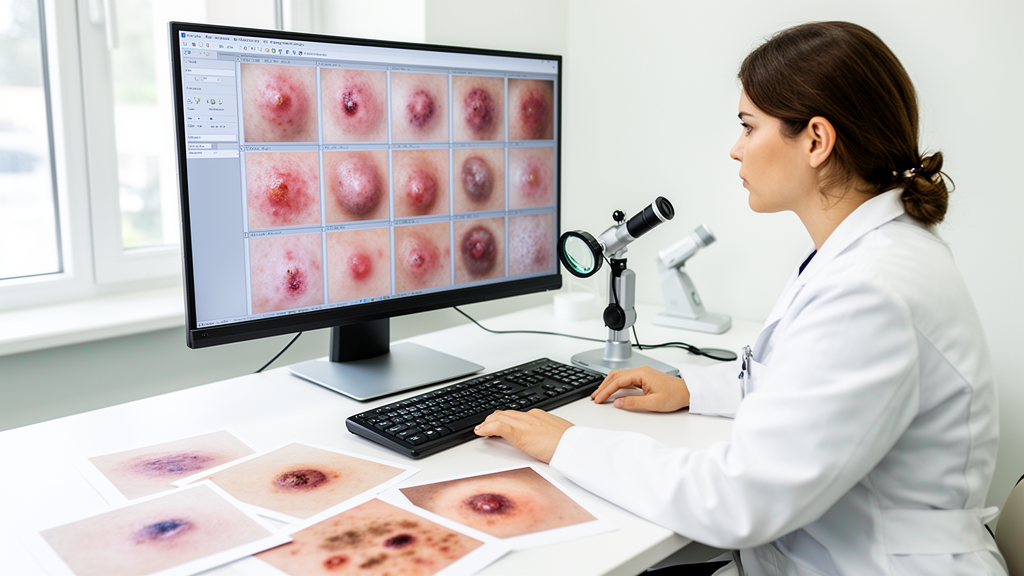
Artificial intelligence systems that promise to help doctors detect skin cancer are only as good as the images they learn from, and those images are far messier than most headlines suggest. Dermoscopic photographs of skin lesions—the close-up, non-invasive images that dermatologists rely on to spot melanoma early—are routinely contaminated by stray hairs, dark corners cast by the circular lens of the dermatoscope, gel bubbles trapped against the skin, ruler markings, ink traces from clinical examinations, and adhesive patches placed near the lesion. A new resource called DermArtifactDB, described in Frontiers in Big Data, now provides expert-validated labels for exactly these flaws across more than 20,000 publicly available dermoscopic images, giving the machine learning community its first large-scale, standardized map of where the noise hides.
The dataset was assembled by researchers at Rey Juan Carlos University in Madrid, working with a dermatologist from Hospital Universitario de Móstoles, and covers the complete image sets of three widely used public repositories: ISIC-2019 with 19,000 images, Derm7pt with 1,011 images, and PH2 with 200 images. For every one of the 20,211 images, the dataset records whether each of seven artifact categories is present, producing 141,477 individual binary labels. The contribution is not the images themselves, which remain with their original repositories, but the standardized, expert-reviewed artifact metadata layered on top of them, together with the annotation pipeline and dataset statistics released alongside.
Why does this matter? Prior work has shown that artifacts are not merely cosmetic nuisances. Studies have linked surgical skin markings and scale bars in dermoscopic images to measurable drops in the diagnostic performance of market-approved deep learning systems for melanoma recognition. Artifacts can alter the color and texture patterns that both clinicians and algorithms depend on, and they act as confounding factors that models can latch onto for the wrong reasons—learning, for example, that a dark corner correlates with a particular diagnosis rather than anything biologically meaningful. Earlier efforts to annotate artifacts, such as manual labeling of small subsets of ISIC 2018 and the Dermoscopic Atlas, demonstrated the problem but covered only a fraction of available data, and later classifier-generated labels lacked expert validation.
DermArtifactDB tackles the scale problem with a hybrid, multi-phase pipeline. In the first phase, images were collected from the three source repositories, none of which originally included artifact labels. The second phase deploys an ensemble of artifact-specific detectors: six categories—dark corners, gel border, gel bubbles, ruler markings, ink markings, and patches—are handled by classical image-processing techniques operating in multiple color spaces such as HSV, YCrCb, and CIELAB, while hair detection uses an ensemble of three deep learning segmentation networks (Attention U-Net, Dense U-Net, and Attention Dense U-Net) chosen for their ability to capture the morphological complexity of hair filaments. For each artifact, three complementary detectors run in parallel, each tuned to a different visual aspect such as color, geometry, or intensity, and a majority-voting rule accepts an artifact as present when at least two of the three detectors agree.
The technical details reveal how demanding reliable detection can be. Ruler markings are found with the probabilistic Hough transform, which identifies straight line segments; because a ruler edge typically appears as fragmented segments rather than one continuous line, the method groups segments sharing a common orientation within a tolerance of about ten degrees. Gel bubbles are isolated through Canny edge detection and morphological filtering, then filtered by a circularity index and an area window between 50 and 1,000 pixels, with hair masks suppressing false contours. Patch detection first segments the lesion itself using a Double U-Net model so that lesion pixels can be excluded, then searches for the saturated warm and cool chromatic tones characteristic of adhesive markers. Dark corners are flagged by analyzing the proportion of dark pixels along border rows and columns in each image quadrant, a thresholding scheme sensitive enough to catch subtle vignetting from the dermatoscope lens.
The third phase brings in a transformer. The team adapted C-Tran, a general multi-label classification transformer, pairing a ResNet-101 backbone pretrained on ImageNet with a Transformer encoder that models dependencies between artifact categories—for instance, the tendency of gel borders and gel bubbles to appear together. Training used a masked-label strategy, in which a random subset of labels is hidden so the model must infer them from context, together with a custom imbalance-aware loss called Class-Adaptive Focal with Confidence, designed to sharpen sensitivity to rare and visually subtle artifacts. In head-to-head comparisons against convolutional baselines including ResNet-101, DenseNet-121, and EfficientNet-B0, the transformer achieved the best scores on all four evaluation metrics: mean average precision, micro-averaged F1 and recall, and macro-averaged class-wise F1.
Neither automated stage is trusted alone. Whenever the classical ensemble and the transformer disagreed on any artifact category, the image was flagged for human review by two independent annotators—a computer vision researcher and a board-certified dermatologist—who examined the original image at full resolution, compared both sets of predictions, and consulted the transformer’s attention maps to locate the evidence behind each prediction. Before any joint discussion, the annotators independently labeled all 10,711 artifact-level decisions submitted for review, reaching 94.3 percent overall agreement with a Cohen’s kappa of 0.88. Agreement was perfect for patches and nearly perfect for ruler markings and dark corners, while gel border and gel bubbles proved hardest to separate from each other and from lookalike structures such as milia-like cysts within lesions. Of the flagged decisions, 5.7 percent required joint discussion, and three-quarters of those involved the two gel-related categories.
The resulting statistics expose how differently artifacts distribute across collections. In ISIC-2019, hair appears in 56.8 percent of images, gel bubbles in 37.2 percent, and dark corners in 32.7 percent, and it is the only dataset where ruler markings are frequent at 20.3 percent—a reflection of its large-scale, multi-center acquisition. PH2, captured under controlled conditions at a Portuguese hospital, is dominated by dark corners in 92 percent of images, with no ruler markings or patches at all. Derm7pt, drawn from an atlas of dermoscopy, shows a striking 76.2 percent prevalence of gel bubbles and almost no dark corners at 1.7 percent. Every dataset exhibits artifact co-occurrence, confirming that multi-artifact images are the norm rather than the exception in real clinical acquisition.
The authors are candid about the limits of their method. Agreement between the two automated approaches does not guarantee correctness, since both can fail in the same way on subtle artifacts, and such cases are invisible to the disagreement statistic. On the fully reviewed PH2 dataset, about 5.5 percent of the decisions on which the two systems agreed turned out to be inconsistent with the expert reference—roughly the same order as the 4.1 percent disagreement rate. Random audits of agreed labels in ISIC-2019 and Derm7pt corrected 2.76 and 3.33 percent of decisions respectively. The labels are therefore presented as a high-quality reference for benchmarking rather than absolute ground truth. The annotations are also image-level only: they say whether an artifact is present, not where it is, which rules out tasks like artifact segmentation or inpainting-based removal for now.
Released under FAIR data principles and documented with the Datasheets for Datasets framework, with annotations matched to original images by their unique identifiers, DermArtifactDB arrives at a moment when the field is reckoning with dataset bias and the brittleness of diagnostic AI. By quantifying artifact prevalence, co-occurrence, and diversity at scale, it gives developers the tools to stratify test sets, debias training data, and build preprocessing pipelines that detect and mitigate artifacts before they distort a diagnosis. The natural next step, the authors note, is region-level annotation—masks and bounding boxes for a representative subset—which would open the door to localization-aware artifact removal. For now, the hidden flaws of dermoscopic imaging finally have a systematic, searchable record.
Subject of Research: Multi-label annotation of acquisition artifacts in public dermoscopic image repositories for skin lesion analysis
Article Title: DermArtifactDB: a multi-label dataset for artifact annotation in public dermoscopic image repositories
Article References: Gómez-Martínez, V., Chushig-Muzo, D., Polimón-Olabarrieta, I., & Soguero-Ruiz, C. (2026). DermArtifactDB: a multi-label dataset for artifact annotation in public dermoscopic image repositories. Frontiers in Big Data, 9, Article 1866430. https://doi.org/10.3389/fdata.2026.1866430
Image Credits: AI Generated
DOI: 10.3389/fdata.2026.1866430
Keywords: dermoscopy, artifact detection, skin cancer, machine learning, medical imaging, dataset annotation, deep learning, transformer models, computer-aided diagnosis, melanoma, data quality, image segmentation
Cite Scienmag News
Nathaniel Bowman. (October 15, 2026). Massive New Dataset Labels the Hidden Flaws in 20,000 Skin Cancer Images. Scienmag. https://scienmag.com/massive-new-dataset-labels-the-hidden-flaws-in-20000-skin-cancer-images/
Nathaniel Bowman. "Massive New Dataset Labels the Hidden Flaws in 20,000 Skin Cancer Images." Scienmag, 15 October 2026, https://scienmag.com/massive-new-dataset-labels-the-hidden-flaws-in-20000-skin-cancer-images/. Accessed 15 October 2026.
Nathaniel Bowman. "Massive New Dataset Labels the Hidden Flaws in 20,000 Skin Cancer Images." Scienmag. October 15, 2026. https://scienmag.com/massive-new-dataset-labels-the-hidden-flaws-in-20000-skin-cancer-images/


