


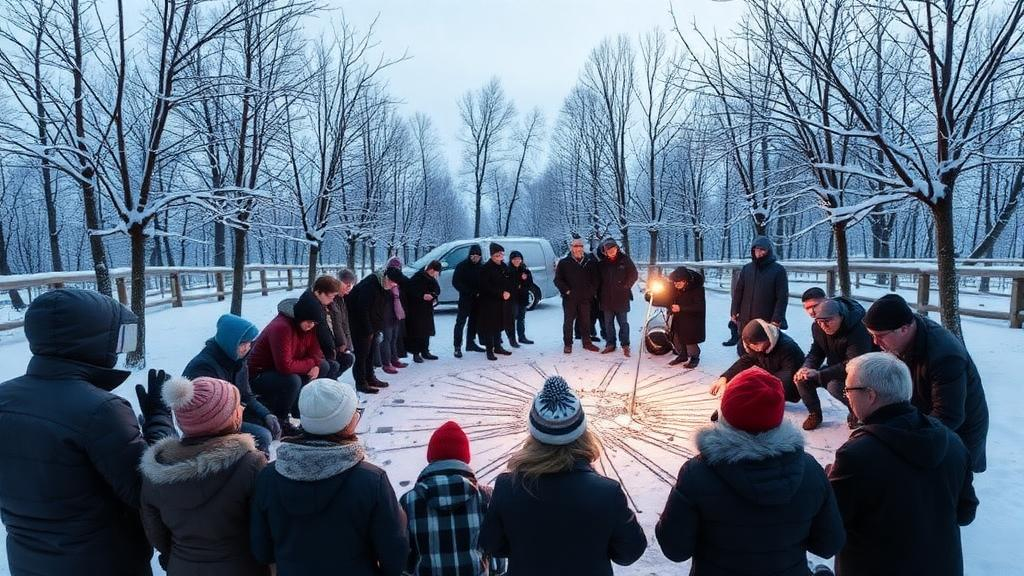
Every winter for the past 11 years, young researchers from across disciplines and around the world have gathered to explore complexity science and to collaborate intensively on self-organised projects. What began in 2015 as a gathering of colleagues who had first met at a previous workshop at the Santa Fe Institute has since consolidated into a self-organised, resilient workshop for early-career scientists in the complexity community. The Winter Workshop on Complex Systems is characterised by its format: participants form interdisciplinary teams and spend a week developing projects of their own design. By maintaining an economical model that serves as a low-cost alternative to expensive traditional conferences, the workshop prioritises inclusion, ensuring that financial constraints do not prevent talented early-career researchers from participating. This approach not only promotes collaboration and the exchange of ideas but also helps to build a strong, supportive community of young researchers. Many of these collaborations have endured well beyond the workshop, leading to successful publications and long-term partnerships and friendships.
The story of the Winter Workshop on Complex Systems offers a rare longitudinal case study in how scientific communities can sustain themselves without institutional anchoring. Most academic events depend on universities, professional societies, or commercial publishers to guarantee continuity, yet this workshop has persisted for more than a decade through an entirely different mechanism: the deliberate transfer of responsibility from one cohort of participants to the next. Understanding how that mechanism works in practice reveals much about the broader question of how early-career researchers can build durable scientific infrastructure when traditional channels of support are unavailable or inaccessible to them.
The founding moment is instructive. The first edition in 2015 was described by one of its originators as a small experiment, carried out in Europe by researchers who had met the previous year at a Santa Fe Institute summer school. That gathering brought together roughly twenty participants under improvised funding for a week centred on collaborative project development. The scale matters: complexity science has long been associated with small, intensive residential formats, from the Santa Fe Institute’s own tradition of working groups to the European Complex Systems Society’s doctoral colloquia. What distinguished this experiment was not the format itself but the decision to make its reproduction the explicit responsibility of the participants rather than of a standing institution.
This decision produced a governance structure with recognisable features of self-organising systems. There is no permanent central authority. Instead, a Steering Committee provides continuity and oversight while delegating the practical execution of each edition to an Organising Committee drawn primarily from former participants. The Steering Committee selects the organisers through a public call, ensures compliance with the workshop’s statutes, supports the organisers with advice and fundraising, and manages communication channels. Its own membership rotates, with terms capped at three editions, and past members remain available as an advisory body. This layered design separates long-term stewardship from year-to-year execution, a division of labour that many volunteer-run organisations arrive at only after painful failures.
The annual rhythm that sustains the workshop is equally deliberate. The event itself takes place in January or February, timed to coincide with the academic break in most European universities so that participation is easier. During the workshop, the call for the next Organising Committee is announced, and the Steering Committee adjusts its membership. Within a month, the new committee members begin their mandate and select the next organisers. Spring and summer are devoted to securing funds, confirming a venue, and inviting keynote speakers, with preparations completed by September when the call for participants opens. From September to December, participants are selected and travel grant recipients are determined. This pipeline means that at no point does the workshop depend on a single person’s availability; the calendar itself distributes the workload across the year and across successive teams.
The weekly structure is engineered to balance intellectual intensity with social bonding. Days begin with a communal breakfast, followed by keynote presentations from invited speakers and specialised tutorials in which participants share methods and datasets with one another. Afternoons are dominated by collaborative self-managed projects, the core of the workshop’s design, in which interdisciplinary teams apply techniques from different fields in real time. Structured social activities—coffee breaks, communal lunches and dinners—punctuate the schedule, and evenings are reserved for quizzes, wine tastings, star-gazing, and other informal gatherings. The week culminates in a public event where teams present their ideas, discussions, and conclusions. The authors observe that the workshop functions as a complex system in its own right, with non-linear interactions among diverse actors allowing new collaborations to emerge organically rather than by prescription.
That framing is more than rhetorical. Complexity researchers have long argued that innovation often arises at the boundaries between disciplines, where vocabularies differ and assumptions must be made explicit. A physicist, an ecologist, and an economist placed on the same project team cannot simply divide labour along disciplinary lines; they must negotiate a shared problem formulation first. The workshop’s format forces precisely this negotiation within the compressed timeframe of a single week, and the intensity of that process appears to be what converts brief encounters into lasting partnerships. Testimonies collected from founders, organisers, and participants suggest that the relationships formed during late-night discussions and informal exchanges are as consequential as the formal academic programme.
Economic accessibility stands out as a transversal principle rather than an afterthought. The founders deliberately kept fees minimal by securing funding to cover dinners and lodging, so that financial constraints would never bar participation. This matters because early-career researchers—doctoral students, postdocs, and researchers on short-term contracts—face the steepest barriers at traditional conferences, where registration, travel, and accommodation costs can exceed a month’s disposable income. By positioning itself as a low-cost alternative, the workshop widens the pool of talent able to participate and, in doing so, reshapes who gets to form the professional networks that shape subsequent careers. The provision of travel grants within the September-to-December selection period formalises this commitment.
The professional benefits for organisers deserve particular attention. Serving on an Organising Committee requires advertising a call, selecting participants, securing venues and funding, coordinating online interaction, and reporting after the event—essentially the full portfolio of skills that running any scientific meeting demands. Early-career researchers rarely acquire these competencies through formal training, yet they are increasingly valuable as academic careers intersect with project management, fundraising, and community building. The workshop’s model converts organisational labour, often treated as a burden, into a formative experience that participants carry forward. The Steering Committee’s role as a cross-edition transmission body, passing accumulated lessons to each new team, turns individual experience into collective memory.
The resilience of the model over eleven editions suggests that its design choices address known failure modes of volunteer-run scientific initiatives. Succession crises are avoided by making organisers emerge from the previous cohort, so institutional knowledge flows through participation rather than through documents alone. Mission drift is constrained by statutes that the Steering Committee can amend only unanimously, and by the requirement that organisers have attended the workshop themselves. Burnout is mitigated by term limits and by the annual rhythm that spreads responsibilities. None of these mechanisms is individually novel, but their combination, applied consistently over more than a decade, demonstrates that a small scientific community can achieve continuity comparable to that of professionally managed events.
The scientific outcomes reinforce the case for this format. Collaborations initiated at the workshop have endured well beyond the event, producing publications and long-term partnerships. This aligns with a wider body of experience in complexity science, where interdisciplinary projects often need sustained contact to mature, since integrating methods across fields rarely succeeds in a single meeting. The workshop’s emphasis on project development during the week itself—rather than merely presenting completed work—gives teams a genuine starting point, and the public presentation at the end creates an early accountability milestone that helps projects survive the return to ordinary academic routines.
For the broader research community, the workshop’s decade of experience offers a template that could be adapted beyond complexity science. The essential ingredients are identifiable: a founding cohort willing to experiment, a succession rule that ties each edition to the last, a governance split between stewardship and execution, a calendar that distributes work across the year, and a financial model that treats inclusion as a design constraint rather than a charitable add-on. As debates about the sustainability and inclusivity of academic conferences intensify, this self-organised experiment demonstrates that early-career researchers, given a workable structure, can build and maintain scientific institutions that serve their needs better than inherited formats—while remaining, in the spirit of the field they study, adaptive systems that continue to evolve with each new generation of participants.
Subject of Research: Winter workshop on complex systems: more than a decade of self-organised community building in complexity research
Article Title: Winter workshop on complex systems: more than a decade of self-organised community building in complexity research
Article References: Winter workshop on complex systems: more than a decade of self-organised community building in complexity research. (n.d.). https://doi.org/10.3389/fcpxs.2026.1856624
Image Credits: AI Generated
DOI: 10.3389/fcpxs.2026.1856624
Keywords: Winter, workshop, complex, systems, than, decade, self-organised, community, building, complexity, research, scientific research
Cite Scienmag News
Courtney Benton. (October 15, 2026). Winter workshop on complex systems: more than a decade of self-organised community building in complexity research. Scienmag. https://scienmag.com/winter-workshop-on-complex-systems-more-than-a-decade-of-self-organised-community-building-in-complexity-research/
Courtney Benton. "Winter workshop on complex systems: more than a decade of self-organised community building in complexity research." Scienmag, 15 October 2026, https://scienmag.com/winter-workshop-on-complex-systems-more-than-a-decade-of-self-organised-community-building-in-complexity-research/. Accessed 15 October 2026.
Courtney Benton. "Winter workshop on complex systems: more than a decade of self-organised community building in complexity research." Scienmag. October 15, 2026. https://scienmag.com/winter-workshop-on-complex-systems-more-than-a-decade-of-self-organised-community-building-in-complexity-research/


