


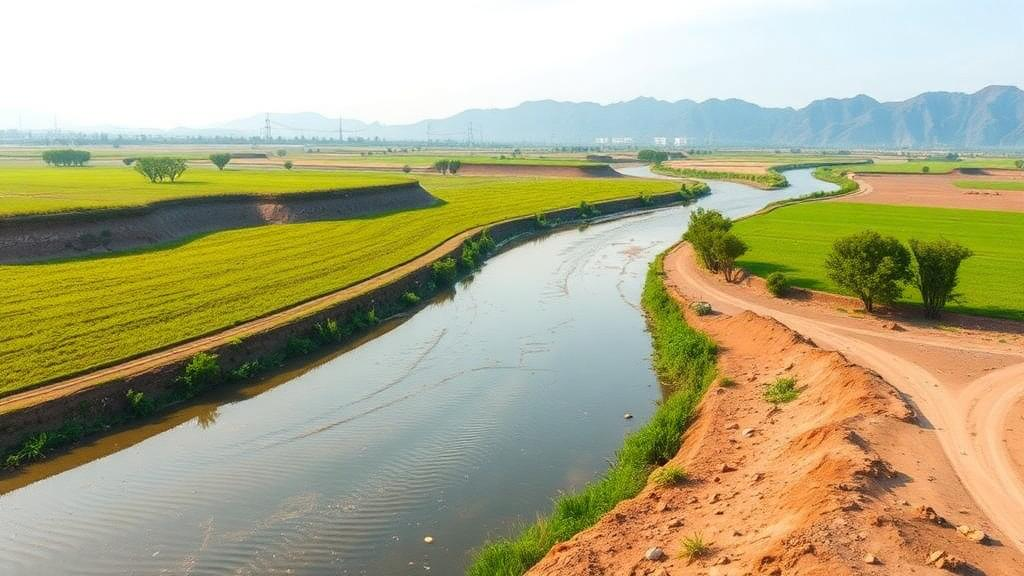
In the arid heart of northwestern China, where annual evaporation can exceed precipitation by more than five times, every cubic meter of water counts. Now, researchers at Gansu Agricultural University have built a hybrid statistical model that forecasts agricultural water use in the Heihe River Basin with remarkable precision, achieving a coefficient of determination of 0.997 and a mean absolute percentage error of just 0.495 percent. The study, published in Frontiers in Water, combines principal component analysis with Lasso regression to untangle a web of twenty interacting factors that drive how much water farms consume in one of China’s most water-stressed regions.
The Heihe River Basin, the second-largest inland river basin in China, stretches roughly 821 kilometers from the Qilian Mountains through Zhangye and Jiuquan in Gansu Province before reaching Juyan Lake in Inner Mongolia. Its middle-reach Zhangye oasis contains approximately 95 percent of the basin’s cultivated land, 91 percent of its population, and more than 80 percent of its economic output. This oasis agricultural system is profoundly dependent on irrigation, and agricultural water use has historically accounted for more than 80 percent of total basin water consumption. The tension between food production and water scarcity here is not abstract; it shapes policy, ecology, and livelihoods across the entire watershed.
Between 2001 and 2023, agricultural water use in the basin ranged from 24.01 × 10⁸ to 32.20 × 10⁸ cubic meters, representing 77.26 to 85.72 percent of total water supply. The trajectory was anything but linear. Water use declined steadily by 21.20 percent from 2001 to 2012, then rebounded sharply in 2013, peaking at 32.20 × 10⁸ cubic meters in 2014 before entering a sustained downward trend. By 2022, agriculture’s share of total water supply had fallen to approximately 77 percent, reflecting deliberate shifts in the basin’s water-allocation structure. These stage-dependent adjustments hint at the complex interplay between natural hydrological cycles, economic development, and evolving water-management policies.
Understanding what drives agricultural water use in such a system is notoriously difficult. Precipitation, temperature, evapotranspiration, runoff, cultivated land area, irrigation technology, population, and water-pricing institutions all exert influence simultaneously, and many of these variables are deeply entangled with one another. The research team, led by Chao Xian and Maoding Zhou, found that several groups of indicators had Pearson correlation coefficients exceeding 0.80. Gross domestic product correlated at 0.98 with primary-industry added value, and tertiary-industry output correlated at 0.97 with GDP. Feeding such redundant variables directly into a regression model would produce unstable parameter estimates and inflate the risk of overfitting, particularly with only twenty-three annual observations available.
To address this, the researchers deployed a two-stage modeling strategy. First, principal component analysis transformed the twenty correlated indicators into a smaller set of mutually uncorrelated principal components through orthogonal linear transformation. Eight components emerged, collectively explaining 97.70 percent of the total variance in the original data. The first three components alone accounted for nearly 80 percent of that variance, with the first interpretable as an integrated socioeconomic-development and water-use-structure factor, and the second reflecting total water supply and intersectoral allocation. From this reduced space, fourteen indicators were retained as candidate inputs for the prediction model.
The second stage applied Lasso regression, a linear method constrained by L1 regularization that shrinks weak coefficients toward zero and performs automatic variable selection. The regularization parameter λ was tuned using an expanding-window time-series cross-validation scheme, which preserves the chronological order of the data and avoids future-information leakage that random partitioning could introduce. The optimal λ was 0.02. Under this setting, the model achieved an R² of 0.997, with root mean squared error of 0.152, mean absolute error of 0.114, and mean absolute percentage error of 0.495 percent. The predicted trajectory tracked the observed fluctuations in agricultural water use closely across the entire study period.
To probe which categories of information mattered most, the team conducted ablation analysis, systematically removing groups of variables and re-running the model. Removing the water-resource and water-use-structure variables caused the most dramatic degradation: R² fell from 0.997 to 0.696, RMSE rose from 0.152 to 1.465, and MAPE jumped from 0.495 percent to 4.636 percent. In contrast, removing socioeconomic variables left R² and RMSE essentially unchanged, while removing agricultural production and irrigation variables produced only modest performance shifts. These results indicate that the model’s predictive power stems not from any single indicator but from the combined contribution of multiple information dimensions, with water-resource and allocation variables carrying the heaviest weight.
Ranked by absolute standardized coefficient, the most influential predictors were ecological and environmental water use (−0.317), total population (0.183), water use for forestry, animal husbandry, and fisheries (−0.055), and per capita water use (0.017). The negative coefficient for ecological water use is best understood as an allocation-substitution relationship: under a fixed water supply, more water directed to environmental flows leaves less available for agriculture, rather than implying that ecological restoration directly reduces crop water demand. The positive contributions of population and per capita water use suggest that expanding demand for agricultural products and overall water-use intensity place upward pressure on agricultural consumption. Notably, water-saving irrigation area showed a weak positive association, echoing the well-documented irrigation-efficiency paradox, in which water saved through improved field efficiency can be offset by expansion of irrigated area.
The authors are careful to frame these findings as predictive rather than causal. With only twenty-three annual samples, an R² approaching unity warrants caution regarding overfitting, and the model is best suited for trend reproduction and driver screening rather than extrapolation to unseen conditions. Institutional changes during the study period, including water-resource allocation reforms, groundwater management strengthening, and ecological water-use expansion, may have altered the statistical relationships between socioeconomic variables and agricultural water use over time. Future work incorporating remote-sensing evapotranspiration, crop-specific water consumption, groundwater depth, and water-price data, along with structural-change tests and rolling-window validation, could sharpen the model’s adaptability across policy regimes and climatic variability.
Nevertheless, the implications for water management in arid regions are substantial. The results support shifting agricultural water policy beyond single-purpose engineering solutions toward coordinated strategies involving total water-use control, cropping-structure optimization, and efficiency improvements. Prior studies suggest that optimizing the spatial configuration of crops in the Heihe River Basin could reduce irrigation water requirements by approximately 7.53 percent while improving agricultural returns. By embedding ecological water requirements as explicit constraints in forecasting frameworks, water managers can better align agricultural predictions with basin-wide allocation objectives. As climate change intensifies pressure on inland river basins worldwide, the PCA-Lasso approach offers a transferable, interpretable template for other water-scarce regions grappling with the same fundamental challenge: how to sustain food production when every drop is contested.
Subject of Research: Hybrid PCA-Lasso statistical modeling for forecasting agricultural water use and identifying key predictor variables in the arid Heihe River Basin of northwestern China
Article Title: PCA-Lasso-based forecasting of agricultural water use and identification of key predictor variables in inland river basins of Northwest China
Article References: Xian, C., Zhou, M., Tian, Z., Shi, C., Wang, Y., & Sun, D. (2026). PCA-Lasso-based forecasting of agricultural water use and identification of key predictor variables in inland river basins of Northwest China. Frontiers in Water, 8, Article 1976296. https://doi.org/10.3389/frwa.2026.1976296
Image Credits: AI Generated
DOI: 10.3389/frwa.2026.1976296
Keywords: agricultural water use, Heihe River Basin, principal component analysis, Lasso regression, water resource management, arid regions, irrigation efficiency, machine learning, water scarcity, China, predictive modeling, inland river basins
Cite Scienmag News
Violet Maxwell. (October 15, 2026). AI Model Predicts Farm Water Use With 99.7% Accuracy in China’s Driest River Basin. Scienmag. https://scienmag.com/ai-model-predicts-farm-water-use-with-99-7-accuracy-in-chinas-driest-river-basin/
Violet Maxwell. "AI Model Predicts Farm Water Use With 99.7% Accuracy in China’s Driest River Basin." Scienmag, 15 October 2026, https://scienmag.com/ai-model-predicts-farm-water-use-with-99-7-accuracy-in-chinas-driest-river-basin/. Accessed 15 October 2026.
Violet Maxwell. "AI Model Predicts Farm Water Use With 99.7% Accuracy in China’s Driest River Basin." Scienmag. October 15, 2026. https://scienmag.com/ai-model-predicts-farm-water-use-with-99-7-accuracy-in-chinas-driest-river-basin/


