


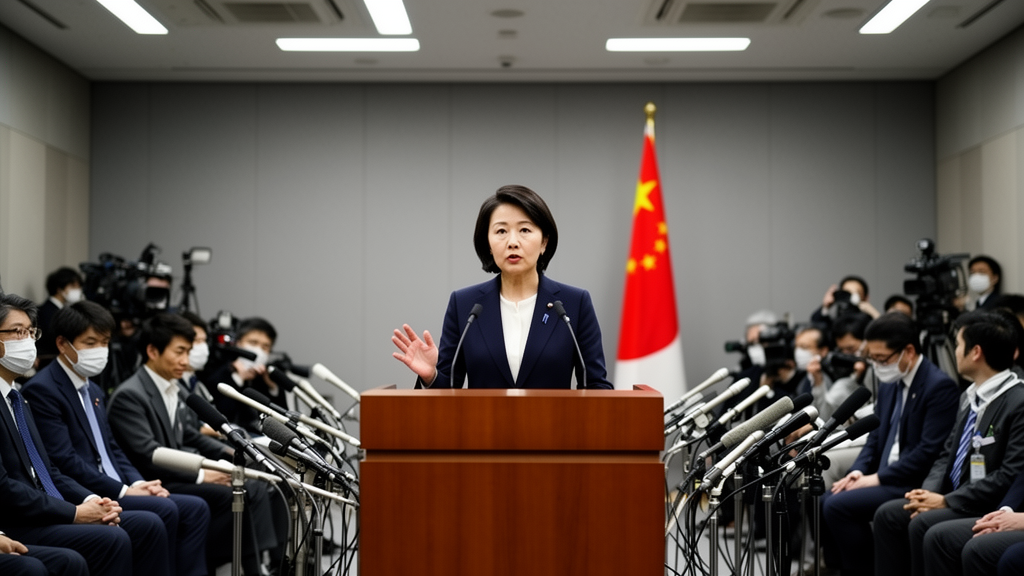
When Prime Minister Takaichi Sanae told the Japanese Diet in November 2025, just three weeks into her premiership, that a Chinese move against Taiwan could constitute a situation threatening Japan’s survival, the remark was widely read as a gaffe — an inexperienced leader straying past the careful ambiguity that had governed Tokyo’s Taiwan posture for half a century. Within days it had triggered a diplomatic crisis with Beijing. Within months it had been followed by an accelerated programme of rearmament, intelligence reform, and arms-export liberalisation. A new study published in Frontiers in Political Science asks whether that opening remark was an isolated incident or the visible edge of a sustained pattern, and, if it was a pattern, whose interest the pattern serves.
The research, conducted by Can Küçükali of Istanbul Rumeli University, applies a framework called Discursive Political Analysis (DPA) to sixteen official texts issued through the Japanese Prime Minister’s Office between October 2025 and May 2026. DPA is a critical discourse analysis method originally developed for studying domestic political hegemony, and its extension to foreign-policy securitisation is itself part of the study’s contribution. The analysis proceeds in three stages: a close reading of three monologic policy speeches to specify how an existential frame is built; a dynamic analysis tracing change, stability, and discrepancy across the whole corpus; and a political analysis that refers the discursive trajectory to its structural conditions.
The corpus was assembled on explicit criteria rather than opportunistically. The starting point is Takaichi’s inauguration on 21 October 2025, so that the unit of analysis is the discourse of the office-holder rather than the candidate. Every official text bearing on Japan’s posture toward China was admitted, while purely domestic texts with no China-relevant security content were excluded. Fifteen of the sixteen texts come from the Prime Minister’s Office in its official English provisional translations; the parliamentary exchange of 7 November 2025 that became the rupture point is drawn from the National Diet Library’s official record of proceedings. The three speeches selected for detailed analysis — the policy speeches of 24 October 2025 and 20 February 2026 and the foreign policy speech delivered in Hanoi on 2 May 2026 — are the monologic texts in which the leader speaks at length without interlocutors.
The October speech, delivered before the rupture, does what the study calls building the container. Its securitising work is embryonic: security is redefined from military defence into a comprehensive register bundling economic, food, energy, and health security under the heading of strategic investments that enhance resilience against potential crises. China appears only once, grouped with North Korea and Russia as a matter of grave concern, and is then repredicated a few lines later as an important neighbouring country with which a constructive and stable relationship is necessary. Crucially, the strongest aggressive phrase in the entire speech — the refusal to tolerate unilateral attempts to change the status quo by force — is reserved for Russia, not China. The vocabulary of aggressive predication already exists; what will change across the corpus is the target to which it is attached.
The February speech, delivered after a landslide election, fills that container. The threat is no longer diffuse. The speech opens its security section by declaring that Japan faces the most severe and complex security environment of the post-war era — a superlative that, the author’s check against the Japanese originals confirmed, is the verbatim formula of the December 2022 National Security Strategy, reactivated rather than invented. The central finding is a migration: the force-formula reserved for Russia in October now attaches to China, broadened by the addition of the words or coercion, which extends the charge from the military to the economic register. North Korea, Russia, and China are merged into one interlinked threat bloc, while the partnership pole contracts to a single ritual formula. The proposition expands from reinforcing defence to a comprehensive transformation: a space-capable reorganisation of the air force, liberalisation of arms exports, a screening mechanism for inbound investment, and a prime-ministerial intelligence council.
The May speech in Hanoi represents the apex of masking. Delivered to a foreign student audience, it never names China once. Instead, it organises an entire regional architecture around a threat it refuses to name, condemning excessive dependence on a single country and market-distorting practices and economic coercion without ever supplying an addressee. The speech routes the three bodies of water China most actively claims — the South China Sea, the Taiwan Strait, and the East China Sea — through a four-hundred-year trade history, naturalising them as historically free routes of exchange. The most concrete containment instruments, patrol vessels and radar offered to front-line partners, sit between passages about semiconductors, lunar rovers, and popular culture. The author reads this indirection not as de-escalation but as audience-appropriate packaging: a Southeast Asian audience that trades heavily with China cannot be asked to endorse a named adversary, so Japan builds the encircling lattice precisely by leaving the name blank.
The dynamic analysis yields the study’s most striking finding, a divergence between two curves. Verbal aggressiveness is zero at the baseline, low and mitigated in October, and rises to its maximum at the November rupture, where the Prime Minister attached the statutory survival-threatening threshold — the legal term for the limited exercise of collective self-defence — to a Taiwan scenario. Disclosed answer materials show the prepared brief advised withholding an answer and did not contain the existential formulation, making the utterance an unscripted escalation. Yet after that peak, the verbal register recedes: by May, China is unnamed. The second curve — the escalation of policy and institutional commitment — rises without interruption across the whole period. The verbal pitch falls while the policy keeps climbing, which the author takes as the clearest evidence that the discourse is an instrument rather than the engine: once it has built the existential frame and manufactured consent for a harder posture, it can lower its voice, because the policy it cleared the way for no longer depends on it. The aggression does not recede; it changes form, passing from the verbal register into the material one, which is harder to reverse.
Three independent change-markers move in the same direction across same-genre texts by the same agent: the dual-track turns asymmetric, the aggression vocabulary migrates onto China and broadens, and the institutional proposition expands and accelerates. The one apparent counter-current — the early peak and later softening of verbal aggression — confirms rather than weakens the pattern reading, because the policy content keeps accelerating while the verbal surface is managed. The study also runs a calibration test against independent threat indicators. Air Self-Defense Force scrambles against Chinese aircraft declined in each of the four fiscal years since FY2021, from 722 to 366 in FY2025, and Chinese Coast Guard presence around the Senkaku Islands, though at a record in 2025, was the smooth continuation of a decade-long trend. Against this declining or continuously rising gradient, the posture moved in steps: the 2 percent spending level, scheduled for fiscal 2027, was pulled forward into fiscal 2025 within days of the inauguration, the revision of the three strategic documents was advanced by a year, and the arms-export principles were revised within six months. The discontinuity in posture matches the change of government, not any change in observable Chinese activity.
The political analysis then adjudicates the study’s central thesis: that the securitisation, voiced in the language of national interest and autonomy, functions as the linguistic instrument of an entrapment binding Japan into a multi-front confrontation serving the United States’ containment of China more than Japan’s own interest. The timing evidence is suggestive — the front-loading of defence spending was announced days before the first summit with the US president, and missile co-production, critical-minerals, and energy commitments were concluded at the Washington summit — while the summit records show commitments flowing in one direction, with no reassurance specific to Japan beyond a general affirmation of the alliance. The author acknowledges the strongest objection, that Japan is a deliberate and autonomous agent making a rational choice to align with a powerful ally. His answer is narrower: entrapment in the alliance-dilemma sense does not require a passive or duped state, only that deepening commitment raises the probability of being drawn into a conflict the state would not independently have chosen. A purely rational balancer would calibrate commitment to threat; the discourse instead maximises commitment on Taiwan, where ambiguity had served Japan, and hardens the posture on North Korea even while the same government pursues a summit with its leader.
The implications reach beyond one government’s rhetoric. By the logic of the security dilemma, a harder posture can invite the very response it anticipates, and on Taiwan the effect is sharper because converting a question long governed by ambiguity into a public commitment narrows the room for crisis management and raises the risk of being drawn into confrontation by inadvertence rather than choice. The study notes its own limits — a seven-month window, a small qualitative corpus, official translations, and a single analyst — and proposes comparative work against the Abe and Kishida periods and cross-national designs with other front-line states. But its conclusion is pointed: the discursive conditions under which a Taiwan crisis could draw Japan, and through Japan the alliance, into a wider confrontation were built quickly and in plain view, and the security that the securitisation claims to defend is partly eroded by the very posture taken in its name.
Subject of Research: Discursive political analysis of Japan's securitisation of China under Prime Minister Takaichi
Article Title: Incident or pattern? A discursive political analysis of aggressive securitisation of China in Japan’s new leadership
Article References: Küçükali, C. (2026). Incident or pattern? A discursive political analysis of aggressive securitisation of China in Japan’s new leadership. Frontiers in Political Science, 8, Article 1919740. https://doi.org/10.3389/fpos.2026.1919740
Image Credits: AI Generated
DOI: 10.3389/fpos.2026.1919740
Keywords: Japan, China, securitisation, discourse analysis, Takaichi Sanae, Taiwan, alliance politics, entrapment, United States, foreign policy, critical discourse analysis, security dilemma
Cite Scienmag News
Daisy Hatcher. (October 15, 2026). How Japan’s New Leadership Turned a Taiwan Remark Into a Pattern of Confrontation With China. Scienmag. https://scienmag.com/how-japans-new-leadership-turned-a-taiwan-remark-into-a-pattern-of-confrontation-with-china/
Daisy Hatcher. "How Japan’s New Leadership Turned a Taiwan Remark Into a Pattern of Confrontation With China." Scienmag, 15 October 2026, https://scienmag.com/how-japans-new-leadership-turned-a-taiwan-remark-into-a-pattern-of-confrontation-with-china/. Accessed 15 October 2026.
Daisy Hatcher. "How Japan’s New Leadership Turned a Taiwan Remark Into a Pattern of Confrontation With China." Scienmag. October 15, 2026. https://scienmag.com/how-japans-new-leadership-turned-a-taiwan-remark-into-a-pattern-of-confrontation-with-china/


