


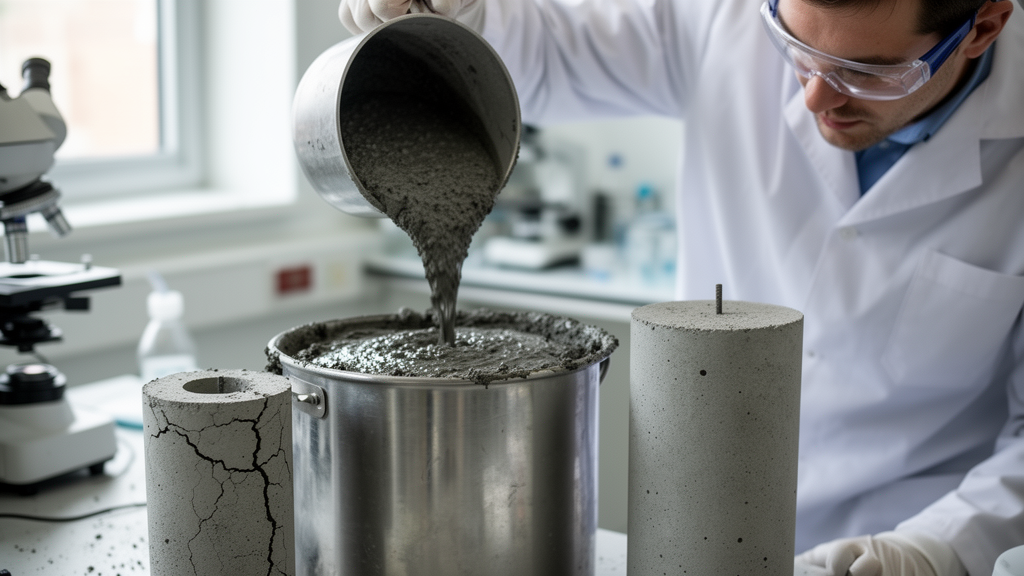
Concrete has carried human civilization for two millennia, yet it remains a stubbornly brittle material, prone to microscopic cracks that quietly spread until structures weaken. Now, engineers at Vellore Institute of Technology in India have shown that a vanishingly small sprinkle of graphene oxide—less than one twentieth of one percent of the cement’s weight—can transform the material’s inner architecture, producing concrete that is measurably stronger and stiffer than the conventional mix. The study, published in Frontiers in Nanotechnology, pairs electron microscopy with computer simulation to reveal exactly how a two-dimensional carbon sheet reshapes the way concrete hardens and bears load.
The research team, led by Vishnu Vardhan Kasibhatla and Mohan Ganesh Gopal of the Department of Structural and Geotechnical Engineering, prepared three concrete mixes: one with no graphene oxide, one with 0.04 percent by weight of cement, and one with 0.08 percent. The graphene oxide itself was characterized before mixing, revealing wrinkled sheets roughly 500 nanometers across and about 5 nanometers thick, with an oxygen content near 21 percent. Those oxygen-bearing functional groups are the secret to the material’s effectiveness, because they give the sheets a strong chemical affinity for the calcium silicate hydrate gel—the glue-like compound that gives concrete its strength.
Getting nanoparticles to spread evenly through wet concrete is notoriously difficult, so the team took careful measures. The graphene oxide powder was weighed on a balance accurate to a thousandth of a gram, stirred into water, and then sonicated for twenty minutes in an ice bath to prevent overheating. A zeta potential measurement of −39.16 millivolts confirmed the resulting suspension was highly stable and well dispersed. Only then was the treated water gradually added to the dry ingredients—ordinary Portland cement, fine aggregate, and coarse aggregate in a mix designed for M25-grade concrete with a water-to-cement ratio of 0.46.
The mechanical results were striking. At 28 days, the concrete containing 0.04 percent graphene oxide reached a compressive strength of 40.6 megapascals, a 30.97 percent increase over the untreated control mix. Even more telling was the pace of that gain: at 7 days, the modified concrete was already 44 percent stronger than the control, suggesting the nanomaterial accelerates early hydration rather than merely strengthening the final product. The 0.08 percent mix also beat the control, but fell short of the lower dosage—a hint that more is not always better when it comes to nanoscale additives.
Scanning electron microscopy explained why. In the control mix at 7 days, the researchers saw loosely packed outer calcium silicate hydrate resembling cloud-like masses, visible gel pores, partially hydrated cement grains, and microcracks concentrated in porous zones. In the 0.04 percent mix, the picture changed dramatically: the calcium silicate hydrate gel appeared denser, with fibrillar crystalline networks that were more interconnected and better bridged across voids. The graphene oxide sheets, the authors conclude, act as nucleation sites—tiny platforms that give hydration products a head start, converting loose outer gel into tighter inner gel and reducing the pore connectivity that normally weakens the matrix.
At 14 and 28 days, the trend continued. The modified concrete showed reticular inner calcium silicate hydrate interwoven with thread-like crystalline fibres, which the researchers interpret as growth templates for further gel formation. Crack initiation within the gel was comparatively rare, indicating improved early-stage matrix integrity. But the 0.08 percent mix told a cautionary tale: localized agglomerations of clustered hydration products appeared, creating morphological irregularities that could concentrate micro-stresses and undermine the very uniformity the nanomaterial is meant to enhance. Excess graphene oxide, in other words, gets in its own way.
To connect these microscopic observations to macroscopic behavior, the team built a three-dimensional finite element model of a 150-millimeter concrete cube in COMSOL Multiphysics. The model treated each mix as a homogeneous, linearly elastic solid, with Young’s modulus derived from the experimentally measured compressive strength, a Poisson’s ratio of 0.2, and a density of 2,400 kilograms per cubic meter. The bottom surface was fully constrained while the top was pushed downward by a prescribed displacement of 0.165 millimeters—enough to keep the material within its elastic range. A mesh sensitivity analysis confirmed the results converged, with reaction forces varying by less than 0.01 percent across successive mesh refinements.
The simulation revealed a clear stiffness hierarchy. Under identical displacement, the control cube resisted with a reaction force of 697.88 kilonewtons, while the 0.04 percent graphene oxide cube pushed back with 798.65 kilonewtons—a 14.44 percent increase that reflects greater resistance to elastic deformation and improved load-bearing capacity. The 0.08 percent mix fell in between at 770.62 kilonewtons. Von Mises stress contours peaked at roughly 7.0 × 10⁷ newtons per square meter for the optimal mix, compared with about 6.0 × 10⁷ for the control, with the sharpest concentrations appearing near the constrained base edges—a boundary effect rather than a material flaw.
The authors are careful about what these numbers mean. Because the elastic moduli fed into the model were derived from the measured compressive strengths, the higher reaction force should be read as complementary numerical evidence of stiffness-dependent elastic behavior, not as an independent prediction of strength. The finite element analysis captures how a stiffer material responds under the same deformation, not how it fails. That distinction matters for engineers hoping to translate laboratory nanomodification into structural design codes, where the difference between stiffness and ultimate capacity is fundamental.
Still, the combined picture is compelling. A dosage of just 0.04 percent graphene oxide—four hundredths of one percent of the cement’s mass—produced a denser, more interconnected hydration network, faster early strength gain, and a stiffer elastic response, while doubling the dose reversed some of those benefits through agglomeration. As graphene oxide production scales up and costs fall, the study suggests that the future of concrete may lie not in pouring more material, but in engineering its microstructure one atomically thin sheet at a time.
Subject of Research: Effect of graphene oxide dosage on the microstructure and elastic mechanical response of concrete, studied by scanning electron microscopy and finite element modelling.
Article Title: Microstructural evolution and elastic response of graphene oxide–modified concrete: SEM and finite element modelling using COMSOL multiphysics
Article References: Microstructural evolution and elastic response of graphene oxide–modified concrete: SEM and finite element modelling using COMSOL multiphysics. (n.d.). https://doi.org/10.3389/fnano.2026.1957798
Image Credits: AI Generated
DOI: 10.3389/fnano.2026.1957798
Keywords: graphene oxide, concrete, cement, calcium silicate hydrate, compressive strength, microstructure, scanning electron microscopy, finite element analysis, COMSOL Multiphysics, nanomaterials, elastic modulus, construction materials
Cite Scienmag News
Neil Sanderson. (October 15, 2026). Graphene Oxide Gives Concrete a Microscopic Makeover, Boosting Strength by Nearly 31 Percent. Scienmag. https://scienmag.com/graphene-oxide-gives-concrete-a-microscopic-makeover-boosting-strength-by-nearly-31-percent/
Neil Sanderson. "Graphene Oxide Gives Concrete a Microscopic Makeover, Boosting Strength by Nearly 31 Percent." Scienmag, 15 October 2026, https://scienmag.com/graphene-oxide-gives-concrete-a-microscopic-makeover-boosting-strength-by-nearly-31-percent/. Accessed 15 October 2026.
Neil Sanderson. "Graphene Oxide Gives Concrete a Microscopic Makeover, Boosting Strength by Nearly 31 Percent." Scienmag. October 15, 2026. https://scienmag.com/graphene-oxide-gives-concrete-a-microscopic-makeover-boosting-strength-by-nearly-31-percent/


