


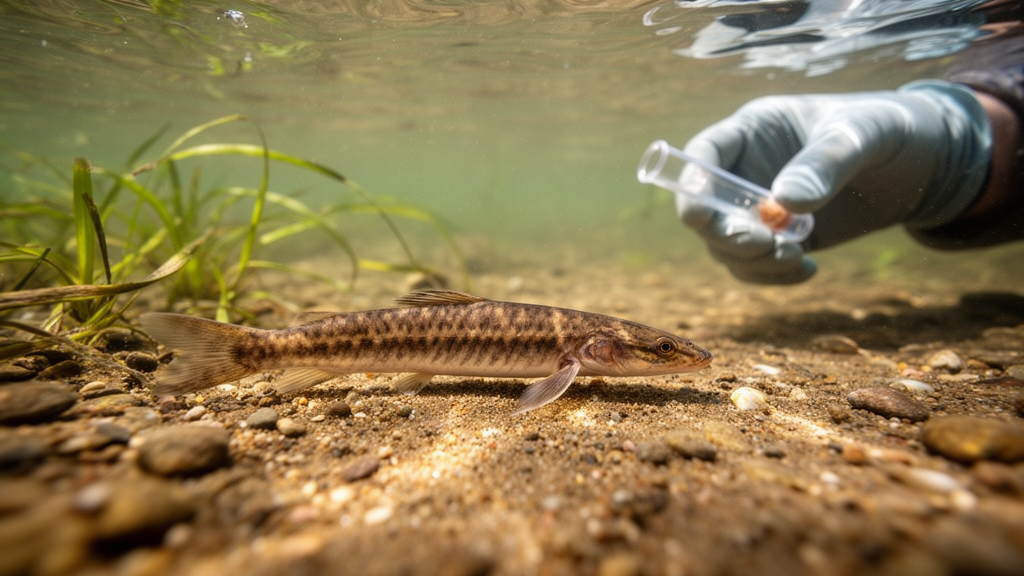
One of Europe’s most elusive freshwater fish is offering conservationists an unexpected lesson in genetics. The European weatherfish, Misgurnus fossilis, is a serpentine bottom-dweller that thrives in shallow, stagnant waters choked with vegetation, and it can even gulp atmospheric oxygen to survive in oxygen-poor ponds. Once widespread from the Volga basin to northern France, the species has vanished from much of its former range as wetlands have been drained, channelised and paved over. A new study published in the journal Nature Conservation has now mapped the genetic diversity of weatherfish populations across the Czech Republic, Austria, Bavaria and adjacent regions, and the results carry a double warning: the species is genetically impoverished overall, yet it harbours distinct regional lineages that could be lost forever if conservation planning ignores them.
The research team analysed 170 specimens from 35 populations, drawing on museum collections in Vienna, Munich, Bonn and Wroclaw as well as the authors’ own samples and sequences from the Barcode of Life Data portal. Two independent genetic markers were employed: the mitochondrial cytochrome c oxidase subunit I gene, or COI, which is inherited only through the maternal line, and the nuclear recombination-activating gene 1, or RAG1, which is inherited from both parents. Using both types of markers is a standard strategy in phylogeography because concordant patterns from independently evolving genomes strongly indicate genuine historical population structure rather than statistical noise or marker-specific artefacts.
The laboratory work followed classic Sanger sequencing protocols. Genomic DNA was extracted from tissue or mucus samples, amplified with the polymerase chain reaction using fish-specific primers, and sequenced on capillary analysers. The nuclear marker posed a particular challenge: the weatherfish genome is tetraploid, meaning it carries duplicated copies of RAG1, and direct sequencing produced numerous heterozygous positions. To untangle this, the researchers cloned PCR products from heterozygous individuals, confirmed the presence of two gene copies, and used computational phasing tools to infer which sequence variants belonged to which allele. Only the more variable copy proved phylogeographically informative and was retained for analysis.
The results were striking in their simplicity. The 656-base-pair COI alignment contained just nine polymorphic sites, about 1.4 percent of the sequence, and yielded only ten haplotypes across 154 specimens. Nucleotide diversity was vanishingly small at 0.00086. The nuclear RAG1 alignment was even less variable, with four variable positions in 947 base pairs producing six alleles among 112 sequences. In the resulting haplotype networks, neighbouring haplotypes differed by at most a single mutational step. Two mitochondrial haplotypes, A and B, and two nuclear alleles, A and B, dominated the dataset, with all rarer variants appearing as single-step satellites derived from these common types.
Geographically, the picture was far from uniform. Every specimen from Bavaria and Austria carried the most common combination, mitochondrial haplotype B paired with nuclear allele B, and this B/B signature also dominated roughly 92 percent of Czech specimens. But populations in the Czech portion of the Oder River basin told a different story. At the locality called Stepan, near the Polish border, all 23 specimens carried haplotype A, and the nuclear alleles found there, including the rare derivatives A1 and A2, were absent from the Danube and Elbe basins. A nearby site at Kunin, close to the watershed divide, showed mixed mitochondrial haplotypes but only nuclear allele A, hinting at secondary contact and asymmetric introgression between lineages.
The agreement between the mitochondrial and nuclear markers is the study’s most important finding. Both genomes independently recovered the same two major genetic groups, with the B/B lineage dominating the Danube and Elbe drainage basins and the A/A lineage predominating in the Oder basin. Because mitochondrial DNA and nuclear genes are inherited differently and accumulate mutations independently, their concordance strongly suggests that this pattern reflects genuine historical separation, most likely rooted in postglacial recolonisation routes, rather than a chance artefact of one particular gene. Notably, the weatherfish lacks the deep phylogeographic splits seen in many other central European freshwater fishes, such as brown trout, stone loach or bitterling, which survived Pleistocene glaciations in multiple isolated refugia and now carry deeply divergent mitochondrial lineages.
Two Slovak populations emerged as genetic outliers that complicate the tidy basin-based picture. At Gajary, on the Morava River, and at a site on the Laborec in the Tisza basin, all individuals carried mitochondrial haplotypes of group C, which appeared nowhere else despite dense regional sampling. Nuclear alleles C and D were likewise found only in these populations. Given the genetic uniformity of neighbouring sites in the same drainage, the researchers consider long-term in-situ persistence of such a distinct lineage unlikely and instead suggest a relatively recent founder event from an unsampled source population. Either way, the finding demonstrates that the species’ overall genetic diversity remains underestimated, particularly in the eastern part of its range.
Not all anomalies are ancient. Two Czech localities in the Elbe basin, the Zehunsky pond in Central Bohemia and Majdalena in the Trebonsko pond system, showed admixture of A and B markers within otherwise genetically homogeneous wetland networks. The researchers argue that a purely historical explanation is implausible given how localised the mixing is, and they point instead to anthropogenic translocation. Both regions have centuries-old traditions of carp aquaculture, and weatherfish are plausibly moved unintentionally along with stocked carp. The absence of A markers in neighbouring wetlands without dispersal barriers supports a recent origin for these mixed populations, a reminder that human activity continues to shuffle fish genetics in ways that can obscure natural patterns.
Compared with other central European freshwater fishes, the weatherfish sits at the low end of the diversity spectrum. Species such as brown trout, bullhead, bitterling, spined loach and minnow exhibit exceptionally high mitochondrial diversity in the region, while vimba, crucian carp and roach show intermediate levels. Only a handful of species, including tench, perch and northern pike, resemble the weatherfish in possessing so few haplotypes. The researchers suggest that historical dispersal during large flood events, particularly in the postglacial period when extensive alluvial wetlands connected river systems, may have been more effective than previously assumed, allowing a few lineages to spread across enormous distances and erasing deeper structure.
For conservation, the implications are urgent. Although overall genetic diversity is low, the species is not genetically uniform, and the geographically structured lineages in the Danube, Elbe and Oder basins, plus the enigmatic Slovak group, should be treated as regional units in management planning. The stakes are rising fast: the Czech Republic has lost 99 percent of its lowland wetlands over the past 180 years, Austria has destroyed 70 to 90 percent of its natural wetlands in two centuries, and recent field observations record rapid declines of small isolated populations, with monitored sites drying out or losing suitable habitat within just a few years and several Austrian populations dying out during recent droughts. Climate projections of increasing heatwaves and drought in Central Europe will only accelerate wetland degradation. A species with low genetic variability, narrow habitat requirements and shrinking refuges faces a compounding extinction risk, and preserving both the remaining wetlands and the genetic integrity of each regional lineage must now become an integral part of any strategy to save this remarkable survivor.
Subject of Research: Genetic diversity and phylogeographic structure of the endangered European weatherfish Misgurnus fossilis in Central Europe
Article Title: Genetic diversity among populations of the endangered European weatherfish Misgurnus fossilis in the Czech Republic, Austria and adjacent areas
Article References: Choleva, L., Bohlen, J., Dvořák, T., Palandačić, A., Jung, M., Chai, M. J., Labajová, V., Bezányiová, K., Pavlica, T., Sember, A., Muška, M., Šmejkal, M., & Šlechtová, V. (2026). Genetic diversity among populations of the endangered European weatherfish Misgurnus fossilis in the Czech Republic, Austria and adjacent areas. Nature Conservation, 65, 99-114. https://doi.org/10.3897/natureconservation.65.190840
Image Credits: AI Generated
DOI: 10.3897/natureconservation.65.190840
Keywords: European weatherfish, Misgurnus fossilis, genetic diversity, phylogeography, COI, RAG1, wetland loss, conservation genetics, Oder basin, Danube basin, Elbe basin, endangered species
Cite Scienmag News
Juliet Wilcox. (October 15, 2026). Endangered Weatherfish Reveals Hidden Genetic Lineages Across Central Europe. Scienmag. https://scienmag.com/endangered-weatherfish-reveals-hidden-genetic-lineages-across-central-europe/
Juliet Wilcox. "Endangered Weatherfish Reveals Hidden Genetic Lineages Across Central Europe." Scienmag, 15 October 2026, https://scienmag.com/endangered-weatherfish-reveals-hidden-genetic-lineages-across-central-europe/. Accessed 15 October 2026.
Juliet Wilcox. "Endangered Weatherfish Reveals Hidden Genetic Lineages Across Central Europe." Scienmag. October 15, 2026. https://scienmag.com/endangered-weatherfish-reveals-hidden-genetic-lineages-across-central-europe/


