


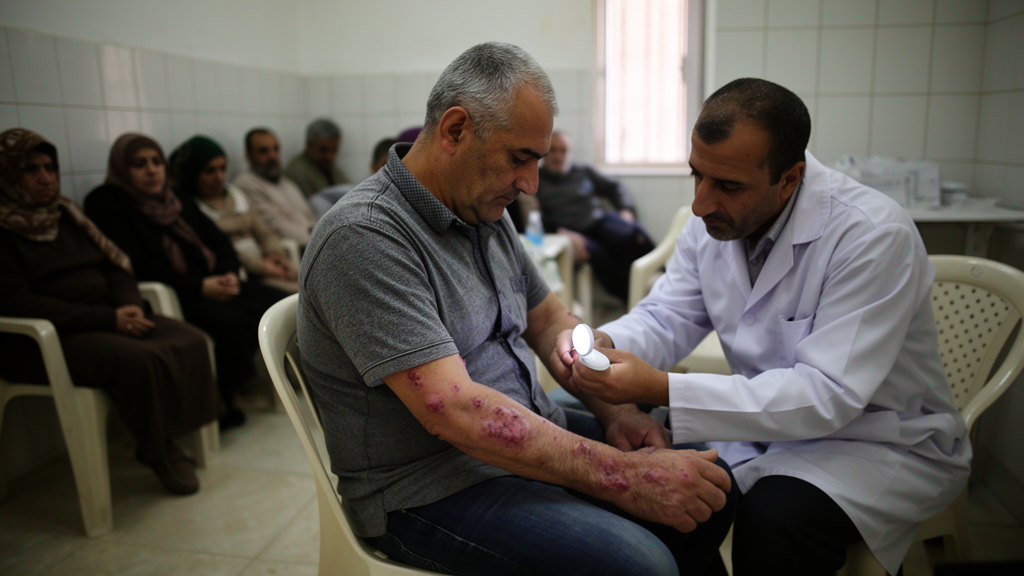
In one of the most striking portraits yet of mental health under active warfare, researchers studying patients at dermatology clinics across the Gaza Strip have found that nearly nine in ten attendees screened positive for extremely severe anxiety, while roughly three quarters showed severe or worse depression, severe stress, and probable post-traumatic stress disorder. The study, published as open-access research in BMC Public Health, offers a rare quantitative window into the entangled fates of skin and mind in a conflict zone, a field known as psychodermatology, where the biology of stress and the biology of skin disease meet.
The research team, led by Farah Elbayoumi of Al-Azhar University Gaza with colleagues from the Islamic University of Gaza, Israa University and Abou Bekr Belkaid University in Algeria, recruited 248 adults attending three governmental dermatology clinics across the Gaza Strip between 15 March and 15 June 2025, in the midst of the 2023 to 2025 Gaza war. Skin diagnoses were established by the attending physician at the point of care, and a trained data collector then administered the questionnaire as a structured interview. Participants completed two widely used psychiatric instruments: the DASS-21, which quantifies depression, anxiety and stress, and the PCL-5, a checklist that screens for probable post-traumatic stress disorder with a conventional positivity threshold of 33 points.
The headline numbers are stark. Overall, 86.3 percent of participants had extremely severe anxiety on the DASS-21. Severe or extremely severe depression affected 76.6 percent of the sample, severe or extremely severe stress affected 76.2 percent, and 74.2 percent screened positive for probable PTSD. For context, in peacetime community surveys, prevalence figures for these conditions typically run to a small fraction of such levels. The authors emphasize that these are clinic attendees rather than a general population sample, so the burden reflects people unwell enough to seek dermatological care during a war, but even with that caveat the scale of distress is exceptional.
The study’s central analytical finding is that skin and psyche moved together. Skin disease severity correlated significantly with poorer scores across all psychiatric domains, with Spearman correlation coefficients ranging from 0.21 to 0.32 and all p-values below 0.001. In regression models adjusted for other factors, severe skin disease independently doubled the odds of severe or extremely severe depression, with an odds ratio of 2.05 and a 95 percent confidence interval of 1.10 to 3.80, and independently doubled the odds of severe or extremely severe stress, with an odds ratio of 2.05 and a confidence interval of 1.09 to 3.86. The mechanism the researchers invoke is a feedback loop long described in psychodermatology: sustained conflict stress dysregulates immune and inflammatory pathways that drive skin disease, while visible, itchy or painful skin lesions in turn amplify psychological distress, each condition feeding the other in a continuous cycle.
Diagnostic category mattered as well. Participants with dermatitis, a group of 17 people in the sample, reported the highest unadjusted psychiatric symptom scores across all DASS-21 and PCL-5 domains. After the authors applied false-discovery-rate correction to their bivariate disease-type comparisons, only the depression and PCL-5 differences remained statistically significant, with corrected p-values of 0.041 and 0.028 respectively. The anxiety and stress differences did not survive correction, with corrected p-values of 0.13 and 0.11, and the authors flag them as exploratory. Separately, fungal infection emerged as an independent predictor of severe stress, carrying an odds ratio of 5.65 with a confidence interval of 1.60 to 19.98, a wide interval that reflects the small number of cases but a signal consistent with the idea that chronic, treatment-resistant infections impose a distinctive psychological toll.
Perhaps the most socially revealing finding concerns visibility. Participants were asked how much they worried about others noticing their skin symptoms on a five-point scale, and each one-point increase in that worry independently raised the odds of probable PTSD by 24 percent, with an odds ratio of 1.24 and a confidence interval of 1.00 to 1.52. Sixty-one percent of participants reported concealing their skin condition from others. Intriguingly, concealment itself was not significantly associated with any psychiatric outcome, suggesting that the burden lies less in the act of hiding than in the anticipatory fear of being seen, a form of appearance-related stigma that operates even in a population facing existential threats on every side.
Methodologically, the team took deliberate steps to guard against over-interpretation in a difficult research environment. Bivariate comparisons across disease types were corrected for the false discovery rate, a statistical safeguard against treating chance findings as real when many comparisons are made. The regression models were checked for internal consistency using Cronbach’s alpha and for multicollinearity using variance inflation factors, diagnostics that confirm the predictor variables carried distinct information rather than redundant signals. Non-parametric tests were used for the skewed symptom scores, an appropriate choice for data that do not follow a normal distribution. Ethical approval was granted by the Health Research Committee at Al-Israa University on 5 March 2025, before recruitment began, and electronic informed consent was obtained from all participants, with participation having no bearing on clinical care.
The authors are candid about the limits of their evidence. The study used a convenience sample of clinic attendees rather than a random population sample, and the final 248 participants fell below the pre-specified target sample size. Cross-sectional design means the data capture a single moment and cannot establish whether skin disease drives psychiatric symptoms, psychiatric symptoms exacerbate skin disease, or, most likely in a war zone, both directions operate simultaneously through shared stress and immune pathways. The authors also note that the article was shared early as a peer-reviewed, accepted version of record in progress, citable with a permanent DOI but subject to further edits.
Even with those caveats, the implications reach beyond Gaza. The authors argue that their findings highlight the potential value of integrated psychodermatology approaches in conflict-affected humanitarian settings, including mental health screening embedded in dermatology clinics, stigma-sensitive counselling, and appropriate referral pathways, all of which they frame as candidates for further evaluation rather than established interventions. The logic is practical as much as scientific: in a health system under siege, dermatology clinics may be one of the few clinical touchpoints still functioning, and a patient presenting with an inflamed skin condition may in fact be carrying an untreated psychiatric emergency that no one has measured.
The study also contributes to a growing scientific literature on how armed conflict disrupts health through sustained stress and immune-related pathways. Chronic psychological stress alters hypothalamic-pituitary-adrenal axis activity and sympathetic output, which in turn modulate inflammatory cytokines, skin barrier function and itch signaling, providing a plausible biological substrate for the correlations observed here. What this study adds is documentation from inside an active war zone, where such evidence has long been scarce, and a demonstration that even in extremis, the old clinical observation holds: the skin and the mind are not separate organs of suffering. For the 248 patients counted in this study, and for the many they represent, treating one without the other may mean treating neither.
Subject of Research: Psychiatric symptom burden among dermatology patients in the Gaza conflict
Article Title: Psychological symptom burden among dermatology clinic attendees during the Gaza conflict: a cross-sectional psychodermatology study
Article References: Psychological symptom burden among dermatology clinic attendees during the Gaza conflict: a cross-sectional psychodermatology study. (n.d.). https://doi.org/10.1186/s12889-026-29885-7
Image Credits: AI Generated
DOI: 10.1186/s12889-026-29885-7
Keywords: psychodermatology, Gaza Strip, armed conflict, mental health, PTSD, depression, anxiety, skin disease, DASS-21, PCL-5, stigma, public health
Cite Scienmag News
Glenn Wilkins. (October 15, 2026). Skin Deep and Wounded: Gaza Dermatology Patients Show Crushing Psychiatric Burden. Scienmag. https://scienmag.com/skin-deep-and-wounded-gaza-dermatology-patients-show-crushing-psychiatric-burden/
Glenn Wilkins. "Skin Deep and Wounded: Gaza Dermatology Patients Show Crushing Psychiatric Burden." Scienmag, 15 October 2026, https://scienmag.com/skin-deep-and-wounded-gaza-dermatology-patients-show-crushing-psychiatric-burden/. Accessed 15 October 2026.
Glenn Wilkins. "Skin Deep and Wounded: Gaza Dermatology Patients Show Crushing Psychiatric Burden." Scienmag. October 15, 2026. https://scienmag.com/skin-deep-and-wounded-gaza-dermatology-patients-show-crushing-psychiatric-burden/


