


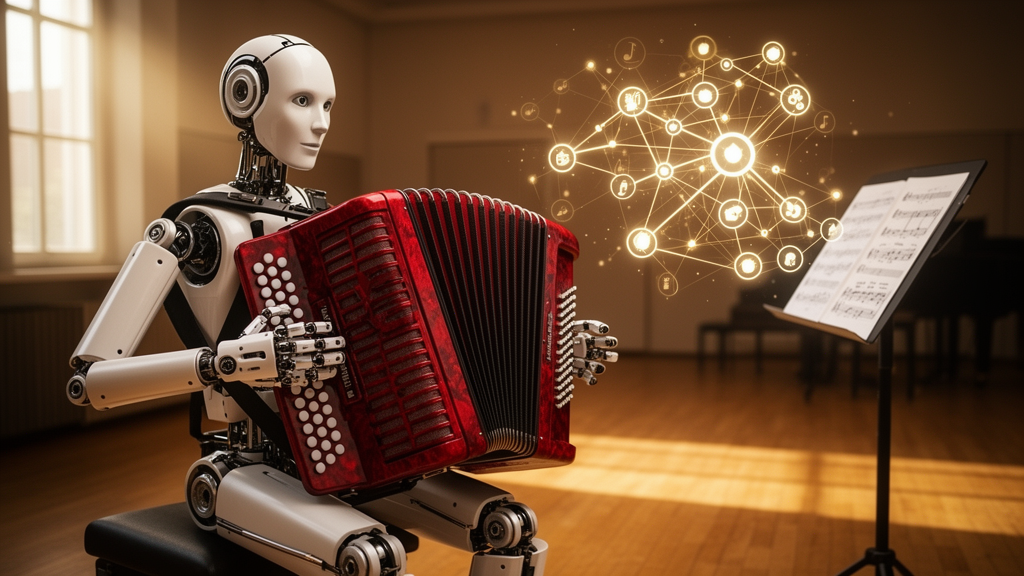
Artificial intelligence can now write symphonies, pop songs, and film scores, but one instrument has stubbornly resisted the algorithmic muse: the accordion. Unlike the piano or guitar, the accordion demands an intricate partnership between two hands that operate under entirely different mechanical logics — the right hand navigating melody while the left hand drives a circular Stradella bass system whose buttons trigger preset chord combinations. On top of that sits the bellows, whose continuously changing air pressure shapes dynamics and articulation in ways that purely data-driven models have struggled to capture. A new study published in Discover Artificial Intelligence by Ming Zhao and Liangfei Dong of Yanshan University proposes an answer that goes beyond simply feeding more data into a neural network: teach the machine music theory itself, and make that knowledge an active participant in every note it generates.
The heart of the framework is a specialized knowledge graph built to encode the structural logic of accordion performance. Formally defined as a set of entities, relations, and triples, the graph represents pitch, duration, bass buttons, accompaniment patterns, modulation paths, and dynamics coupling as interconnected nodes and edges. The researchers concentrated heavily on the accordion’s left-hand Stradella system, capturing its distinctive circular arrangement rule and defining a harmony mapping function that quantifies compatibility between right-hand melodies and left-hand chord entities through cosine similarity weighted across harmonic overtone series. In total, the graph contains 15 entity types and 32 relation types, built from roughly 2,800 manually annotated triples drawn from music theory rules and professional accordion textbooks.
Critical to the graph’s credibility was the annotation process. Two experts with more than a decade of accordion performance experience independently labeled the knowledge elements, and a third expert verified consistency. The team then stress-tested the representation quantitatively: a link prediction task using a translation-based embedding model achieved a Hits@10 score of 89.6 percent on a held-out test set, while expert evaluation of 200 randomly sampled generated sequences found a basic music theory violation rate below 1.2 percent under the graph’s constraints — significantly lower than unconstrained baselines. In other words, the graph does not merely store knowledge; it demonstrably captures learnable, generalizable relationships.
But a knowledge graph sitting beside a neural network does little on its own. The study’s central technical contribution is the Graph-Guided Self-Attention mechanism, or GGSA, which injects the graph’s relational structure directly into the attention computation of a Generative Pre-trained Transformer. For every pair of note entities in the input sequence, the model retrieves the shortest path distance between them in the knowledge graph and converts it into a guidance value that decays exponentially with distance. These values form a bias matrix that is added element-wise to the standard scaled dot-product attention scores before the softmax normalization. The result is that notes connected by strong music-theoretical relationships attend more heavily to one another — the graph’s constraints participate at the token level of generation rather than functioning as shallow post-hoc filters. The authors contrast this with existing knowledge-guided Transformers, which typically concatenate knowledge graph features as external inputs, yielding weak and indirect constraints.
The GGSA also proved computationally tractable. The added operations contribute only about 2 to 3 percent of standard self-attention cost, and the bias matrix can be precomputed and cached, avoiding overhead during inference. To handle the long sequences that accordion compositions demand, the team incorporated Flash Attention, an I/O-aware algorithm that computes attention in blocks and recomputes intermediates on the fly. Memory complexity dropped from quadratic to linear in sequence length; in practical training, peak GPU memory fell from approximately 20.3 gigabytes to 16.9 gigabytes — a reduction of about 17 percent — without sacrificing long-range dependency modeling.
Generating variations on a theme introduces a second challenge: keeping new material recognizably connected to the original melody while still allowing genuine creative departure. The researchers tackled this with a Variation Feature Injection Module (VFIM) that compresses an original phrase into a fixed 256-dimensional motif embedding via a two-layer bidirectional LSTM encoder, then injects that vector into the fourth and sixth decoder layers of the generator through residual connections and a linear affine transformation. A dynamic fusion coefficient controls how closely the variation hugs the theme; after sweeping values from 0.4 to 0.8, the team identified 0.60 as the optimal balance point, while a separate noise coefficient between 0 and 0.3 governs stochastic deviation. Complementing this, a Segment Recurrence Mechanism chains hidden states across segmented sequences, and relative position encoding sharpens the model’s perception of rhythmic patterns and temporal structure.
Because the Nottingham folk music database contains no accordion-specific annotations, the researchers had to build them. An automated matching script traversed MIDI bass tracks and applied the knowledge graph’s harmony mapping function to assign Stradella bass chord labels, producing 21,642 valid left-hand bass annotations, with conflicts resolved manually. Rule templates mapped time signatures such as 4/4 and 3/4 onto bellows push–pull cycles, associating strong beats with increased bellows pressure, while professional performers supplemented missing dynamics labels. A sliding cosine similarity algorithm across four-bar phrases automatically flagged motif boundaries. The dataset was then split 8:1:1 into training, validation, and test subsets.
The results are striking. The full model achieved a perplexity of 3.42 and a harmonic validity rate of 94.8 percent, outperforming baselines including the original GPT, LSTM variants, Music Transformer, MuseScore-ABC Transformer, PopMAG, and MusicGen. For comparison, the MuseScore-ABC Transformer topped out at 92.3 percent harmonic validity, and the Variation Transformer achieved a motif retention rate of only 76.5 percent against the proposed model’s 81.9 percent. All major experiments were repeated five times, with paired t-tests confirming statistical significance at p < 0.01. Ablation studies reinforced each module’s role: removing GGSA dropped harmonic validity to 89.2 percent, removing VFIM sank motif retention to 71.8 percent, and removing the Segment Recurrence Mechanism cut the structural repetition rate from 84.7 to 77.2 percent. Notably, removing GGSA and VFIM together degraded performance more than the sum of their individual losses — evidence of a genuine synergy in which structural constraints stabilize the context for thematic injection.
Subjective evaluation added human weight to the numbers. Twelve trained reviewers, including five accordion performers and seven music theory researchers, judged samples in a double-blind protocol, achieving an intraclass correlation coefficient of 0.86 — well above the 0.75 threshold conventionally regarded as reliable. In a teaching-assistance simulation, three university accordion instructors rated generated variation materials across three pedagogical dimensions with average scores of 4.0, 3.7, and 4.2, suggesting the system could support sight-reading practice and introductory improvisation training. A style consistency test across 20 seed melodies yielded an average interval contour similarity of 0.72 between variations and originals, indicating thematic preservation without noticeable drift.
The authors are candid about limitations. The training corpus consists of symbolic MIDI data that cannot fully represent key-touch intensity, expressive dynamics, or nuanced bellows control, and the knowledge graph is grounded primarily in folk music, leaving jazz, contemporary classical, and non-Western styles untested. Still, the roadmap is ambitious: real-time interactive accompaniment for human–AI collaboration, composition plugins for digital audio workstations that can generate accordion-compatible bass lines and flag harmonic inconsistencies, and integration with large language models to generate pedagogical explanations alongside the music. What the study demonstrates most compellingly is a principle likely to resonate across generative AI: when domain knowledge is woven into the architecture itself — into the very mathematics of attention — machines stop merely imitating and begin to understand the rules that make music coherent.
Subject of Research: Knowledge graph-guided Transformer generation of accordion music and variations
Article Title: Accordion music generation and variation algorithm integrating knowledge graph and transformer
Article References: Accordion music generation and variation algorithm integrating knowledge graph and transformer. (n.d.). https://doi.org/10.1007/s44163-026-02151-w
Image Credits: AI Generated
DOI: 10.1007/s44163-026-02151-w
Keywords: accordion music generation, knowledge graph, Transformer, Graph-Guided Self-Attention, symbolic music generation, artificial intelligence, algorithmic composition, variation generation, music theory, deep learning, Nottingham dataset, bimanual coordination
Cite Scienmag News
Blake Davidson. (October 15, 2026). AI Learns to Play the Accordion by Encoding Music Theory into a Knowledge Graph. Scienmag. https://scienmag.com/ai-learns-to-play-the-accordion-by-encoding-music-theory-into-a-knowledge-graph/
Blake Davidson. "AI Learns to Play the Accordion by Encoding Music Theory into a Knowledge Graph." Scienmag, 15 October 2026, https://scienmag.com/ai-learns-to-play-the-accordion-by-encoding-music-theory-into-a-knowledge-graph/. Accessed 15 October 2026.
Blake Davidson. "AI Learns to Play the Accordion by Encoding Music Theory into a Knowledge Graph." Scienmag. October 15, 2026. https://scienmag.com/ai-learns-to-play-the-accordion-by-encoding-music-theory-into-a-knowledge-graph/


