


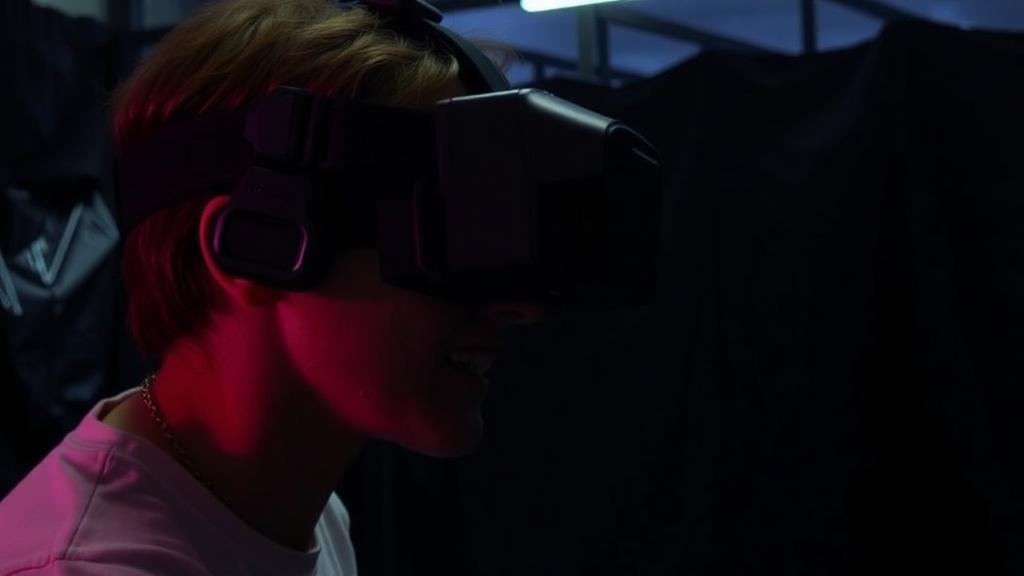
Fear has always been one of the most reliable emotions to provoke in a laboratory. Show someone a frightening image, play a startling sound, or drop them into a virtual horror scenario, and within seconds their nervous system springs into the familiar fight-or-flight posture: the heart quickens, sweat glands activate, and the brain shifts into a state of heightened vigilance. What has been far harder to pin down is what happens when fear is not a single, uniform jolt but a multidimensional experience unfolding across body, mind, and language. A research team from Tecnologico de Monterrey and Universidad Autónoma de Querétaro in Mexico set out to answer exactly that question, and their results, published in Frontiers in Systems Neuroscience, offer one of the most detailed multi-modal portraits of fear recorded outside a conventional laboratory.
The team built a semi-immersive, projection-based environment in which ten healthy adults, aged 18 to 36, moved through four sequential scenes, each lasting three minutes and each designed around a different cognitive dimension of fear. Rather than borrowing standardized affective stimuli from existing databases, the researchers co-created the audiovisual material with creative artists, building scenes that responded in real time to the participant’s own physiology. While participants wore an eight-channel dry-electrode EEG headset from OpenBCI and an Empatica E4 wristband, a parallel stream of their brain and autonomic signals drove adaptive visuals, lighting, and sound. An EEG-based Valence-Arousal-Dominance emotion model, previously trained on the DEAP dataset, calculated a live categorical fear score that made the environment more intense when fear rose and calmer when it fell.
The conceptual scaffolding of the experiment is perhaps its most unusual feature. The four scenes were mapped onto Kantian cognitive dimensions drawn from the philosophy of knowledge. The first scene, Embodied Fear, involved pure physical experience with no language: participants reacted bodily to stressful imagery and sound, their movements altering projection distances and generating sounds. The second, Conceptual Fear, asked them to verbalize which words from a projected word cloud best captured their fear experience, drawing on a recommendation system trained on novels, journalism, social media posts, and essays. The third, Discursive Fear, required them to read aloud text fragments selected by Jaccard similarity to their chosen words, with emphasis and nuance. The fourth, Integrative Fear, closed the loop with a symbolic synthesis: seated participants engaged facially with a projected Vanitas painting while a camera tracked their features and generative AI running on an NVIDIA RTX 3090 modified the imagery.
On the measurement side, the study is a technical tour de force compressed into a small footprint. EEG signals were sampled at 250 hertz from prefrontal, central, parietal, and occipital electrodes, then processed through the standardized PREP pipeline, artifact subspace reconstruction, and independent component analysis with ICLabel to strip out eye, heart, and muscle contamination. Theta, alpha, and beta band power were extracted for each region, along with composite indices of Engagement, Excitement, and Fatigue. The wristband recorded blood volume pulse at 64 hertz and electrodermal activity at 4 hertz, from which the team derived heart rate, ultra-short-term heart rate variability metrics such as SDNN, RMSSD, pNN50, LF and HF power and their ratio, and a battery of skin conductance features including tonic level, phasic response counts, amplitudes, and rise and recovery times. Every feature was z-score normalized against each participant’s own two-minute eyes-open baseline, a crucial step that turns a noisy individual recording into a comparable signal across the group.
After preprocessing, two participants were excluded from the EEG analysis and two from the autonomic analysis, leaving an effective sample of eight, and six for the multi-modal clustering. Despite the small cohort, the statistical strategy was careful: two-sided exact permutation tests with Bonferroni correction compared each scene to baseline, paired Cohen’s d and non-parametric Cliff’s delta quantified effect sizes, and bootstrap-validated hierarchical clustering probed how features organized across modalities. A Mantel test then asked whether the brain and the body, considered as whole distance matrices, moved in any kind of coordinated fashion.
The headline neural finding was remarkably consistent. Frontal beta power rose significantly above baseline in three of the four scenes, Embodied, Discursive, and Integrative, with the largest jump during Discursive fear, where the median normalized beta power at frontal electrodes reached nearly 12 standard deviations above baseline. The prefrontal channels FP1 and FP2 showed significant beta synchronization across those same scenes. Because the frontal lobes sit at the heart of fear-related circuitry, governing cognitive control, decision-making, and action planning, this beta surge points to sustained attentional and executive engagement during threat processing. Parietal alpha, by contrast, dropped below baseline in most scenes, a pattern long associated with heightened visual-spatial attention and emotional processing, and the decrease reached statistical significance at the P7 electrode during the Conceptual scene, an effect that was distinctly left-lateralized.
The derived EEG indices told a complementary story. The Fatigue index, a theta-to-alpha ratio reflecting mental weariness under sustained attention, was significantly elevated in every scene, peaking during Discursive fear. The Excitement index, built on beta relative to alpha, hit its maximum during the Embodied scene, which is precisely where raw sensory and motor engagement dominated. The Engagement index rose significantly during Embodied and Discursive fear but not during Conceptual fear, hinting that abstract reflection on fear engages the mind differently than encountering or enacting it. Together, the researchers argue, these signatures distinguish bottom-up sensory processing, which characterized Embodied fear, from the top-down belief updating and threat salience marking the Conceptual scene, with the Discursive and Integrative scenes blending both modes.
The autonomic picture was messier, and the authors are refreshingly candid about it. Heart rate was descriptively higher than baseline during the first three scenes, with the largest standardized difference during Embodied fear, but none of the heart rate or time-domain HRV comparisons survived correction for multiple comparisons. The strongest autonomic signals appeared in the phasic electrodermal measures during Discursive fear: both the cumulative skin conductance response amplitude and the mean response amplitude reached their maxima there and rose significantly above baseline with very large effect sizes. Intriguingly, the same scene also showed descriptively elevated RMSSD, pNN50, and HF power, markers usually read as parasympathetic dominance, which seems to contradict the sympathetic surge. The researchers suggest the apparent paradox may reflect speech itself: emphatic vocalization simultaneously drives sympathetic activation and reshapes vagally mediated heart rate variability through respiration, and since breathing was not monitored, the mixed pattern may be partly a respiratory artifact rather than a fear signature.
When all three modalities were analyzed together, the results revealed a brain-body system that is coordinated but not tightly fused. Hierarchical clustering organized features primarily by modality, producing robust, separately validated branches for EDA, skin conductance responses, heart rate variability, and EEG, with no significant higher-level connection between the neural and autonomic domains. A weak but statistically significant global EEG-autonomic association emerged from the Mantel test, and exactly one cross-modal cluster achieved bootstrap validation: the pairing of the HRV low-frequency-to-high-frequency ratio with the skin conductance response peak count, a link consistent with the joint sympathetic and parasympathetic regulation of arousal. In other words, brain and body each tell a coherent story about fear, and they rhyme only faintly at the global level.
The study’s limitations are acknowledged plainly by its authors: ten participants is a small cohort, the scenes were always presented in the same fixed order because of their constructive design, and EEG served both as a control signal for the adaptive environment and as the outcome measure, complicating any purely stimulus-driven interpretation. Without matched non-fear control scenes, effects of movement, verbal demand, and audiovisual stimulation cannot be fully disentangled from fear itself. Yet these constraints are arguably the price of ecological validity, and the payoff is a framework that captures fear as it actually unfolds, in an environment that watches, listens, and responds. The team positions the work as a foundation for closed-loop, adaptive paradigms, including the next generation of VR-based exposure therapies for phobias, where physiological signals already drive real-time scenario adjustment. If fear is multidimensional, then treating it, and measuring it, may require exactly this kind of multimodal, immersive machinery.
Subject of Research: Neurophysiological responses to multidimensional fear measured with EEG, heart rate variability, and electrodermal activity in an interactive semi-immersive environment
Article Title: Are you afraid? Neurophysiological responses to multidimensional fear in an interactive semi-immersive environment
Article References: Are you afraid? Neurophysiological responses to multidimensional fear in an interactive semi-immersive environment. (n.d.). https://doi.org/10.3389/fnsys.2026.1908489
Image Credits: AI Generated
DOI: 10.3389/fnsys.2026.1908489
Keywords: fear, EEG, heart rate variability, electrodermal activity, virtual reality, semi-immersive environment, autonomic nervous system, beta waves, alpha waves, psychophysiology, closed-loop neurofeedback, emotion research
Cite Scienmag News
Cassandra Pierce. (October 15, 2026). Inside the Fear Lab: EEG and Wearables Decode How the Brain and Body React to Immersive Terror. Scienmag. https://scienmag.com/inside-the-fear-lab-eeg-and-wearables-decode-how-the-brain-and-body-react-to-immersive-terror/
Cassandra Pierce. "Inside the Fear Lab: EEG and Wearables Decode How the Brain and Body React to Immersive Terror." Scienmag, 15 October 2026, https://scienmag.com/inside-the-fear-lab-eeg-and-wearables-decode-how-the-brain-and-body-react-to-immersive-terror/. Accessed 15 October 2026.
Cassandra Pierce. "Inside the Fear Lab: EEG and Wearables Decode How the Brain and Body React to Immersive Terror." Scienmag. October 15, 2026. https://scienmag.com/inside-the-fear-lab-eeg-and-wearables-decode-how-the-brain-and-body-react-to-immersive-terror/


