


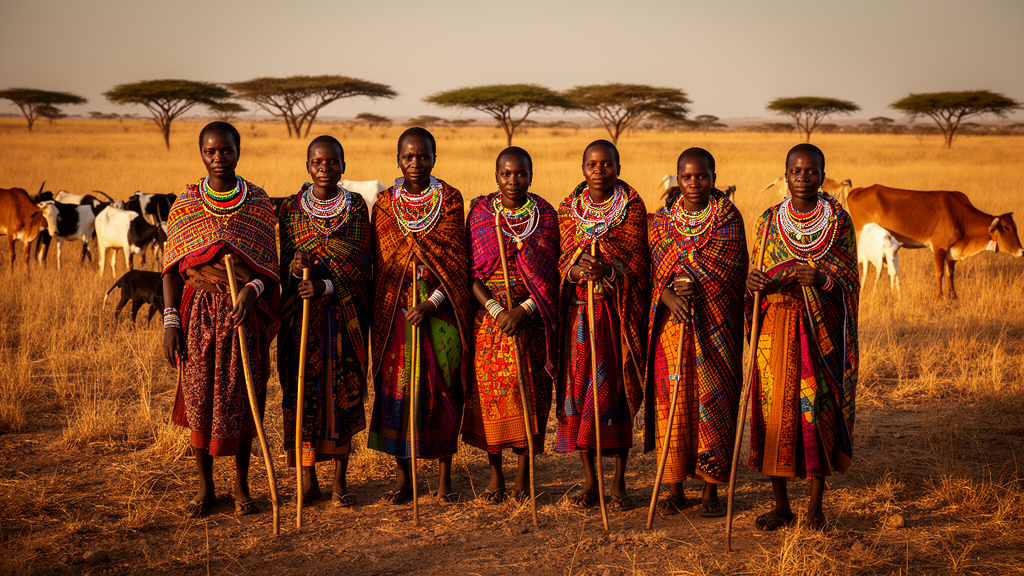
Across the drylands of Africa, more than a hundred million people depend on rangelands that no one owns outright but that millions of households use, manage and defend together. A new study published in the journal Pastoralism challenges one of the most persistent assumptions in land policy: that the surest way to secure women’s rights to land is to put each woman’s name on an individual title deed. Drawing on fieldwork in pastoralist communities in Burkina Faso, Sudan and Kenya, researchers from the International Livestock Research Institute, the Overseas Development Institute, the International Food Policy Research Institute and Tufts University found that women can and do feel strongly secure in their access to land when that access flows through a well-governed collective. In some of the communities studied, women felt just as secure as men, and in one Kenyan community, where women hold real decision-making power, they felt deeply confident about the future of their land rights.
The research team, led by Fiona Flintan of the International Livestock Research Institute, set out to fill a conspicuous gap in how the world measures land security. Global initiatives such as Prindex, which surveyed 107,849 people across 108 countries in its second round completed in 2024, ask individuals whether they could lose their land or property. But these instruments are built around private, individual ownership and largely ignore collective tenure systems, the customary, community-based arrangements that are estimated to cover roughly 3.1 billion hectares of the planet. Rangelands alone span 54 percent of the earth’s terrestrial surface, and virtually all of them are governed as commons, with nested layers of rights allocated to herders, grass cutters, beekeepers, gum collectors and, increasingly, encroaching farmers. For the women who depend on these landscapes, the relevant question is not whether their names appear on a certificate but whether the group’s rights are robust and whether the group will protect them as members.
The study deliberately selected three pastoralist communities known to have well-functioning customary governance: the Wakilé Allah Fulani clan in Zoundwéogo Province, Burkina Faso, numbering around 3,000 people; the Bagagir community of North Kordofan, Sudan, around 2,000 people bound by common ancestry; and the Waldaa Boran of northern Marsabit, Kenya, settled in their area since the early 1980s. Between 2022 and 2023, the researchers ran twelve focus group discussions, mixed and sex-segregated, involving 18 participants in Burkina Faso, 33 in Sudan and 23 in Kenya. Sessions began with participatory mapping of grazing lands and moved on to a technique more familiar from survey research than from village discussion: probabilistic questioning. Participants were asked how likely it was that they would lose their land, or their freedom to move livestock, within one year, five years, ten years, or over a lifetime, and whether their children would inherit the community’s rights of access and mobility.
The answers split sharply along lines that had little to do with formal law and everything to do with social structure. Among the Bagagir in Sudan, most men and women said it was unlikely or very unlikely that they would lose their lands or mobility at any point in their lifetime. The community, which has occupied Rahad el Tamor for more than a century, considers itself asyad elarid, landowners, on the strength of first settlement and four generations of uninterrupted use, even though the land formally belongs to the state. Their confidence rested on three pillars: a strong sense of historical rights, membership in the wider and respected Kababish confederation that can be called upon for support, and an abundance of good grazing land with no mineral deposits to attract competition. In Kenya, the Waldaa also reported strong group cohesion, reinforced by the 2016 Community Land Act, which the community sees as a route to further strengthening tenure because men and women alike can be listed in the registration document. Yet the Waldaa perceived relatively high short-term insecurity, driven not by weaknesses within the group but by the slow pace of land registration and by the unsettling example of the LAPSSET transport corridor, where neighbouring communities in Isiolo have been sidelined from decisions and removed from their land.
The Wakilé Allah of Burkina Faso told a different story. The community arrived only about 45 years ago, after severe droughts pushed them south from northern Burkina Faso, and they live on land ultimately controlled by the chief of their Bissa farmer hosts. Most respondents, including women and youth, said it was somewhat likely or very likely that the group would lose access to its most important grazing land, and its mobility, within the next one to five years. Agricultural encroachment, privatization of peri-urban land, mining, and weak law enforcement were cited as the main threats, and women in particular highlighted weakening social cohesion. Yet in a striking inconsistency, about half of respondents were very confident that their children would inherit community rights, reasoning that educated children would be better placed to defend those rights in the long run. Men held this long-term hope more firmly than women, and younger participants were markedly more pessimistic than their elders, who trusted the village chief’s wisdom and the value of ongoing negotiations.
Beneath these national contrasts, the study uncovered a common technical pattern with major policy implications. Perceived tenure security in these pastoralist systems is produced socially rather than legally. Group solidarity, reciprocity and institutionalized leadership emerged as the protective factors cited by both men and women in all three sites. In Sudan, the social architecture is elaborate: nafir, organized voluntary collective labour for households in need, and fazza, a communal effort to recover stolen animals, keep mutual obligation alive, while widowed and unmarried women receive support from relatives and neighbours. In Burkina Faso, pastoralists have united to protest encroachment on their lands, and both men and women said open dialogue with host communities was among the most important factors preventing the loss of their rights. When those dialogues weakened, perceived insecurity rose. The researchers found that women often placed even greater emphasis than men on cohesion and communication as the sinews of tenure security.
The findings push back against the standard narrative in which pastoralist women are portrayed simply as victims of male-dominated institutions. In Sudan, although cultural norms restrict young women’s mobility and keep women out of formal decision-making, the women interviewed did not express dissatisfaction; they valued the security the group provided and the certainty of assistance in times of need. In Kenya, Waldaa women go further: they have historically been included in the council of elders as equal and capable members, their land rights are described as a birthright equal to men’s, and this central involvement appears to sharpen their knowledge of threats and opportunities, including the benefits of registration under the Community Land Act. Only in Burkina Faso, where the pastoral system is newer, more precarious and under greater external pressure, did women report less knowledge of tenure issues, less influence over decisions and less confidence in their leaders, though even there they located the principal threat outside the group, in expanding farming, rather than within their own institutions.
The study also documents why the alternative, privatization, can be dangerous for women. In Kenya, women lost out during the dismantling of group ranches, with individual titles granted primarily to men. In India, Maldahari pastoralist women have lost community status as mechanized crop farming displaces pastoral roles. Researchers describe such women as falling between two stools: unprotected by a weakening customary system and unprotected by a formal legal system that never reaches them. Individual titling may deliver short-term reassurance, but over the long term it shrinks the commons, erodes the group and can leave women with less access to shared resources than they had as members of a collective. Meanwhile, growing numbers of unmarried pastoralist women living alone face new vulnerabilities that neither regime adequately addresses.
The authors are careful about the limits of their work. They purposively chose well-governed communities precisely to study collective dynamics relatively undisturbed by leadership conflict or mass outmigration, which means the findings cannot be generalized to contexts of weak governance or active conflict. The reliance on focus groups, without follow-up individual interviews or surveys, leaves room for triangulation in future research, and the study itself notes that even in well-ordered communities some members had ignored group rules and claimed land for individual use, fractures that leaders had to correct. Older participants worried that a more individualistic, market-oriented youth, drawn to gold mining and work abroad, could weaken the social fabric on which security depends, even as those same young people still relied on relatives to fund their ventures.
Nevertheless, the policy conclusions are pointed. Global land indicators and monitoring frameworks should explicitly measure collective tenure and perceptions of security within collectives, rather than relying solely on individual ownership metrics. Interventions aimed at strengthening women’s land rights should prioritize reinforcing collective governance institutions and women’s representation within them, with formalization pursued cautiously and in context. And legal processes such as Kenya’s Community Land Act should be implemented at a pace and in a manner that reinforces, rather than disrupts, customary institutions. As climate change intensifies pressure on the drylands, the study suggests that the most effective shelter for pastoralist women’s land rights may not be a piece of paper with one name on it, but the collective itself, its institutions, its social ties and the channels it opens for women’s voices.
Subject of Research: Pastoralist women's perceptions of land tenure security within collective tenure systems in Burkina Faso, Sudan and Kenya
Article Title: Pastoralist women’s perceptions of tenure security and implications for collective tenure regimes, policies and practices
Article References: Flintan, F., Nassef, M., Sawadogo, I., Sulieman, H., Otieno, K., Langdown, I., Locke, A., Meinzen-Dick, R., & Doss, C. (2026). Pastoralist women’s perceptions of tenure security and implications for collective tenure regimes, policies and practices. Pastoralism: Research, Policy and Practice, 16, Article 16531. https://doi.org/10.3389/past.2026.16531
Image Credits: AI Generated
Keywords: land tenure security, pastoralism, women's land rights, collective tenure, rangelands, customary governance, Burkina Faso, Sudan, Kenya, commons, land indicators, climate resilience
Cite Scienmag News
Courtney Benton. (October 15, 2026). For Pastoralist Women, Security on the Land Comes From the Group, Not a Title Deed. Scienmag. https://scienmag.com/for-pastoralist-women-security-on-the-land-comes-from-the-group-not-a-title-deed/
Courtney Benton. "For Pastoralist Women, Security on the Land Comes From the Group, Not a Title Deed." Scienmag, 15 October 2026, https://scienmag.com/for-pastoralist-women-security-on-the-land-comes-from-the-group-not-a-title-deed/. Accessed 15 October 2026.
Courtney Benton. "For Pastoralist Women, Security on the Land Comes From the Group, Not a Title Deed." Scienmag. October 15, 2026. https://scienmag.com/for-pastoralist-women-security-on-the-land-comes-from-the-group-not-a-title-deed/


