


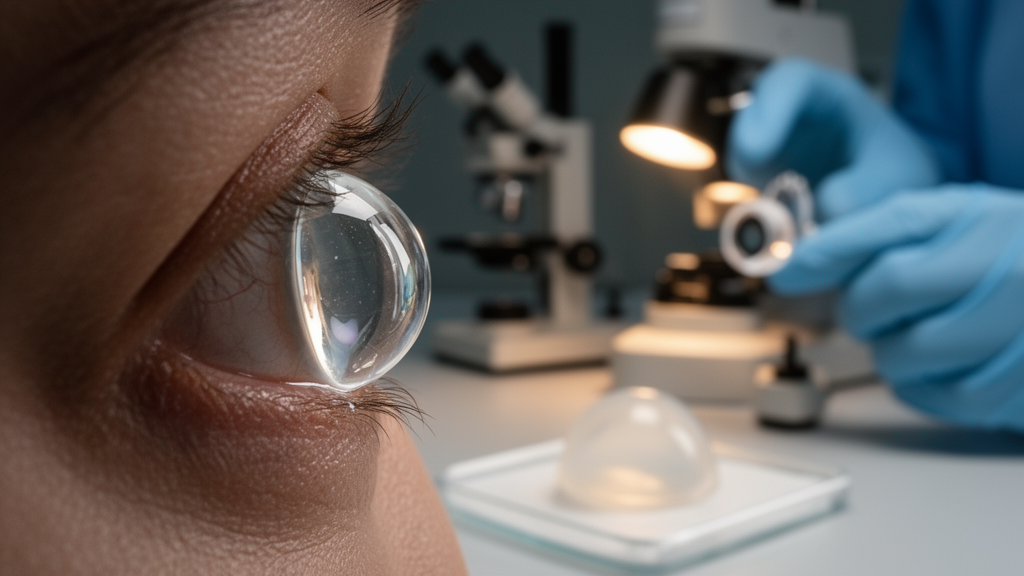
Keratoconus has long been described as a problem of optics: the clear front window of the eye slowly thins, bulges into a cone, and scatters light into glare, halos, and ghosted images. But a growing body of work argues that the real story is mechanical. The cornea is a biological pressure vessel, and in keratoconus its load-bearing scaffolding fails. A new review published in Frontiers in Medical Technology reframes the entire treatment landscape around this idea, arguing that the future of keratoconus care lies not in compensating for a weak cornea but in engineering it back to structural health.
The review, led by Graziana M. Ragonese of the PolitoBIOMed Lab at the Politecnico di Torino together with colleagues in Trieste and Calabria, takes an explicitly biomechanical view of a disease that affects an estimated 0.24 percent of the global population. A recent meta-analysis cited in the paper puts prevalence at roughly 289 cases per 100,000 people, with markedly higher rates in Africa and South Asia. The disease typically announces itself in the teenage years with mild thinning and small refractive errors, then can progress relentlessly for two decades or more. In its wake come photophobia, monocular double vision, and progressive blurring that contact lenses may eventually fail to tame. Between 15 and 20 percent of patients ultimately need a corneal transplant, and the authors are blunt about why that endpoint is problematic: only one donor cornea is available worldwide for every seventy needed, and roughly a tenth of transplants face long-term immune rejection or other serious complications.
That shortfall is the engine driving the search for alternatives. The review’s central insight is a careful separation of four outcomes that clinicians and patients often conflate: stiffening the cornea, flattening its shape, improving vision, and stabilizing the disease. A treatment that improves one does not necessarily deliver the others. Contact lenses, the workhorse of early-stage care, illustrate the point perfectly. Rigid gas permeable lenses, made from silicone-acrylate materials with a Young’s modulus of 1 to 1.9 megapascals, sit over the irregular cornea and form a tear lens that neutralizes irregular astigmatism. They work optically, but they add no intrinsic strength to the stroma, and their rigidity itself can generate excessive contact pressure, epithelial damage, and tear film disruption. Softer hydrogel lenses, at 0.4 to 0.6 megapascals, drape over the cone and often undercorrect. Hybrid, piggyback, and scleral designs vault the cornea to sidestep these problems, yet the review’s verdict is unsparing: lenses manage symptoms, not the disease.
The one established therapy that genuinely changes the cornea’s mechanical properties is corneal collagen crosslinking, or CXL, which the authors describe as the reference treatment for progressive keratoconus. The logic is molecular. The cornea’s shape is maintained by an exquisitely ordered lattice of collagen fibrils, and in keratoconus this organization is disrupted, in part through reduced natural crosslinking. CXL reverses the trend artificially: riboflavin droplets are activated with 370-nanometer ultraviolet-A light, generating reactive oxygen species that forge new covalent bonds between fibrils. In the standard epithelium-off Dresden protocol, 30 minutes of irradiation at 3 milliwatts per square centimeter delivers a total fluence of 5.4 joules per square centimeter. Ex vivo stress-strain testing shows the payoff dramatically, with corneal rigidity increasing roughly 4.5-fold, from a Young’s modulus of 1.3 megapascals to 5.9 megapascals. Long-term studies report sustained stabilization for up to ten years.
Yet even the gold standard has soft spots, and the review dissects them with unusual technical candor. Faster accelerated protocols trade irradiance for time, and pulsed delivery schemes aim to boost oxygen availability during treatment, but direct comparisons between protocols are muddied by differing experimental models and follow-up durations. Transepithelial CXL, which spares the corneal surface to reduce pain and infection risk, pays a steep biomechanical price: tight epithelial junctions limit riboflavin diffusion. In rabbit corneas, epi-on treatment raised the Young’s modulus by about 21 percent, versus roughly 102 percent for the standard approach, which helps explain its weaker record against ectasia progression. Iontophoresis-assisted CXL, using a low-intensity electric current to drive riboflavin through intact tissue, stiffens the cornea less than the standard technique, with a two-year mean keratometry reduction of 2.1 percent compared with 4.3 percent. For very thin corneas, where endothelial safety limits conventional dosing, modified options such as hypo-osmolar riboflavin, contact lens-assisted irradiation, and individualized fluence protocols are expanding the eligible population, though long-term equivalence remains an open question.
The most striking data in the review concern the gap between what we can measure and what we cannot. Intracorneal ring segments, crescent-shaped polymethyl methacrylate implants threaded into stromal tunnels, act as spacers between collagen lamellae, and finite element models show their flattening effect is proportional to segment thickness and inversely proportional to corneal diameter. The implants also stretch strain-stiffening collagen lamellae at the corneal periphery, raising effective structural stiffness. But the measurable result is geometric remodeling, not intrinsic tissue stiffening, and the nomograms that guide segment selection are, the authors note, largely empirical and often based on unpublished clinical data. Reported outcomes vary widely with cone morphology, tunnel depth, and design: Intacs delivered a maximum keratometry reduction of about 3.8 diopters at three years, KeraRing segments showed early migration in around 6 percent of eyes, and Ferrara segments were associated with extrusion in 4.8 percent and disease progression in 26 percent of one cohort.
Two newer players are changing that calculus. The continuous 360-degree MyoRing, inserted into a corneal pocket rather than tunnels, acts as an artificial limbus, redistributing load around the entire periphery and producing more symmetric flattening; comparative studies found greater maximum keratometry reductions than the segmental KeraRing. Meanwhile, corneal allogenic intrastromal ring segments, or CAIRS, replace inert plastic with donor stromal tissue that can integrate biologically, be customized to individual anatomy, and suit thinner corneas, with one-year data showing maximum keratometry falling from 55.85 to 50.69 diopters. Combination strategies capture the complementary physics: implants reshape while crosslinking stiffens. A retrospective series of inferior-segment Intacs with and without CXL found the combined group achieved a mean keratometry reduction of 1.34 diopters versus 0.64 for implants alone, and a best-corrected visual acuity gain of 6.5 lines versus 0.93, though the authors caution that optimal timing and sequencing remain unstandardized.
Beyond the established toolkit, the review maps a regenerative frontier. Cell-based therapies aim to restore the keratocyte population, the principal stromal cells that maintain the extracellular matrix, using corneal stromal stem cells and adipose-derived stem cells; early clinical studies reported favorable safety but only moderate visual and thickness improvements, with little direct biomechanical assessment. Stromal lenticule implantation adds donor or refractive surgery byproducts to restore volume and redistribute stress, sometimes combined with CXL, though small cohorts, short follow-up, and persistent interface haze temper enthusiasm. Tissue-engineered scaffolds of polylactic acid, polyglycolic acid, or biologically derived collagen matrices aim to mimic the extracellular matrix itself, collagen constituting roughly 70 percent of it; early-phase studies of biosynthetic substitutes demonstrated integration, re-epithelialization, and preserved transparency, but challenges of optical clarity, strength, degradation, and long-term stability persist.
Perhaps the review’s most consequential argument is about measurement. If stiffening, flattening, and stabilization are distinct outcomes, then clinical endpoints such as corneal thickness, curvature, and visual acuity are insufficient on their own. The authors call for future trials to incorporate objective biomechanical metrics, including corneal hysteresis, Brillouin microscopy, optical coherence elastography, and patient-specific computational modeling, so that researchers can determine whether a therapy truly reinforces the ectatic cornea or merely improves its shape. The digital twin paradigm, in which a patient’s tomographic, biomechanical, and clinical data feed a personalized model that simulates disease progression and predicts treatment outcomes, is flagged as the likely framework for individualized planning.
The upshot is a field in transition. Keratoconus management has moved from masking a deforming cornea to arresting it with CXL, reshaping it with rings, and now contemplating its biological regeneration. What the Torino-led team makes clear is that none of these steps alone completes the task. The destination they describe is multimodal: stabilizing the tissue mechanically, rebuilding its structure, and regenerating its biology, all guided by predictive models that treat the cornea as what it ultimately is, an engineered structure that can be measured, modeled, and repaired.
Subject of Research: Biomechanical stabilization strategies for the keratoconic cornea, including crosslinking, intrastromal implants, and regenerative therapies
Article Title: Biomechanical stabilization of the keratoconic cornea: a review of current therapeutic strategies
Article References: Biomechanical stabilization of the keratoconic cornea: a review of current therapeutic strategies. (n.d.). https://doi.org/10.3389/fmedt.2026.1919880
Image Credits: AI Generated
DOI: 10.3389/fmedt.2026.1919880
Keywords: keratoconus, corneal biomechanics, collagen crosslinking, intracorneal ring segments, CAIRS, corneal stiffness, contact lenses, stromal regeneration, tissue-engineered scaffolds, digital twin, corneal transplant shortage, Brillouin microscopy
Cite Scienmag News
Denise Maddox. (October 15, 2026). How Engineers Are Rethinking the Failing Cornea in Keratoconus. Scienmag. https://scienmag.com/how-engineers-are-rethinking-the-failing-cornea-in-keratoconus/
Denise Maddox. "How Engineers Are Rethinking the Failing Cornea in Keratoconus." Scienmag, 15 October 2026, https://scienmag.com/how-engineers-are-rethinking-the-failing-cornea-in-keratoconus/. Accessed 15 October 2026.
Denise Maddox. "How Engineers Are Rethinking the Failing Cornea in Keratoconus." Scienmag. October 15, 2026. https://scienmag.com/how-engineers-are-rethinking-the-failing-cornea-in-keratoconus/


