


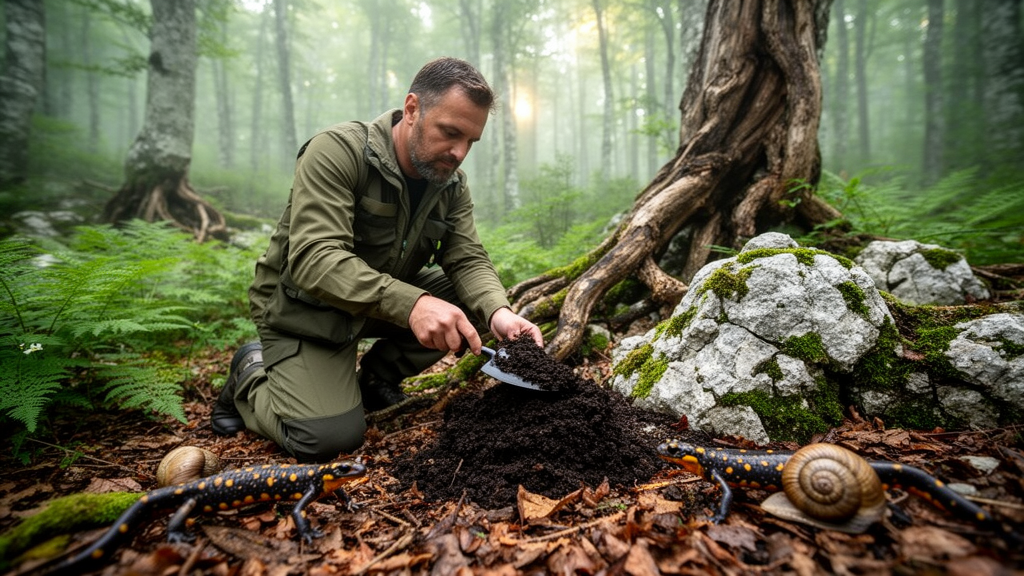
High in the mountains of the Balkan Peninsula, scattered pockets of forest harbor living remnants of the Tertiary period: Serbian spruce, Macedonian pine, and Bosnian pine, tree species that have survived millions of years of climate upheaval in tiny, isolated refuges. A new study published in Frontiers in Forests and Global Change offers the most detailed comparative look yet at the soils beneath these prehistoric survivors, and the results overturn a simple assumption. It is not altitude or bedrock alone that determines what grows in these forests, but an intricate feedback loop between trees, ground vegetation, stand structure, and the shallow earth beneath them.
The research team, led by Aleksandar Popović of the University of Belgrade, established twelve sample plots totaling 3.6 hectares across three representative localities: Veliki Stolac in Bosnia and Herzegovina for Serbian spruce, Beleg in central Serbia for Macedonian pine, and Zeletin in Montenegro for Bosnian pine. All plots sit within strictly protected areas where forestry interventions are prohibited, and all developed on the same limestone substrate, forming shallow calcareous-dolomitic rendzina soils classified as Leptosols. This shared geological foundation proved to be a scientific gift, because any differences between the forests could not be blamed on bedrock.
What the researchers found instead were three chemically distinct soil worlds. The Serbian spruce stands, growing on steep north-facing limestone slopes between roughly 1,165 and 1,200 meters, produced the most striking numbers: humus contents of 48 to 55 percent, total nitrogen between 1.37 and 1.80 percent, and the widest carbon-to-nitrogen ratios of all three sites. Such a wide C/N ratio signals slow decomposition and the accumulation of carbon-rich organic matter, hinting at a soil environment where nutrients are locked up rather than rapidly recycled. The spruce soils also held the most hygroscopic water, consistent with the water-retaining power of abundant organic material.
Macedonian pine told a different story. At Beleg, in the subalpine zone between 1,795 and 1,890 meters where mean annual temperatures hover around just 2.6 to 3.7 degrees Celsius, the soils were the most acidic and the poorest in available nutrients. Phosphorus levels ranged from only 1.15 to 4.45 milligrams per 100 grams, with similarly low potassium. These conditions act as a harsh environmental filter, and the understory flora that persists there, including Arctic-Alpine elements, reflects species tolerant of both cold and nutrient scarcity. Bosnian pine occupied the middle ground chemically, with moderate humus, a less acidic reaction, and an intriguing nutrient imbalance of relatively high phosphorus but very low potassium.
The correlation analysis revealed that these soil properties do not vary independently. One tightly linked group comprised the adsorptive complex parameters, including exchangeable bases, total exchange capacity, and base saturation. A second group bound together organic matter, nitrogen, the C/N ratio, available phosphorus, and hygroscopic water. Strikingly, soil depth ran counter to the second group: shallower soils held more humus, nitrogen, and moisture. In these thin mountain soils, depth is not just a physical attribute but a marker of where organic life concentrates.
Above ground, the three forests were equally distinct. Across all plots the team recorded 152 vascular plant taxa from 31 families, with Bosnian pine stands supporting the richest flora at 102 species. Hemicryptophytes dominated everywhere, but the proportions of chamaephytes rose toward the harsher high-mountain pine sites, and Sub-Mediterranean elements appeared only in the Bosnian pine stands of Montenegro, which receive up to 1,746 millimeters of precipitation annually, mostly peaking in November.
To capture structural diversity in a single measure, the researchers calculated a Forest Structural Complexity Index by standardizing variables such as tree density, basal area, canopy cover, and the Shannon diversity index. Serbian spruce scored highest at +1.42, reflecting tall, dense stands with regular structure and the greatest species diversity indices. Bosnian pine scored lowest at -1.24, but this masked a different kind of richness: its stands showed the greatest variability in trunk diameters and the highest Gini coefficient of heterogeneity at 0.66. The messy, uneven structure of Bosnian pine forest appears to generate a mosaic of microsites, and it is precisely these stands that host the most plant species.
The study’s central conclusion is that no single environmental factor explains these forests. Soil properties and forest diversity emerge from the interaction of orographic conditions, tree species identity, stand structure, and ground vegetation. Tree species are known from broader European research to account for roughly 30 to 36 percent of variation in forest-floor carbon-to-nitrogen ratios, and the contrasting litter inputs of these three relicts plausibly drive their distinctive soil chemistries, which in turn shape what can germinate and survive beneath the canopy.
The implications reach beyond academic curiosity. Serbian spruce survives on a total of roughly 305 hectares with fewer than 30,000 individual trees and is listed as Endangered on the IUCN Red List; at one peat bog site on Mount Tara, only two adult trees remain with no natural regeneration. Macedonian pine is Near Threatened. For such fragmented populations, the authors argue, conservation focused solely on mature trees risks missing the point. Protecting the shallow, organic-rich soils, natural stand structure, and ground vegetation that create suitable regeneration microsites may matter more than any single rescue effort.
Because the study is observational, the proposed feedback mechanisms remain hypotheses awaiting direct tests of litter chemistry, decomposition rates, and microbial activity. But the message from these ancient forests is already clear: the ground beneath a forest is not a passive backdrop. It is a partner in an ancient conversation, and in the Balkans’ refugial conifer woods, that conversation has been running since before the ice ages, in soils often barely deeper than a hand.
Subject of Research: Soil and vegetation relationships in refugial endemic coniferous forests of the Balkan Peninsula
Article Title: Soil–diversity relationships in refugial endemic coniferous forests of the Balkan Peninsula
Article References: Soil–diversity relationships in refugial endemic coniferous forests of the Balkan Peninsula. (n.d.). https://doi.org/10.3389/ffgc.2026.1869703
Image Credits: AI Generated
DOI: 10.3389/ffgc.2026.1869703
Keywords: Serbian spruce, Macedonian pine, Bosnian pine, Balkan Peninsula, refugial forests, soil properties, forest diversity, endemic conifers, Leptosols, plant-soil feedback, forest structure, conservation
Cite Scienmag News
Margaret Porter. (October 15, 2026). Living Fossils of the Balkans Reveal How Soil and Forest Diversity Feed Each Other. Scienmag. https://scienmag.com/living-fossils-of-the-balkans-reveal-how-soil-and-forest-diversity-feed-each-other/
Margaret Porter. "Living Fossils of the Balkans Reveal How Soil and Forest Diversity Feed Each Other." Scienmag, 15 October 2026, https://scienmag.com/living-fossils-of-the-balkans-reveal-how-soil-and-forest-diversity-feed-each-other/. Accessed 15 October 2026.
Margaret Porter. "Living Fossils of the Balkans Reveal How Soil and Forest Diversity Feed Each Other." Scienmag. October 15, 2026. https://scienmag.com/living-fossils-of-the-balkans-reveal-how-soil-and-forest-diversity-feed-each-other/


