


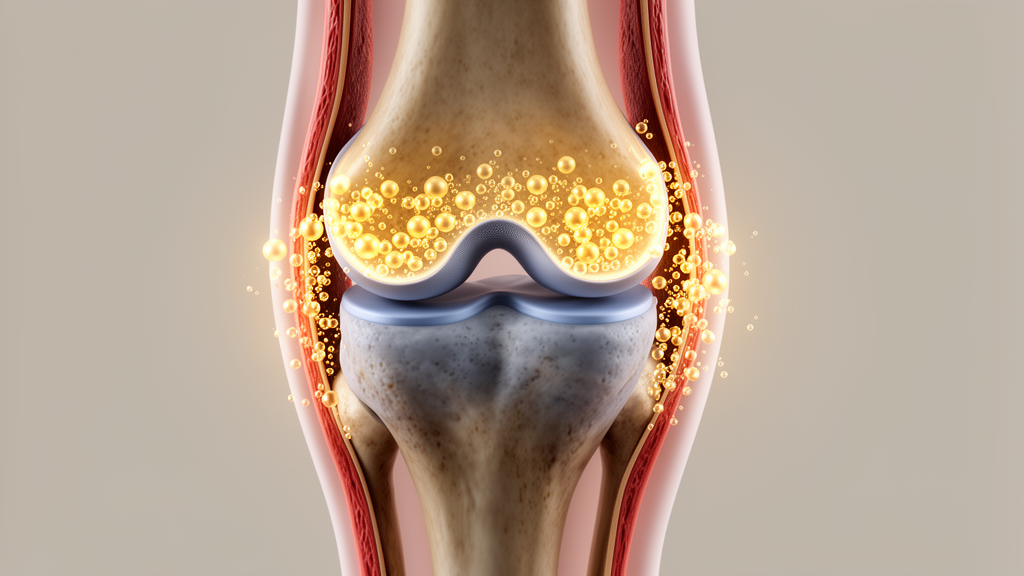
Deep inside the knee, the meniscus has a secret weakness that has frustrated orthopedic surgeons for decades: the inner white zone, where most tears that refuse to heal occur, is almost completely cut off from the blood supply that delivers nutrients. Now a new computational study suggests that the problem may be even more specific than researchers thought. It is not just a general lack of nourishment, but a glucose transport bottleneck so severe that, under realistic conditions, sugar simply cannot diffuse fast enough to reach a tear located just 2.5 millimeters from the vascularized edge of the tissue.
The study, published in Frontiers in Bioengineering and Biotechnology, was conducted by Tiya Patel of the Orthopaedic Research Laboratory at Rutgers Robert Wood Johnson Medical School. Patel built a one-dimensional reaction-diffusion model that simulates glucose traveling from the vascularized red zone at the meniscus periphery toward a simulated deep white-zone tear. The framework treats glucose explicitly as the transported molecule, assigning it a measured diffusivity and a consumption rate, rather than relying on a generic nutrient variable that cannot be tied to real physiology.
The mathematics are grounded in hard experimental numbers. The three native diffusivity values used in the model were drawn from published measurements of apparent glucose diffusion in porcine meniscus fibrocartilage, captured with a one-dimensional steady-state diffusion chamber under three levels of static compression: 20, 10, and 0 percent. Compression matters because squeezing the tissue narrows the pathways through which molecules move. The corresponding diffusivities ranged from 0.79 to 1.68 times ten to the minus ten square meters per second, a span that captures how dramatically everyday joint loading can throttle nutrient delivery.
The results paint a stark picture of transport failure. After four simulated hours, the lower diffusivity case produced a normalized glucose concentration of only 0.044 at the tear site, the reference case reached 0.084, and the uncompressed upper case managed 0.163. Every one of these native scenarios fell below even the lowest fractional comparison level of 0.20 relative to the glucose concentration imposed at the red-zone boundary. Crucially, extending selected simulations to 24 hours did not rescue the situation: the reference case crept up to just 0.127, showing that the deficit was not an artifact of a short simulation window.
Against this baseline, Patel tested an augmented design example combining a four-fold increase in effective diffusivity with a localized sustained glucose-equivalent source centered at the tear, representing a hypothetical scaffold or microchannel-assisted delivery system. The effect was striking. The augmented case crossed the 0.20 comparison level at 65 minutes, 0.30 at 97 minutes, and 0.40 at 151 minutes, ending the four-hour window at 0.468. It was the only condition tested that maintained glucose above the 0.30 level across the full range of tear depths examined.
Just as valuable are the model-derived estimates of how much transport improvement would actually be required. Without any local source, reaching the 0.30 comparison level at a 2.5 millimeter tear within four hours demanded an effective diffusivity roughly 2.63 times the reference value. Adding the local source lowered that requirement to about 2.33-fold. More demanding targets scaled steeply: 3.23-fold for the 0.40 level and 4.56-fold for 0.50. These numbers give scaffold engineers, for the first time, a quantitative yardstick for how radically they would need to restructure tissue transport.
The study is unusually careful about what its numbers do and do not mean. The fractional levels of 0.20, 0.30, 0.40, and 0.50 are explicitly mathematical comparison points, not validated healing thresholds or clinical targets, because no glucose concentration that guarantees meniscal healing has ever been established. The augmented diffusivity case is a model-derived exploration rather than a measured material property, and the consumption rate and source strength are phenomenological values chosen for transparency and later sensitivity testing.
That sensitivity testing reveals how much the balance between supply and demand shapes the answer. When glucose consumption was halved, the required diffusivity enhancement dropped to about 1.59-fold; when consumption doubled, it climbed to roughly 4.12-fold. Release kinetics mattered too. A first-order depletion source delayed comparison-level crossing by a few minutes and lowered the four-hour concentration to 0.445, while a burst-decay source landed at 0.450, confirming that the constant-source case is an optimistic upper bound rather than a prediction for real hydrogels and polymer matrices, which often exhibit burst release and degradation-dependent decline.
The model also passes important internal credibility checks. The finite-difference solver, run on 151 spatial nodes with an implicit scheme, reproduced an analytical steady-state solution with a relative error of just 1.22 times ten to the minus five, and late-time profiles converged to relative changes below one thousandth. An initial-condition sensitivity analysis showed that starting the tissue with a physiological steady glucose gradient instead of a depleted domain left the central conclusion intact: native transport still fell short at the deep tear, while the augmented case held its advantage.
The framework has clear limitations, and the author is candid about them. The one-dimensional radial geometry ignores the meniscus’s three-dimensional wedge shape, its circumferential collagen alignment, anisotropic permeability, and the synovial fluid that bathes the articular surfaces, making the estimates conservative. Vascular remodeling, governed by anti-angiogenic factors such as chondromodulin-I in the inner meniscus, was deliberately excluded. But the real payoff is a roadmap: future ex vivo experiments on human or sheep meniscus explants can now measure whether porous scaffolds, microchannels, or trephination-like pathways deliver the two- to four-fold diffusivity enhancements the model identifies as necessary, replacing abstract comparison levels with measured cell viability, matrix synthesis, and inflammatory markers. For the millions of patients whose white-zone tears refuse to heal, the message is that engineering the transport environment, not just the biology, may be the key design constraint.
Subject of Research: Glucose transport modeling as a design constraint in white-zone meniscus tissue engineering
Article Title: Glucose transport as a design constraint in white-zone meniscus tissue engineering: a reaction-diffusion framework
Article References: Patel, T. (2026). Glucose transport as a design constraint in white-zone meniscus tissue engineering: a reaction-diffusion framework. Frontiers in Bioengineering and Biotechnology, 14, Article 1880978. https://doi.org/10.3389/fbioe.2026.1880978
Image Credits: AI Generated
DOI: 10.3389/fbioe.2026.1880978
Keywords: meniscus, glucose transport, white-zone tear, reaction-diffusion model, tissue engineering, scaffold design, diffusivity, knee repair, avascular zone, computational modeling, release kinetics, orthopedics
Cite Scienmag News
Denise Maddox. (October 15, 2026). Why Deep Knee Meniscus Tears Starve: Glucose Diffusion Emerges as a Hidden Design Constraint for Repair Scaffolds. Scienmag. https://scienmag.com/why-deep-knee-meniscus-tears-starve-glucose-diffusion-emerges-as-a-hidden-design-constraint-for-repair-scaffolds/
Denise Maddox. "Why Deep Knee Meniscus Tears Starve: Glucose Diffusion Emerges as a Hidden Design Constraint for Repair Scaffolds." Scienmag, 15 October 2026, https://scienmag.com/why-deep-knee-meniscus-tears-starve-glucose-diffusion-emerges-as-a-hidden-design-constraint-for-repair-scaffolds/. Accessed 15 October 2026.
Denise Maddox. "Why Deep Knee Meniscus Tears Starve: Glucose Diffusion Emerges as a Hidden Design Constraint for Repair Scaffolds." Scienmag. October 15, 2026. https://scienmag.com/why-deep-knee-meniscus-tears-starve-glucose-diffusion-emerges-as-a-hidden-design-constraint-for-repair-scaffolds/


