


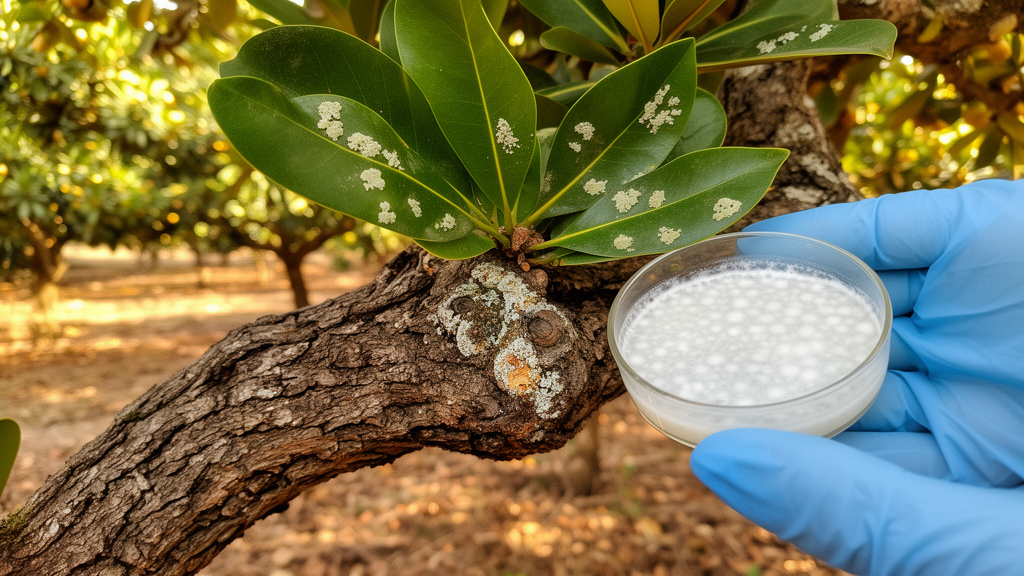
The macadamia nut is often called the king of nuts, prized for its rich flavor, high nutritional value, and growing economic importance across the tropics and subtropics. Yet while plant pathologists have catalogued the diseases that attack macadamia orchards and microbiologists have documented the endophytes living invisibly inside healthy trees, one group of macadamia-associated organisms has remained almost entirely unexplored: the saprobic fungi, the quiet decomposers that colonize dead twigs and stems and set about breaking them down. A new study, published in the journal MycoKeys, offers the most detailed look yet at this overlooked fungal community, and it delivers a series of surprises, from five brand-new species to enzymes with real industrial promise.
Between 2023 and 2024, researchers collected dead and decaying twigs bearing fungal fruiting bodies from macadamia plantations in Yunnan Province in southwestern China and Chiang Mai Province in northern Thailand. These two regions are significant for different reasons. China first introduced macadamia in the 1970s and now accounts for more than 60 percent of the world’s cultivated macadamia area, with Yunnan alone representing 88 percent of that national footprint, making it the largest macadamia-growing region on Earth. Thailand, where the crop was trialed experimentally as early as 1953, has seen rapid expansion of plantations in the north, particularly around Chiang Mai, as domestic consumption and export potential have grown.
Back in the laboratory, the team combined classical morphological examination with modern molecular systematics to work out exactly what they had collected. Under compound and stereomicroscopes they documented the fine details of fungal anatomy: the size and shape of the flask-like fruiting bodies known as ascomata, the layered structure of their walls, the form of spore-producing sacs called asci, and the dimensions, septation, and surface texture of the ascospores themselves. For the molecular work, DNA was extracted from pure cultures, and six genetic loci were amplified and sequenced, including the internal transcribed spacer region (ITS), the nuclear large and small ribosomal subunits (nrLSU and nrSSU), and the protein-coding genes tef1-α, tub2, and rpb2. These sequences were aligned, combined, and analyzed using maximum likelihood and Bayesian inference methods, generating phylogenetic trees for each fungal genus with strong statistical support at the critical nodes.
The results were striking. Eighteen fungal taxa were identified across ten genera and seven families, all within the phylum Ascomycota. Five of these proved to be new to science: Dothiorella lignicola, Lasiodiplodia macadamiae, Palmiascoma macadamiae, Xylochrysis macadamiae, and Xylochrysis yunnanensis. Each was formally described and named according to the International Code of Nomenclature for algae, fungi, and plants, with type specimens deposited in herbaria in China and Thailand and living cultures preserved in culture collections. In several cases, the new species were separated from their closest relatives by a combination of subtle morphological differences and substantial genetic distances. Xylochrysis macadamiae, for example, differs from its nearest known relatives in having larger, semi-immersed fruiting bodies and rough-walled ascospores, along with nucleotide differences of around 7 to 12 percent in key gene regions.
Thirteen previously described species were also recorded from macadamia for the first time, spanning genera such as Sporidesmium, Crassiparies, Chromolaenicola, Montagnula, Pseudochaetosphaeronema, and Helminthosporium. Several of these records were also new geographic findings, extending known distributions across national borders. Perhaps most intriguingly, the sexual reproductive structures of three species, Chromolaenicola ananasi, Pseudochaetosphaeronema siamense, and Helminthosporium nanjingense, had never been observed before; this study documented them for the first time, filling significant gaps in mycological knowledge. Eight of the ten genera encountered had never previously been reported from macadamia anywhere in the world.
One species had a tangled taxonomic backstory. Dothiorella lignicola had been described earlier under a different name, but that earlier name was formally rejected because its original description was based on an incorrect host, species name, etymology, and DNA sequences, a violation of Article 52.1 of the nomenclatural code. The replacement name D. lignicola, referring to the fungus’s wood-dwelling habit, now stands, anchored by a Thai collection whose tef1-α gene sequences differ from its closest relatives by more than 20 base pairs, alongside consistent morphological distinctions such as larger, ovoid conidia.
Identifying the fungi was only half of the study. Because saprobic fungi survive by secreting enzymes that dismantle tough plant polymers, the researchers wanted to know what these macadamia colonizers could actually digest. Twenty pure cultures representing the 18 species were screened on agar plates for four lignocellulolytic enzymes: cellulase, xylanase, mannanase, and laccase. For the first three enzymes, plates containing carboxymethyl cellulose, xylan, or locust bean gum were flooded with Congo red after incubation; where enzymes had broken down the substrate, a clear halo appeared around the fungal colony. Laccase activity was detected instead on guaiacol agar, where the enzyme oxidizes the compound to produce a brownish-red color change. Enzyme output was quantified with an enzyme potency index, calculated from the difference between the halo diameter and the colony diameter, and all experiments were run in triplicate with statistical analysis by one-way ANOVA and Duncan’s multiple range test.
The enzyme screening revealed a community of capable biomass degraders, but with clear patterns of specialization. Xylanase was the most frequently detected activity, produced by 17 isolates representing 15 species, followed by cellulase, found in 14 isolates from 12 species, and mannanase, found in 10 isolates from nine species. Laccase, the oxidative enzyme needed to attack the chemically stubborn lignin fraction of plant cell walls, appeared in only five isolates. The single strongest xylanase producer was the newly described Xylochrysis macadamiae, with an enzyme potency index of 3.50, followed by Sporidesmium tropicale at 3.10. In the cellulase category, two Helminthosporium species dominated, with H. puerense reaching an index of 2.25. Mannanase activity peaked in Pseudochaetosphaeronema puerense at 1.98, while Sporidesmium tropicale led laccase production at 2.20. Only three isolates, Dothiorella lignicola and two Lasiodiplodia species, showed no detectable activity for any enzyme, possibly because their enzyme production fell below the assay’s detection limit or because they preferentially consumed simple sugars available in the medium.
The predominance of xylanase makes ecological sense. Hemicellulose, the xylan-rich matrix that surrounds cellulose fibers in plant cell walls, is less crystalline and more chemically accessible than cellulose itself, so decomposer fungi typically attack it first, gaining access to the more recalcitrant components afterward. Lignin, encrusted around the cellulose in hardwood twigs, requires specialized oxidative enzymes such as laccases and peroxidases, which relatively few ascomycetes produce in quantity. The observed enzyme profile of the macadamia community mirrors this well-known decomposition sequence, and the four isolates that produced all four enzymes tested, including Crassiparies quadrisporus, Pseudochaetosphaeronema chiangraiense, and Sporidesmium tropicale, stand out as particularly versatile degraders.
Beyond their ecological role in recycling carbon, nitrogen, and phosphorus through decaying orchard wood, these fungi have potential commercial value. Lignocellulolytic enzymes are workhorses of industrial biotechnology, used in converting plant biomass to biofuels, in food and feed processing, in pulp and paper manufacture, in textile production, and in environmental bioremediation. The authors suggest that the next steps should include quantitative enzyme assays, optimization of culture conditions, and purification and biochemical characterization of the most promising enzymes. For now, the study’s core message is clear: even beneath one of the world’s most intensively studied nut crops, entire communities of fungi, including species unknown to science, have been quietly waiting on dead twigs, and some of them carry enzymatic toolkits worth far more than their weight in nuts.
Subject of Research: Diversity, taxonomy, and lignocellulolytic enzyme production of saprobic microfungi associated with macadamia in China and Thailand
Article Title: New species and additional records of saprobic microfungi associated with Macadamia in China and Thailand and their lignocellulitic enzyme production
Article References: Zhang, X., Karunarathna, S. C., Tibpromma, S., Senwanna, C., Kumla, J., Du, T.-Y., Elgorban, A. M., Alfagham, A. T., Filimban, F. Z., Dai, D.-Q., & Suwannarach, N. (2026). New species and additional records of saprobic microfungi associated with Macadamia in China and Thailand and their lignocellulitic enzyme production. MycoKeys, 141, 217-281. https://doi.org/10.3897/mycokeys.141.209886
Image Credits: AI Generated
DOI: 10.3897/mycokeys.141.209886
Keywords: macadamia, saprobic fungi, new species, taxonomy, phylogenetics, lignocellulolytic enzymes, xylanase, cellulase, laccase, biotechnology, China, Thailand
Cite Scienmag News
Roger Howard. (October 15, 2026). Fungi Living on Macadamia Trees Reveal Five New Species and a Trove of Industrial Enzymes. Scienmag. https://scienmag.com/fungi-living-on-macadamia-trees-reveal-five-new-species-and-a-trove-of-industrial-enzymes/
Roger Howard. "Fungi Living on Macadamia Trees Reveal Five New Species and a Trove of Industrial Enzymes." Scienmag, 15 October 2026, https://scienmag.com/fungi-living-on-macadamia-trees-reveal-five-new-species-and-a-trove-of-industrial-enzymes/. Accessed 15 October 2026.
Roger Howard. "Fungi Living on Macadamia Trees Reveal Five New Species and a Trove of Industrial Enzymes." Scienmag. October 15, 2026. https://scienmag.com/fungi-living-on-macadamia-trees-reveal-five-new-species-and-a-trove-of-industrial-enzymes/


