


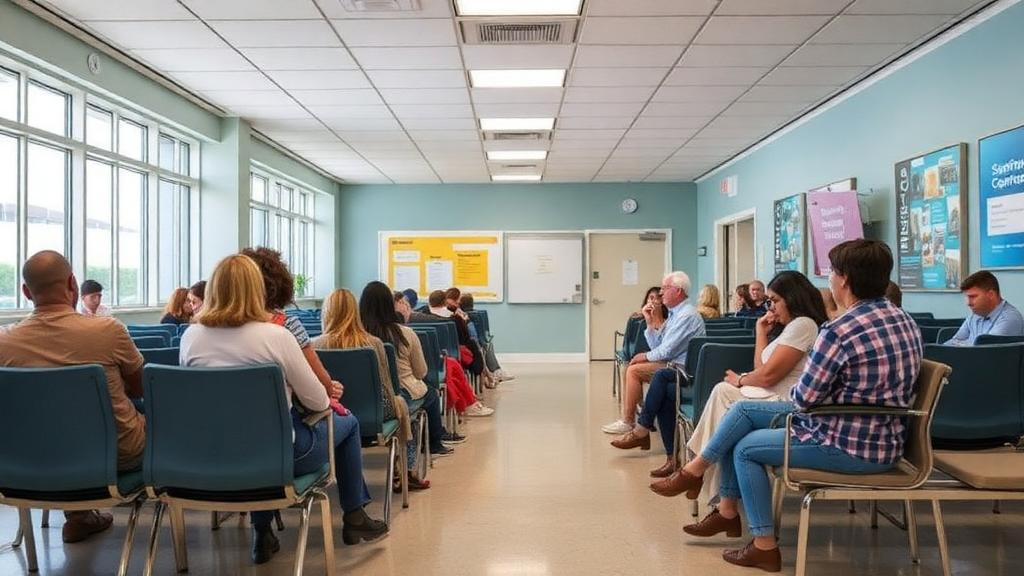
The waiting room of a special education and rehabilitation center is, on the surface, one of the most mundane spaces in institutional life: rows of plastic chairs, a clipboard at the reception desk, the low hum of televisions and the periodic call of a therapist summoning the next child. Yet new research from Türkiye suggests these overlooked corridors are anything but empty. A qualitative case study published in Current Psychology by Erhan Alabay of the University of Health Sciences, Hazal Ersal, and Nuray Oncul of Anadolu University reveals that the parents who sit in these waiting areas week after week are quietly building one another into something resembling a support system, exchanging practical knowledge, emotional sustenance, and in some cases the beginnings of lifelong friendships. The finding reframes an architectural afterthought as an informal psychosocial environment, and it arrives with a practical implication: the design and management of waiting spaces may matter far more than administrators have assumed.
The study set out to examine naturally occurring interactions among parents waiting for their children in special education and rehabilitation centers in Türkiye, conceptualizing those interactions as forms of informal peer support. Unlike formal parent-to-parent programs, which pair families deliberately and structure their contact, the support documented here emerged spontaneously, without facilitators, curricula, or institutional encouragement. That distinction is what gives the research its bite. A growing body of literature, including systematic reviews of peer support interventions for parents of children with disability or chronic illness, has established that structured programs can improve well-being and quality of life. What has been far less visible is whether the same mechanisms operate when nobody organizes them at all, simply because a group of parents happens to share a room and a schedule.
Methodologically, the researchers employed a qualitative case study design, conducting semistructured interviews with 40 parents who regularly remained in institutional waiting areas. Semistructured interviewing allowed the team to anchor each conversation in a common guide, asking parents whether they talked with other families, how close they felt to them, what topics they discussed, and whether these exchanges were beneficial or harmful, while still leaving room for unanticipated themes to surface. The interviews were then subjected to content analysis, a systematic process in which transcripts are coded, categories are derived from recurring patterns in the data, and the categories are refined until they capture the full range of parental experience. The authors report that the analysis converged on three distinct categories of support: informational support, psychological cohesion, and social connection and adjustment.
The first category, informational support, is perhaps the most immediately tangible. Parents in the study described exchanging experience-based information about diagnosis, educational needs, institutional procedures, and legal rights. For families navigating the bureaucratic and clinical labyrinth that often surrounds special education, another parent who has already been through the same steps can be an invaluable guide, translating jargon, flagging pitfalls, and normalizing questions that might otherwise feel too small or too embarrassing to ask a professional. This echoes a consistent finding in the wider literature: studies of information-seeking behavior among parents of children with physical disabilities, and surveys of the sources of information and support used by parents of children with autism spectrum disorders, both indicate that other parents rank among the most trusted and most used information channels, sometimes outranking formal services in perceived relevance.
The second category, psychological cohesion, speaks to the emotional architecture of these encounters. Because the parents in a given waiting room share a profound and often isolating experience, raising a child with special needs, conversations between them carried an unusual density of empathy. Parents reported emotional relief, reassurance, and a sense of belonging that flowed directly from being understood without lengthy explanation. This mechanism is well documented in stress and coping research, which goes back to foundational work by Richard Lazarus and Susan Folkman in the 1980s, and in social science analyses showing that social ties link to health through multiple pathways, including the provision of emotional sustenance and the sense of being comprehended by similar others. In a setting where parents may otherwise feel judged by the general public or emotionally exhausted by caregiving demands, the waiting room becomes one of the few places where understanding is assumed rather than earned. The study’s authors frame this as the waiting area functioning as an informal psychosocial environment, a description that deliberately elevates the space from neutral transit zone to de facto therapeutic setting.
The third category, social connection and adjustment, captures the variable trajectory of these relationships over time. Some parents described repeated encounters that had developed into close and enduring relationships extending well beyond the institutional setting, into phone calls, family visits, and social ties that persisted independently of therapy schedules. Others maintained more limited or superficial interactions, exchanging pleasantries without deeper investment. The researchers are careful to preserve this heterogeneity rather than romanticizing it: not all parents seek close relationships, and the study’s highlights explicitly note that some interactions remain confined to the surface. This matters for interpretation, because the value of the waiting room as a support environment lies not in mandating intimacy but in offering voluntary opportunity. Parents who wanted connection found it; those who preferred privacy could keep their interactions light, and both patterns were represented in the data.
The theoretical grounding of the study draws on ecological perspectives on human development, most notably Urie Bronfenbrenner’s model, which treats the settings surrounding a developing child, including the environments surrounding the child’s caregivers, as interlocking systems that shape outcomes. Seen through this lens, a waiting room is a microsystem in its own right, populated by adults whose stress levels, knowledge, and sense of isolation or belonging feed back into the family system that the child comes home to. Research on parenting stress and family functioning among families of children with disabilities, and on the mediating role of social support in those relationships, suggests that bolstering the caregiver’s emotional resources is not peripheral to the child’s development; it is intertwined with it. Similarly, studies of parental burnout identify chronic, unrelieved caregiving strain as a serious clinical concern, and the empathy and reassurance documented in this study function as precisely the kind of buffer that the burnout literature implies is protective.
The Turkish context adds a layer of specificity without limiting the relevance of the findings. Special education and rehabilitation centers in Türkiye are institutional settings where children typically attend scheduled sessions on a recurring basis, which means parents return to the same waiting area week after week, often for years. That temporal regularity is the engine of the phenomenon: repeated, predictable co-presence allows strangers to become familiar, familiarity to become trust, and trust to become support. The researchers note that waiting areas are conventionally understood as spaces of temporary waiting, and their central reframing is that these spaces may simultaneously function as informal support environments, in which peer interaction can emerge organically and, for some families, durably. The parallel to findings from parent-to-parent support studies in other countries, including qualitative work with Latina mothers in special education systems and large-scale studies of organized parent-to-parent programs, indicates that the underlying dynamic crosses cultural and institutional boundaries even if its triggers are local.
What elevates the study beyond a sympathetic description is its practical recommendation. The authors suggest that institutional waiting spaces could be organized in ways that facilitate voluntary peer interaction while respecting parents who prefer limited social engagement. The phrasing is deliberate: facilitation, not compulsion. In practice, this could mean arranging seating that makes casual conversation possible without forcing it, providing unobtrusive opportunities for parents to share information, and training front-desk staff to recognize when naturally occurring parent networks could be acknowledged or lightly supported. The design principle is opt-in by default, a recognition that the same conditions that fostered support for some parents made others keep their distance, and that both responses are legitimate. Institutions that take this seriously would be treating the waiting area as part of the service itself rather than as dead space between the entrance and the therapy room.
For a finding to land in the public imagination, it helps when the mundane is revealed as meaningful, and few spaces are as universally mundane as a waiting room. The study’s core insight, that support systems can self-assemble in the cracks of institutional life when people with shared experience are given repeated access to one another, resonates far beyond special education. It suggests a low-cost, human-scale resource that has been sitting unnoticed in plain sight: the accumulated expertise, empathy, and solidarity of parents who show up for their children every week. The researchers’ contribution is to have documented that resource with methodological care, named its three dimensions, and pointed institutions toward a simple truth. If the families who need support most are already finding fragments of it in plastic chairs under fluorescent light, then designing waiting areas with that fact in mind may be one of the least expensive and most humane improvements a special education service can make.
Subject of Research: Informal peer support among parents in special education waiting areas
Article Title: Informal peer support in special education waiting areas: a qualitative case study of parents’ experiences
Article References: Informal peer support in special education waiting areas: a qualitative case study of parents’ experiences. (n.d.). https://doi.org/10.1007/s12144-026-10186-6
Image Credits: AI Generated
DOI: 10.1007/s12144-026-10186-6
Keywords: special education, peer support, parents, waiting areas, qualitative research, social support, disability, psychological cohesion, informational support, family stress, rehabilitation centers, informal networks
Cite Scienmag News
Courtney Benton. (October 15, 2026). Waiting Rooms Become Lifelines: Parents of Children in Special Education Forge Powerful Support Networks. Scienmag. https://scienmag.com/waiting-rooms-become-lifelines-parents-of-children-in-special-education-forge-powerful-support-networks/
Courtney Benton. "Waiting Rooms Become Lifelines: Parents of Children in Special Education Forge Powerful Support Networks." Scienmag, 15 October 2026, https://scienmag.com/waiting-rooms-become-lifelines-parents-of-children-in-special-education-forge-powerful-support-networks/. Accessed 15 October 2026.
Courtney Benton. "Waiting Rooms Become Lifelines: Parents of Children in Special Education Forge Powerful Support Networks." Scienmag. October 15, 2026. https://scienmag.com/waiting-rooms-become-lifelines-parents-of-children-in-special-education-forge-powerful-support-networks/


