


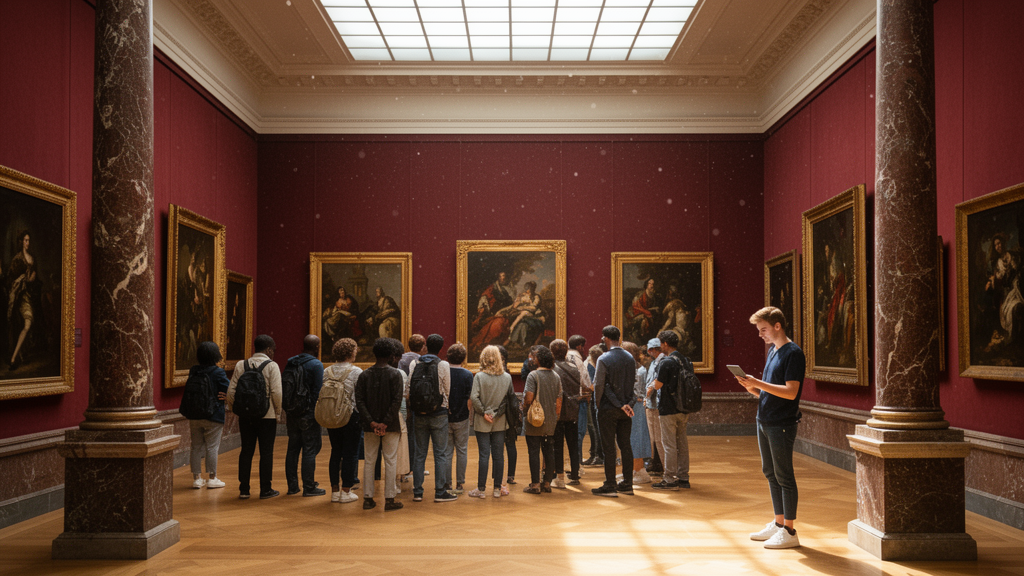
Finland likes to tell itself an egalitarian story. The Nordic welfare state granted women the vote in 1906, well before most of Europe, and its Non-Discrimination Act obliges employers to actively evaluate how equity works in the workplace. Yet a growing body of research complicates that image: Finland has been ranked among the most racist countries in the European Union, surveys show that over 60 percent of music professionals from ethnic minorities have experienced discrimination, and the country’s ongoing colonial practices toward the indigenous Sámi people remain unreconciled. Now, a new study argues that even the policies designed to fix these problems may be quietly perpetuating them, because the very language of diversity carries the imprint of a colonial worldview.
The research, published in the European Journal of Cultural Management and Policy by Lilja Lehmuskallio of the Sibelius Academy at the University of the Arts Helsinki, examines the Finnish Ministry of Education and Culture’s 2023 action plan ‘Art, Culture and Diverse Finland’. The plan sets out measures for the country’s three national arts institutions: the Finnish National Gallery, the Finnish National Theatre and the Finnish National Opera and Ballet. These organisations matter far beyond their box offices. Founded at the end of the nineteenth and start of the twentieth century to forge a Finnish national identity, they remain the official curators of what the nation sees, hears and calls its own.
Lehmuskallio’s central claim is technically ambitious: structural discrimination in the arts cannot be dismantled without examining the epistemology on which policies, institutions and practices are built. She argues that European art institutions rest on what she calls a europatriarchal understanding of difference as hierarchical, a worldview produced by centuries of colonialism that positions white, European, able-bodied, cisgender, heteronormative perspectives as the neutral default and everyone else as the Other. Drawing on decolonial theory, including the well-known warning by Eve Tuck and K. Wayne Yang that ‘Decolonization is not a metaphor’, she insists that diversifying an existing field is not the same as decolonising it, which requires materially disrupting the epistemic and institutional infrastructures that maintain hegemonic power.
To test how these abstractions play out in policy text, Lehmuskallio adapted a four-phase critical discourse analysis tool. First she identified a social question that can be meaningfully approached through language; then she analysed the action plan text and prior policy research; next she examined who wrote the policy and how their power positioning connected to the discourses under study; and finally she searched for discourses that could counteract the dominant ones. The method draws on Michel Foucault’s conception of discourse as a system of knowledge that both reflects and reproduces power. Discourses, in this view, are never neutral: they define what can be said and thought, and thereby shape how material resources flow through the cultural sector. Institutions, in Foucauldian terms, operate as dispositifs, interconnected assemblages of discourse, regulation and practice, that internalise policy language in recruitment, programming and governance.
A telling detail emerged early in the analysis. While the original working group behind the ministry’s 2021 final report included individuals from diverse backgrounds, the action plan itself was written and edited by a senior ministerial adviser, and the measures for each national institution were drafted by the institutions themselves. The result was three starkly different sets of measures: six for the Opera and Ballet, nine for the National Gallery and seventeen for the National Theatre, differing in number, tone and critical depth. As the study notes, following scholarship on policy writing, who is allowed to write what testifies to the real power of the document itself, and policies drafted without diverse epistemologies risk failing the people they are meant to serve.
The analysis identified four discourses threading through the measures. Two of them, the discourse of tolerance and difference-blind universalism and the discourse of tokenism, reproduce hierarchical difference. Tolerance, the study argues, is a nationalist practice of inclusion that reserves the power to permit or deny the Other access to spaces the majority continues to control; phrases like ‘opening doors’ and ‘giving voice’ betray structures still owned by the dominant group. Difference-blind universalism compounds this by treating all diversities as interchangeable, so that stating that cultural diversity ‘is taken into consideration in recruitment’ can mean nothing changes at all. Tokenism, meanwhile, treats marginalised individuals as symbols rather than people, singling out and elevating them above their own groups while leaving structural hierarchies untouched.
The Finnish National Opera and Ballet illustrates the tolerance problem most clearly. Its six measures are brief, impassive and vague, relying only on the terms ‘cultural diversity’ and ‘diversity’, with phrases such as ‘regularly implement diversity training’ and ‘maintain an open diversity discussion’. Because opera and classical ballet still carry the weight of perceived elitism and ongoing struggles with gender equality and misuse of power in leadership, the study argues, stronger measures are needed. Notably, anti-racism is entirely absent from the institution’s measures, a significant omission in the context of recruitment. Encouragingly, the FNOB has developed a four-page representation policy acknowledging problems such as exoticisation and racialisation, and recognising that the institution does not merely reflect society but actively constructs it, but keeping that policy as a separate document outside the public action plan limits its visibility and makes monitoring difficult.
The National Theatre, by contrast, shows how tokenism can hide inside genuine progress. The institution hired Finns born abroad into its ‘Communities and Inclusion’ unit and publicly named a writer-in-residence with a foreign background whose successful production reached the main stage, marking several firsts for Finnish theatre. Yet individuals already othered in Finnish society were thereby placed in the position of transforming institutional structures, often relying on personal experience of the very discrimination they were hired to tackle. Meanwhile, the monitoring report revealed that 0 percent of the theatre’s permanent ensemble of actors came from diverse backgrounds, even after a 2023 recruitment round, because the diversity measure specified no concrete implementation strategy. The National Gallery’s nine measures leaned heavily on accessibility, including safer-space principles, economic access and anti-racism training for all staff, but conspicuously avoided diversity in artistic programming, a gap the study links to collections historically shaped by the assumption that artists are white men.
From this evidence, Lehmuskallio builds a conceptual map connecting systems of inequality to strategies for transformative change. Colonialism, in this account, laid the foundation for europatriarchal norms in which difference is understood hierarchically, producing systemic discrimination in the forms of racism, classism, ableism, sexism, homophobia and transphobia. These structures create barriers to participation that are maintained in institutions through tokenism and difference-blind universalism, rendering marginalised groups absent from recruitment, decision-making and programming, what she terms absent Others. The pathway out begins with the radical deconstruction of colonial knowledge production, proceeds through analysis of discourses to identify embedded privileges and stereotypes, then shifts to decolonial, antiracist, intersectional and accessibility-oriented strategies, ultimately enabling new knowledge systems, policy instruments and institutional reform.
The study’s conclusion is blunt: Finnish cultural policy currently adds diversity into existing systems rather than dismantling the structures that perpetuate hierarchical difference, and policy documents can present an inspirational vision while ultimately preserving the status quo. The emerging discourses of intersectionality and accessibility, rooted in the BIPOC feminist tradition from the Combahee River Collective to Kimberlé Crenshaw’s coining of the term in 1989, offer transformative potential, but remain underdeveloped. What is required is radical inclusion, an approach that does not merely admit marginalised groups into unaltered structures but reimagines and restructures those structures to dismantle discriminatory barriers. As the article closes, quoting Audre Lorde’s famous line, ‘Master’s tools will never dismantle the master’s house.’ For national arts institutions charged with projecting a nation’s identity, that may be the most demanding policy prescription of all.
Subject of Research: Decolonial and intersectional analysis of diversity discourse in Finnish cultural policy and national arts institutions
Article Title: From tolerance and tokenism to radical inclusion: decolonial and intersectional approach to diversity in arts organisations and cultural policy
Article References: Lehmuskallio, L. (2026). From tolerance and tokenism to radical inclusion: decolonial and intersectional approach to diversity in arts organisations and cultural policy. European Journal of Cultural Management and Policy, 16, Article 16054. https://doi.org/10.3389/ejcmp.2026.16054
Image Credits: AI Generated
Keywords: cultural policy, decoloniality, intersectionality, diversity, arts institutions, tokenism, radical inclusion, critical discourse analysis, Finland, racism, museums, accessibility
Cite Scienmag News
Courtney Benton. (October 15, 2026). Diversity policies may be keeping art institutions stuck in the past, study finds. Scienmag. https://scienmag.com/diversity-policies-may-be-keeping-art-institutions-stuck-in-the-past-study-finds/
Courtney Benton. "Diversity policies may be keeping art institutions stuck in the past, study finds." Scienmag, 15 October 2026, https://scienmag.com/diversity-policies-may-be-keeping-art-institutions-stuck-in-the-past-study-finds/. Accessed 15 October 2026.
Courtney Benton. "Diversity policies may be keeping art institutions stuck in the past, study finds." Scienmag. October 15, 2026. https://scienmag.com/diversity-policies-may-be-keeping-art-institutions-stuck-in-the-past-study-finds/


