


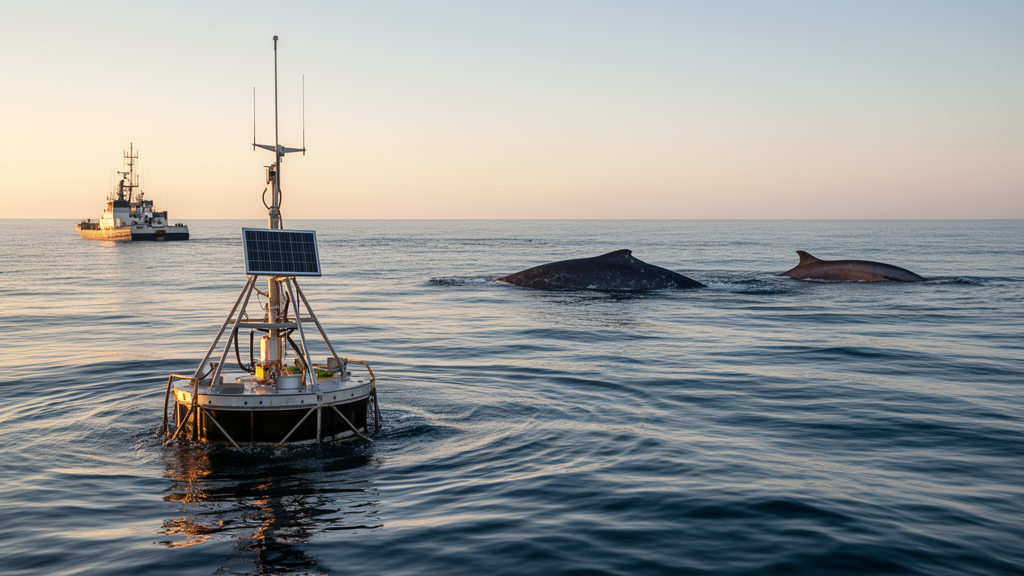
In the murky waters of the Gulf of St. Lawrence, two of the world’s most endangered whales have been hiding in plain acoustic sight. Sei whales and blue whales both produce downward-sweeping calls that overlap so closely in frequency and shape that an automated monitoring system designed to flag one species has been quietly attributing most of the signals to the wrong animal. A new study has now shown that a software and protocol overhaul can untangle the confusion — and the results are striking: false sei whale detections dropped to zero while genuine blue whale detections surged by 89 percent in a single monitoring season.
The research, published in Frontiers in Mammal Science by Kerkeslin MacDonald, Katherine Indeck and Kimberley Davies of the University of New Brunswick, focuses on near real-time passive acoustic monitoring conducted by underwater gliders in the Laurentian Channel, a heavily trafficked shipping corridor linking eastern Canada’s major ports to the rest of the world. Battery-powered Slocum gliders equipped with hydrophones patrol dynamic shipping zones, diving in sawtooth patterns at roughly 0.15 meters per second while continuously recording audio. Every four to six hours they surface and beam a tiny sliver of their acoustic data — pitch-tracked contours derived from spectrograms, capped at about 8 kilobits per hour — to shore via satellite, where trained analysts review the classifications and issue detection scores that can trigger conservation measures.
The bandwidth constraint is the heart of the technical challenge. Because satellite transmission is expensive, analysts never hear the actual audio or see full spectrograms in near real time; they judge whale identity from visual pitch tracks alone. The gliders run a detection engine called the Low Frequency Detection and Classification System, or LFDCS, which compares the attributes of pitch tracks against libraries of exemplar calls for each species. Computationally intensive machine learning is off the table — the platforms are simply too power-limited — so classification quality depends heavily on how well each call library matches the local whale population.
That dependence proved costly for blue whales. Both sei and blue whales produce downsweeping calls in the same 150-to-30-hertz range, but the telltale differences are subtle. Sei whale downsweeps last one to two seconds, span roughly 80 to 30 hertz, and curve upward — concave-up — often arriving in singlets, doublets or triplets separated by intervals of 2 to 3.5 seconds. Blue whales have a broader repertoire: deep infrasonic songs produced only by males, plus audible calls used by both sexes during foraging and contact, including short, medium, steep and long downsweeps and a distinctive arch call. Crucially, blue whale audible calls tend to be concave-down — the mirror image of the sei whale shape — but earlier protocols had no blue whale library to lean on. A precursor analysis found that 97 percent of near real-time sei whale detections were misclassifications, and 91 percent of them contained definite or probable evidence of blue whales.
Fixing this required three simultaneous changes rolled out for the May-to-November 2025 season. First, the team installed a new blue whale audible call library containing five call types, developed from recordings off Newfoundland, Nova Scotia and the Honguedo Strait. Second, the sei whale protocol was made deliberately more conservative: a ‘detected’ score now requires diagnostic doublets or triplets with species-expected inter-note intervals, because archival analysis had shown that stretches containing up to six classified sei whale singlets were actually blue whales. Third, blue whale validation became less restrictive — a single LFDCS-classified call, or even one unclassified concave-down call, could now support a detection, whereas three had been required before. The team compared three 2025 deployments against six deployments spanning 2022 through 2024 across dynamic shipping zones in the gulf.
The numbers tell a dramatic story. Before the update, sei whales were scored ‘detected’ on an average of 3 percent of deployment days; in 2025, the figure was zero, and ‘possible detections’ collapsed from 53 percent of days to just 2 percent. Meanwhile, blue whale detections climbed from 35 percent of deployment days to 66 percent — an 89 percent increase. When the researchers manually reviewed archival audio from every tally period flagged for sei whales in 2025, they confirmed the system’s new restraint: of 14 ‘possible detection’ periods, most were definite or probable blue whales, and the single period judged ‘probable sei whale’ had been correctly flagged in near real time, meaning no genuine sei whale presence was missed. Precision of sei whale possible detections rose from a dismal 0.01 to 0.08.
Beyond fixing the confusion, the study mapped where and when blue whales actually call in the gulf, using generalized linear mixed models across more than 115,000 fifteen-minute monitoring intervals. Detection probability rose steadily through the year, peaking in fall — odds were hundreds of times higher than in spring — and shifted spatially. In spring, detections were more likely in the southeastern zone near the Cabot Strait; by fall the pattern reversed, with the highest probability in the western zone closest to the Lower St. Lawrence Estuary, a known blue whale foraging ground. Audible calls dominated detections in every season, while infrasonic calls — detectable but not classifiable by the LFDCS — were recorded for the first time under a standardized protocol and peaked in fall.
The new call library itself earned a mixed report card. It classified blue whale calls in an average of 35 percent of periods scored as detections, closely matching archival tests, and on 89 percent of the days when blue whales were detected at least one classified call appeared. But three of the five call types were rarely classified, and arch calls — common and stereotyped in the gulf — almost never matched the library’s exemplars, likely because the reference calls came from a different geographic region than the ones whales produced locally. The authors have already compiled a library built exclusively from Gulf of St. Lawrence recordings and plan to test whether regional specificity closes the gap, alongside tuning the system’s prior probabilities toward the acoustically dominant species.
The stakes extend well beyond acoustics. If North Atlantic right whales — which currently trigger mandatory 15-day, 10-knot vessel slowdowns when gliders detect them — are any model, blue whales could one day be folded into the same dynamic management framework. But the study also exposes a governance puzzle: with blue whales now detected on two-thirds of monitoring days and fall detection probabilities exceeding 0.9, right-whale-style dynamic zones would effectively become a permanent speed restriction. Static seasonal zones, used elsewhere for blue whales, may be more practical yet harder to impose on a corridor vital to Canada’s economy. Either way, the authors argue, reliable detection is the precondition for any justifiable conservation action — and after years of the ocean’s largest animals masquerading as one of its rarest, the Gulf of St. Lawrence finally has a listening system that knows which endangered whale is actually speaking.
Subject of Research: Near real-time passive acoustic discrimination of acoustically similar sei and blue whale calls using underwater gliders in the Gulf of St. Lawrence
Article Title: Improving near real-time acoustic monitoring of two endangered whale species that make similar calls
Article References: MacDonald, K. R., Indeck, K. L., & Davies, K. T. A. (2026). Improving near real-time acoustic monitoring of two endangered whale species that make similar calls. Frontiers in Mammal Science, 5, Article 1889531. https://doi.org/10.3389/fmamm.2026.1889531
Image Credits: AI Generated
DOI: 10.3389/fmamm.2026.1889531
Keywords: blue whales, sei whales, passive acoustic monitoring, underwater gliders, Gulf of St. Lawrence, ship strikes, endangered species, LFDCS, call classification, vessel speed restrictions, conservation, Northwest Atlantic
Cite Scienmag News
Margaret Porter. (October 15, 2026). Glider Upgrade Finally Tells Lookalike Calls of Endangered Sei and Blue Whales Apart. Scienmag. https://scienmag.com/glider-upgrade-finally-tells-lookalike-calls-of-endangered-sei-and-blue-whales-apart/
Margaret Porter. "Glider Upgrade Finally Tells Lookalike Calls of Endangered Sei and Blue Whales Apart." Scienmag, 15 October 2026, https://scienmag.com/glider-upgrade-finally-tells-lookalike-calls-of-endangered-sei-and-blue-whales-apart/. Accessed 15 October 2026.
Margaret Porter. "Glider Upgrade Finally Tells Lookalike Calls of Endangered Sei and Blue Whales Apart." Scienmag. October 15, 2026. https://scienmag.com/glider-upgrade-finally-tells-lookalike-calls-of-endangered-sei-and-blue-whales-apart/


