


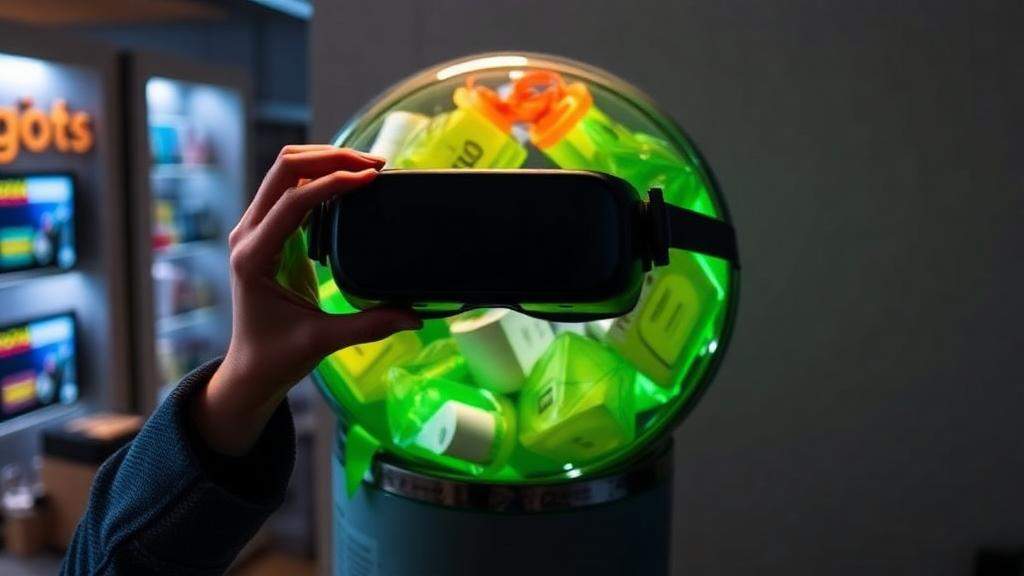
Imagine slipping on a headset and watching a plastic bottle travel through the entire machinery of a circular economy—shredded, reformed, reborn as a new product—before deciding whether to buy it in the first place. That kind of visceral, immersive experience is no longer science fiction, and according to a new scoping review, it may become one of the most unexpectedly powerful tools in humanity’s struggle to stop wasting the planet’s resources. The study, published in Frontiers in Virtual Reality, offers the first comprehensive map of how extended reality, or XR, is being deployed to make the circular economy not just an abstract policy buzzword but something people can actually see, touch, and act upon.
The circular economy, or CE, is a bold rethink of how modern societies use materials. Instead of the traditional linear model—extract, produce, consume, discard—it aims to close material loops by refusing unnecessary products, rethinking consumption, reducing resource use, reusing goods, repairing what breaks, refurbishing what fades, remanufacturing what wears out, repurposing what no longer fits its original role, recycling what cannot serve again, and recovering embedded energy. The problem, researchers at the University of Applied Sciences Ruhr West in Bottrop, Germany, found, is that most members of the public have little to no knowledge of how circular processes might reshape their daily lives, while industries face budget restrictions, knowledge gaps, and regulatory hurdles that stall adoption despite genuine interest. That is where XR—covering virtual reality, augmented reality, and mixed reality—enters the picture.
XR technologies are uniquely suited to making the invisible visible. Virtual reality places users inside fully computer-generated worlds; augmented reality overlays digital information onto the real environment; and mixed reality anchors persistent virtual objects to physical space, allowing them to interact realistically with real-world geometry. Decades of research suggest these tools do more than entertain: they improve understanding, boost knowledge retention, support complex decision-making, and can drive behavioral change in ways that brochures and websites simply cannot. To find out whether that promise is actually being fulfilled in circular economy contexts, Gian Luca Dossena, Lukas Erle, André Helgert, and Sabrina C. Eimler conducted a PRISMA-guided scoping review, combing five major databases—ACM Digital Library, IEEE Xplore, Scopus, SpringerLink, and Web of Science—in a search that initially surfaced a staggering 8,533 records.
After removing 1,718 duplicates, screening titles and abstracts, and subjecting 181 full texts to rigorous eligibility criteria, the team landed on 24 primary studies published between 2015 and 2025, a window that matches the rise of modern consumer XR hardware. Each study was systematically coded along three dimensions: the application domain, the specific circular economy strategy addressed using the well-established 10R framework, and the technological implementation, including hardware, software engines, and whether the work was a deployed application or merely a concept. Crucially, the researchers separated public-oriented applications—those aimed at citizens, students, and consumers—from industry-oriented ones aimed at technicians, engineers, and companies, because these two audiences occupy fundamentally different roles in the transition to circularity.
The results reveal a striking asymmetry. Industry-oriented XR applications for circular purposes are considerably more widespread than those designed for the public. In industrial settings, XR concentrates on four main domains: construction and architecture, product lifecycle management, dismantling and repair, and training. Workers use AR systems that guide technicians through the disassembly of washing machines to recover reusable parts, mixed reality platforms that manage the lifecycle of batteries and rechargeable cells, and digital twins—virtual replicas of buildings and materials—that visualize which steel beams or timber components can be salvaged for reuse rather than demolished. AR overlays provide real-time diagnostic information during maintenance, helping organizations repair rather than prematurely replace expensive assets, directly extending product lifetimes and cutting resource consumption.
On the public side, the picture is narrower but no less fascinating. XR for citizens clusters in four areas: awareness and participation, education and learning, consumption and behavioral change, and everyday resource practices involving water, waste, and food. Researchers have built VR experiences that confront users with the consequences of plastic consumption, AR applications that teach children and students the principles of material cycles, mixed reality systems that visualize circular water management to highlight water waste, and even AR tools that show how plastic waste can be transformed into creative art projects. One multisensory XR platform tackles food spoilage detection, while others encourage more sustainable purchasing and storage practices to reduce food waste. These applications aim less at concrete instructions and more at participation, understanding, and reflection.
The 10R framework analysis exposes an even more revealing pattern. Public-oriented applications addressed only four of the ten circular strategies—Rethink, Reduce, Reuse, and Recycle—which map neatly onto the decisions ordinary people face in daily consumption. Reduce was the most heavily represented, reflecting how household behavior directly shapes production systems and emissions. Industry applications, by contrast, touched nearly every strategy, with Reuse, Repair, and Recycle dominating, because these align with operational activities like inspection, maintenance, and component replacement where XR delivers immediate practical value. One strategy, Remanufacture, was entirely absent from the literature, and Refuse, Reduce, Refurbish, and Repurpose attracted only one or two studies each—clear signals of unexplored territory.
The technical autopsy of these systems tells its own story. Industry developers deploy head-mounted displays such as the Microsoft HoloLens 2, HTC Vive, and Oculus Quest 2, building with engines like Unity and tools including Revit, Autodesk 3ds Max, and the Mixed Reality Toolkit. Public-facing applications lean heavily on smartphones for AR delivery, a pragmatic choice that slashes hardware costs and lowers adoption barriers for broad audiences. But the review also uncovered a troubling transparency problem: many studies failed to disclose their hardware and software stacks at all, undermining reproducibility and making it difficult to assess technological feasibility. There is, the authors note, no common standard for developing XR applications for circular economy purposes—researchers simply use whatever equipment their labs happen to have.
Perhaps the most provocative insight is that the public and industry spheres should not be seen as separate worlds but as a symbiotic pair, and XR could become the bridge between them. AR fault-diagnosis and repair-guidance systems built for professional technicians could be adapted so consumers can judge whether a broken household appliance is worth repairing rather than replacing. Industrial lifecycle-visualization tools could be translated into consumer apps that communicate durability, repairability, and circular alternatives before a purchase is made. Conversely, immersive experiences designed to shift public attitudes could be repurposed to train employees and decision-makers inside companies. The authors caution that the review has limits—five databases only, studies from 2015 onward, and possible publication bias favoring successful prototypes—but the research agenda it sketches is clear: more real-world evaluations, more attention to neglected strategies like Refuse and Remanufacture, and long-term studies of whether virtual experiences genuinely change real behavior. If the circular economy is to escape the conference room and enter kitchens, workshops, and construction sites, extended reality may be the technology that finally makes its loops visible to everyone.
Subject of Research: Extended reality applications supporting circular economy strategies for public and industry stakeholders
Article Title: Extended reality for circular economy: a scoping review
Article References: Extended reality for circular economy: a scoping review. (n.d.). https://doi.org/10.3389/frvir.2026.1894825
Image Credits: AI Generated
DOI: 10.3389/frvir.2026.1894825
Keywords: extended reality, circular economy, virtual reality, augmented reality, mixed reality, scoping review, 10R framework, sustainability, digital twins, recycling, repair, behavioral change
Cite Scienmag News
Sloane Callahan. (October 15, 2026). Virtual Reality Gets Real About Recycling: Mapping How Immersive Tech Could Power the Circular Economy. Scienmag. https://scienmag.com/virtual-reality-gets-real-about-recycling-mapping-how-immersive-tech-could-power-the-circular-economy/
Sloane Callahan. "Virtual Reality Gets Real About Recycling: Mapping How Immersive Tech Could Power the Circular Economy." Scienmag, 15 October 2026, https://scienmag.com/virtual-reality-gets-real-about-recycling-mapping-how-immersive-tech-could-power-the-circular-economy/. Accessed 15 October 2026.
Sloane Callahan. "Virtual Reality Gets Real About Recycling: Mapping How Immersive Tech Could Power the Circular Economy." Scienmag. October 15, 2026. https://scienmag.com/virtual-reality-gets-real-about-recycling-mapping-how-immersive-tech-could-power-the-circular-economy/


