


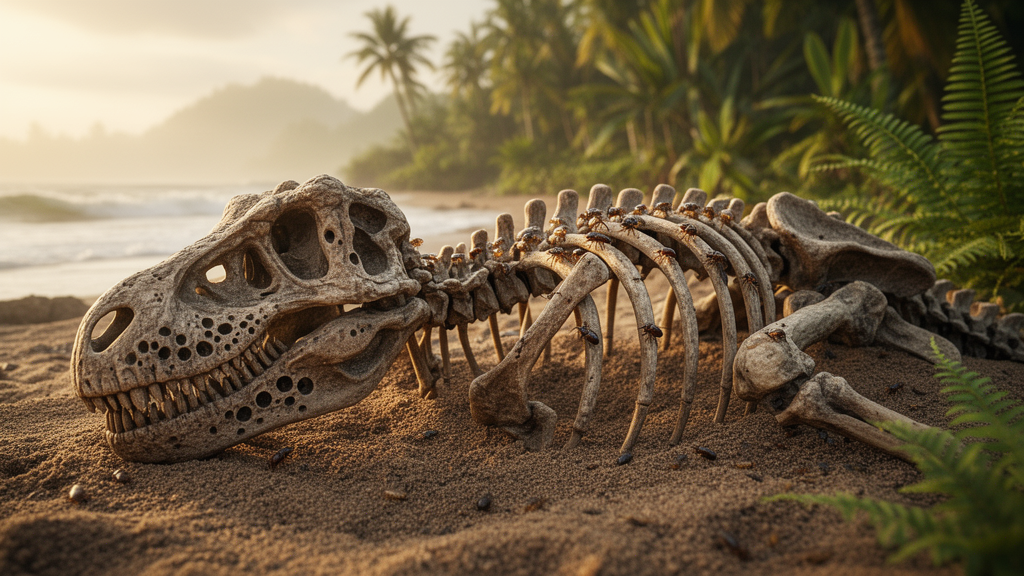
On the surface of a 70-million-year-old dinosaur bone from Romania, a tiny star-shaped pit is telling scientists something remarkable: it was made by a termite. Not by a predator, not by a scavenging dinosaur, but by an insect slowly mining the mineral content of a carcass that had been lying exposed on a subtropical floodplain for months. That detail, and dozens of others like it, are rewriting what researchers know about death and decay on Haţeg Island, a vanished landmass in the Late Cretaceous European Archipelago that hosted one of the strangest dinosaur faunas ever discovered.
A new study published in Fossil Record presents the most extensive survey yet of bioerosion, the traces left on bone by organisms, in the uppermost Cretaceous deposits of the Haţeg Basin in western Romania. Researchers combed through the vertebrate fossil collections of the University of Bucharest, one of the largest holdings of material from this region, and identified twelve previously undocumented examples of bone damage on turtle and dinosaur remains. The specimens came from three lithostratigraphic units beyond the single formation from which nearly all earlier records had been reported, showing for the first time that these traces are widespread across the basin both geographically and through time, spanning from the lowermost to the upper Maastrichtian stage.
The fossil evidence points to three distinct groups of bone-modifying animals. Star-shaped pits, each a shallow bowl-shaped depression roughly five millimeters across with narrow grooves radiating outward, are attributed to termites, whose modern counterparts produce strikingly similar marks when feeding on carcasses to supplement their nitrogen intake. Tunnels and holes bored through the compact bone and into the spongy interior are assigned to the larvae of dermestid beetles, insects that in modern ecosystems are among the last scavengers to arrive, colonizing carcasses only once they have reached the dry stage of decomposition. Most striking of all are opposed pairs of teardrop-shaped grooves etched into a rhabdodontid fibula, interpreted as bite marks from multituberculate mammals, the rodent-like endemics that scurried beneath the feet of Haţeg’s dwarf dinosaurs.
By matching the width and spacing of the paired grooves against the incisor dimensions of the five known kogaionid multituberculate species from the basin, the researchers could even narrow down the culprits. The larger bite mark, with grooves up to 0.51 millimeters wide, best fits a medium-sized animal comparable to Kogaionon radulescui, while the smaller mark, with grooves around 0.21 to 0.30 millimeters wide, matches a small-bodied kogaionid. None of these taxa had previously been confirmed at the Tuştea locality where the bones were found, hinting that an as-yet undetermined kogaionid of similar body size lived there. Whether the mammals were deliberately gnawing bone for minerals, as squirrels do today, or merely leaving incidental scratches while stripping soft tissue remains an open question, but the sheer recurrence of such marks suggests scavenging large carcasses was a regular behavior rather than an occasional accident.
The taphonomic implications are equally significant. Dermestid beetles generally colonize carcasses only after roughly two weeks in warm conditions, when the tissue has dried, and their larvae need weeks more to develop to the pupation stage in which they excavate their chambers. Because the holes and tunnels observed on a titanosaur tibia and on the shell of a nearly complete Kallokibotion turtle mirror those produced in controlled feeding experiments, the researchers estimate the bones must have lain exposed to the air for at least ten weeks, and probably much longer. For the turtle skeleton, in which the limbs and skull were still articulated to the shell, comparative disarticulation stages suggest burial within a few months, providing an unusually tight window on how long a carcass persisted on the ancient floodplain.
All of this points to a consistent pattern: carcasses and bones across Haţeg Island were routinely exposed on the surface for prolonged periods before final burial. The traces occur on bones from a range of settings, from well-drained floodplains under a seasonal semi-arid climate to wetter meandering river systems, yet the same cast of saprophagous animals, termites, dermestids, and multituberculates, appears everywhere. This stability in the decomposition community, unaffected by geological age or depositional environment, aligns with evidence that Haţeg Island’s vertebrate fauna remained remarkably stable throughout the latest Cretaceous.
There are regional differences, however. Bioerosion is distinctly rarer in the poorly drained environments recorded at Nălaţ-Vad, where bones preserve a dark purple hue, unweathered surfaces, and little pre-burial cracking, all signs of rapid burial in a humid setting with a high groundwater table. Such conditions would have shortened the window for insect activity and created unfavorable habitat for termites, which prefer well-drained ground for their mounds. By contrast, the red floodplain fines of the Pui Beds and the distal floodplain deposits at Tuştea show the richest traces, with some bones gnawed across their entire surfaces and others marked only on one side, suggesting different degrees of partial embedding before the burrowing agents finished their work.
The survey methods themselves reveal how easy such traces are to overlook. Out of several hundred macroscopic specimens screened, only about two to nine percent showed bioerosion depending on the locality, a fraction low enough that these features might be dismissed as preparation damage or sedimentary abrasion by the untrained eye. The researchers used reflected light microscopy to characterize trace morphology, measured features with calibrated imaging software, and even deployed micro-computed tomography on the Kallokibotion carapace, imaging a chamber-like structure hidden inside the shell that confirmed a burrowing, rather than surface, origin.
What emerges is a vivid picture of a Late Cretaceous ecosystem’s hidden workforce. While azhdarchid pterosaurs soared overhead and dwarf titanosaurs browsed the floodplains, termites, beetles, and shaggy-furred mammals quietly dismantled the dead. Notably, the islands of the archipelago seem to have lacked large theropod predators, and the traces here reinforce that bone consumption fell to small animals capable of extracting nutrition, minerals, and shelter from long-dead remains. Every gnawed surface and bored tunnel is a record of an ecological interaction that body fossils alone could never document, particularly for insects, which have so far left no skeletal remains in these deposits at all.
The study also cautions that much remains to be learned. The authors acknowledge biases in sample size, collection methods, and specimen availability, and note that comparable surveys of other institutional collections may refine or even revise their conclusions. Still, the core message stands: the decomposition of carcasses on Haţeg Island was a prolonged, predictable, and community-driven process, run by a stable team of saprophages that operated in the shadows of the dinosaurs for millions of years. In the quiet traces they left behind, these forgotten recyclers of a drowned world have finally been given a voice.
Subject of Research: Bioerosion traces on Late Cretaceous dinosaur and turtle bones from the Haţeg Basin and their implications for carcass decomposition on Haţeg Island
Article Title: Not only boring issues: bioerosion on bones from the Upper Cretaceous of the Haţeg Basin (Romania) and the implications for carcass decomposition on Haţeg Island
Article References: Bettermann, A., Csiki-Sava, Z., Bocherens, H., & Augustin, F. J. (2026). Not only boring issues: bioerosion on bones from the Upper Cretaceous of the Haţeg Basin (Romania) and the implications for carcass decomposition on Haţeg Island. Fossil Record, 29(2), 675-705. https://doi.org/10.3897/fr.29.189421
Image Credits: AI Generated
DOI: 10.3897/fr.29.189421
Keywords: Haţeg Island, bioerosion, trace fossils, termites, dermestid beetles, multituberculates, Maastrichtian, taphonomy, dinosaur paleoecology, Kallokibotion, Romania, Late Cretaceous
Cite Scienmag News
Gavin Prescott. (October 15, 2026). Termite gnawings and beetle burrows reveal how dinosaur carcasses rotted on a lost Cretaceous island. Scienmag. https://scienmag.com/termite-gnawings-and-beetle-burrows-reveal-how-dinosaur-carcasses-rotted-on-a-lost-cretaceous-island/
Gavin Prescott. "Termite gnawings and beetle burrows reveal how dinosaur carcasses rotted on a lost Cretaceous island." Scienmag, 15 October 2026, https://scienmag.com/termite-gnawings-and-beetle-burrows-reveal-how-dinosaur-carcasses-rotted-on-a-lost-cretaceous-island/. Accessed 15 October 2026.
Gavin Prescott. "Termite gnawings and beetle burrows reveal how dinosaur carcasses rotted on a lost Cretaceous island." Scienmag. October 15, 2026. https://scienmag.com/termite-gnawings-and-beetle-burrows-reveal-how-dinosaur-carcasses-rotted-on-a-lost-cretaceous-island/


