


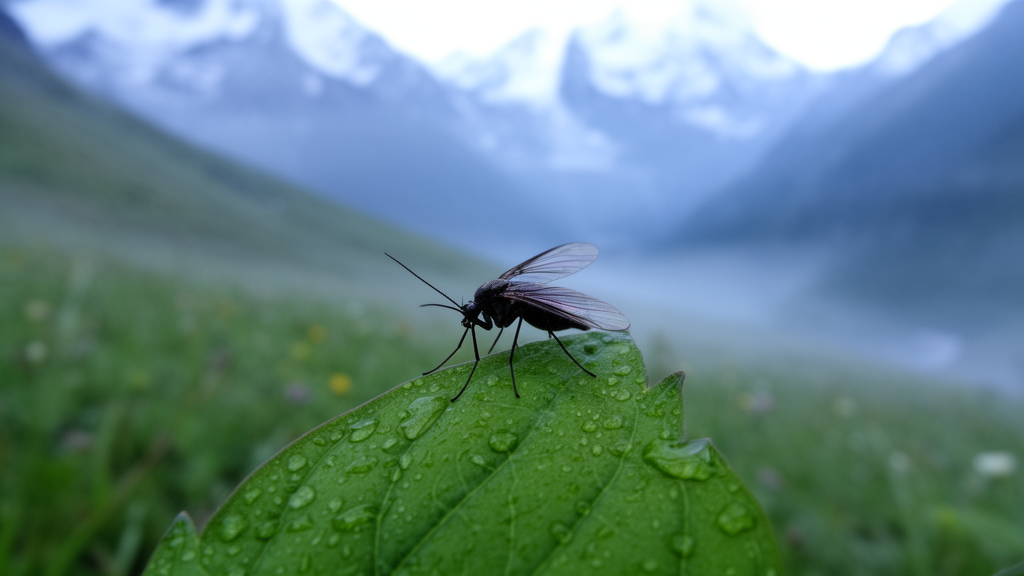
Deep in the foothills of the Eastern Himalaya, where cold hill streams thread through the Terai-Duars landscape of West Bengal’s Kalimpong district, a tiny insect has quietly rewritten the map of a genus. Researchers have recorded the non-biting midge genus Heleniella in India for the first time, capturing adult males at two localities near the village of Bindu and the settlement of Lungsel using overnight ultraviolet light traps. The specimens looked, under the microscope, like a species already known from Thailand and Hong Kong: Heleniella nebulosa, a minute fly whose wings bear greyish-black spots arranged in two distinct dark transverse bands. But when the team sequenced the mitochondrial COI barcode of one specimen, the message written in DNA was far more startling. The Indian flies differ from their East Asian namesakes by 12.29 percent sequence divergence, a figure so large that it points not to a simple range extension but to a candidate cryptic lineage, an independently evolving population concealed behind an almost identical exterior.
The discovery, published in the journal Evolutionary Systematics, is a textbook demonstration of why integrative taxonomy, the deliberate combination of morphology, molecular phylogenetics and quantitative species delimitation, has become the gold standard for untangling biodiversity in morphologically conservative groups. Chironomids, the non-biting midges of the family Chironomidae, are notoriously difficult to distinguish by eye. Adult males are diagnosed by fine structural details of the hypopygium, the terminal genital apparatus, along with features such as the ratio of antennal segments, the shape of leg segments and the patterning of thoracic bristles. Such characters can be subtle, variable and easy to misread, and decades of barcoding studies have shown that what looks like one species may in fact be several. The Indian Heleniella population now joins a growing list of orthoclad lineages in which DNA has exposed splits that morphology alone never suggested.
To confirm the identity of their specimens, the authors compared the Indian males in exhaustive detail with the original 1997 description by Andersen and Wang. The diagnostic signatures matched: hairy eyes, a thorax armed with strongly developed lanceolate setae, an antepronotal lobe densely clothed in setae, a triangular inferior volsella, and a virga, a sclerotized structure of the male genitalia, composed of two long and three short spines. Morphometric differences did appear, including a lower antennal ratio of 0.32 versus 0.55 in the type material, shorter terminal flagellomeres, smaller gonocoxites and a lower hypopygium ratio, but the authors attribute these to observation methods or intraspecific variation rather than discrete species-level differences. A single female, examined alongside the males, showed the same lanceolate setal pattern and the characteristic two-banded wing. On morphology alone, the verdict seemed straightforward: this was H. nebulosa, newly discovered on Indian soil.
The morphological story was reinforced by a cladistic analysis of 38 discrete adult-male characters scored across all 13 valid species of Heleniella worldwide, with Limnophyes subtilus serving as an outgroup because the two genera share distinctive thoracic chaetotaxy and wing venation within the Metriocnemus group. Analyzed in TNT under implied weighting with a concavity constant of 3, a value chosen after sensitivity testing showed it best balanced the penalty on homoplasy against informative characters, the analysis produced three equally optimal trees. The selected tree, with a consistency index of 0.64 and a retention index of 0.58, recovered Heleniella as monophyletic, united by hairy eyes and the strongly developed lanceolate thoracic setae. Within the genus, two major clades emerged: one containing three European species with twisted gonostyli, and a larger clade that includes a spotted-wing cluster of H. osarumaculata, H. nebulosa and H. otujimaculata, their shared wing pigmentation interpreted as a derived, or apomorphic, character. The Indian flies thus sit, morphologically, squarely within the spotted-wing species group.
The genetics told a different tale. The team extracted DNA from thoracic tissue without damaging diagnostic structures, amplified the COI barcode region with BeeCox1 primers, and deposited the sequence in GenBank under accession PZ264398. They then compiled every publicly available Heleniella COI sequence from GenBank and BOLD, 651 records in total, and reduced them to 72 unique sequence variants by screening for exact nucleotide identity across 486 aligned positions, a step that excluded 579 redundant records and guarded against overrepresentation bias. Pairwise distances calculated under the Kimura two-parameter model showed the Indian specimen diverging by 12.29 percent from the East Asian H. nebulosa lineage, the closest match available, and by up to 25.66 percent from other Heleniella species. For context, species delimitation in Chironomidae typically invokes thresholds of roughly 3 to 5 percent; the observed divergence far exceeds them and implies long-term genetic isolation.
Phylogenetic reconstruction drove the point home. An unrooted Neighbor-Joining tree built from the 72 unique haplotypes, with bootstrap support estimated over 1,000 replicates, placed the Indian lineage on an independent, noticeably long branch adjacent to, but separate from, the East Asian H. nebulosa sequence and H. osarumaculata, a relationship supported by moderate bootstrap support of 61.8 percent. By contrast, the five haplotypes of the widespread European H. ornaticollis formed a strongly supported monophyletic cluster with 100 percent bootstrap support and short internal branch lengths, underscoring just how deeply differentiated the Indian lineage is by comparison. Two independent distance-based species delimitation methods, Automatic Barcode Gap Discovery and Assemble Species by Automatic Partitioning, converged on the same conclusion. ABGD detected a clear barcode gap at around 1.03 percent K2P distance and, across a broad range of prior intraspecific divergence values, stably partitioned the data into six molecular operational taxonomic units. In every biologically informative partition, the Indian specimen was assigned to a different unit from the East Asian H. nebulosa sequence, merging only in the most generalized two-subset solution that lumped multiple distinct lineages together.
Why does a village on the Jaldhaka River matter so much to this story? Bindu sits at roughly 600 to 700 meters above sea level near the Indo-Bhutan border, within the globally recognized Himalaya Biodiversity Hotspot, a transitional zone where Himalayan, Indo-Malayan and Palearctic faunal elements intermingle. The region’s steep altitudinal gradients, cold streams and seepages create a mosaic of microclimates favorable to chironomid diversity, yet it remains woefully under-sampled. The new record extends the known distribution of Heleniella into India, where the genus had previously been noted only from South India on the basis of pupal exuviae collected in 1988. That a lineage so genetically distinctive could go unnoticed until now says much about how much cryptic diversity still waits in Himalayan freshwater systems, and about the pace at which even charismatic-looking insects slip through the taxonomic net.
The authors are careful not to overreach. Despite molecular evidence that would justify a new species in many barcoding studies, they decline to formally describe the Indian population as new, and their reasoning is methodologically sound. Species delimitation based solely on mitochondrial DNA can inflate diversity estimates, because deep mitochondrial divergence does not necessarily correspond to reproductive isolation, and mtDNA alone cannot detect introgression or nuclear gene flow. Direct examination of type or topotypic material from the H. nebulosa type locality in Thailand’s Chiang Mai province, and broader sampling across East Asia, remain unavailable. Morphology and molecules, in this case, are not contradictory but complementary: the cladistic and comparative evidence confirms the flies belong to the H. nebulosa species complex, while the genetic evidence shows that complex is not a single homogeneous evolutionary entity. The Indian population is therefore best interpreted as a candidate cryptic lineage within H. nebulosa, pending multi-locus nuclear data and expanded geographic sampling.
The team has also left a practical gift for future workers: a complete identification key to the adult males of all 13 known Heleniella species, built around wing spotting, maxillary palp segmentation, inferior volsella shape and virga architecture, distinguishing for example the two-banded H. nebulosa from the purplish-spotted H. osarumaculata of Japan, Russia and China and the bluish-spotted, Japan-endemic H. otujimaculata. Such frameworks are the scaffolding on which future integrative revisions will rest, particularly if larval and pupal characters, excluded from the present cladistic matrix for lack of comparable data, can be incorporated. As DNA barcoding continues to peel back the façade of morphological uniformity in the Chironomidae, the midges of Bindu stand as a vivid reminder that in the Eastern Himalaya, the smallest insects may carry the deepest evolutionary surprises, and that the true species count of a hotspot can only be revealed by reading both the body and the genome.
Subject of Research: Integrative taxonomy and cryptic diversity in the chironomid midge genus Heleniella
Article Title: First Indian record of Heleniella nebulosa Andersen & Wang ( Diptera , Chironomidae ): Insights into cryptic diversity and the phylogeny of the genus Heleniella Gowin
Article References: Mahato, A., Hui, P., & Hazra, N. (2026). First Indian record of Heleniella nebulosa Andersen & Wang (Diptera, Chironomidae): Insights into cryptic diversity and the phylogeny of the genus Heleniella Gowin. Evolutionary Systematics, 10(2), 359-373. https://doi.org/10.3897/evolsyst.10.208449
Image Credits: AI Generated
DOI: 10.3897/evolsyst.10.208449
Keywords: Chironomidae, Heleniella nebulosa, cryptic species, integrative taxonomy, DNA barcoding, COI, Eastern Himalaya, species delimitation, phylogeny, biogeography, Orthocladiinae, West Bengal
Cite Scienmag News
Gavin Prescott. (October 15, 2026). Himalayan Midge Discovery Hints at Hidden Species Behind a Familiar Face. Scienmag. https://scienmag.com/himalayan-midge-discovery-hints-at-hidden-species-behind-a-familiar-face/
Gavin Prescott. "Himalayan Midge Discovery Hints at Hidden Species Behind a Familiar Face." Scienmag, 15 October 2026, https://scienmag.com/himalayan-midge-discovery-hints-at-hidden-species-behind-a-familiar-face/. Accessed 15 October 2026.
Gavin Prescott. "Himalayan Midge Discovery Hints at Hidden Species Behind a Familiar Face." Scienmag. October 15, 2026. https://scienmag.com/himalayan-midge-discovery-hints-at-hidden-species-behind-a-familiar-face/


