


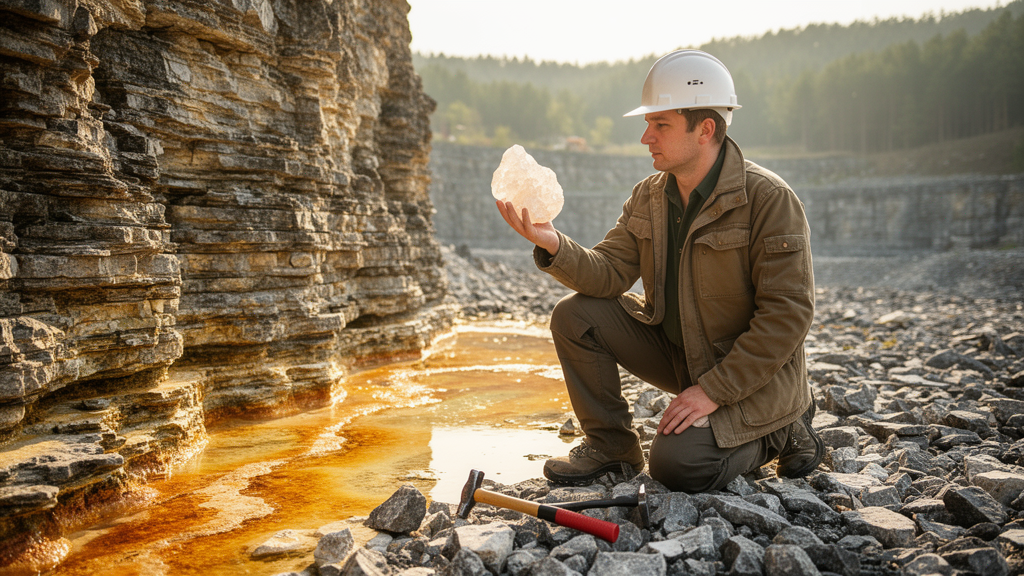
For nearly 150 years, geologists have argued about how the striking dolostone formations of the Franconian Alb in southern Germany came to be. These creamy, honey-hued rocks, formed from sediments deposited in a shallow sea roughly 155 million years ago during the Kimmeridgian age of the Late Jurassic, contain the mineral dolomite, a calcium-magnesium carbonate that famously defies easy explanation. Dolomite is abundant in ancient rocks yet almost impossible to form in today’s oceans, a puzzle known as the dolomite problem. A new study published in the Swiss Journal of Geosciences now offers what may be the most complete answer yet for the Franconian Alb: the rocks were transformed by ordinary seawater, slightly concentrated by evaporation, that seeped downward and outward from shallow-water areas of an ancient carbonate platform.
The research team, working from outcrops near the village of Betzenstein, around five kilometers northwest of the site close to Obertrubach, combined traditional fieldwork with a battery of modern analytical techniques. They collected fifty-six rock samples from four outcrops at different elevations, including the twenty-five-meter-high Römerbrücke outcrop, which reveals a complete vertical story from nodular basinal carbonates at the bottom through marl-limestone alternations to a pervasively dolomitized reefal massive facies at the top. Thin sections stained with Alizarin-red-S allowed researchers to distinguish dolomite from calcite under the microscope, while X-ray diffraction with Rietveld refinement pinned down the precise crystal chemistry of the dolomite, and mass spectrometry delivered carbon and oxygen isotope ratios and trace element concentrations, including rare earth elements and yttrium measured by laser ablation ICP-MS.
The most striking pattern to emerge was vertical. Dolomite abundance rises steadily upward through the succession. The lowermost units, nodular carbonates and carbonate-marl alternations deposited in deeper basinal waters, contain only about six percent dolomite on average. The overlying bedded carbonates average a mere four percent. But the massive facies at the top, interpreted as sponge-algal reef complexes, reaches a mean dolomite content of ninety-one percent. Even within the partially dolomitized intervals, marl layers consistently hold more dolomite, around twenty-one to twenty-three percent, than the limestones above and below them. This stratigraphic fingerprint, the authors argue, is a direct clue to both the direction of fluid flow and the timing of the transformation.
Microscopy sharpened the picture further. In marls, dolomite crystals cluster in the sediment immediately surrounding lithified ammonite shells and inside intraparticle pores. In limestones and transitional lithologies, dolomite preferentially invades the muddy matrix and open or sediment-filled voids, while leaving rigid siliceous sponges, microbial carbonates, and calcitic fossils such as brachiopods largely untouched. The team realized this selective distribution encodes a precise time window. Dolomitization must have occurred after sponges and microbial carbonates had acquired early rigidity and after the fine sediment inside ammonite shells had hardened, but before the surrounding matrix and marls had fully lithified. Since limestone lithification is known to happen very early during diagenesis, often within the uppermost meters of burial, this means the dolomitizing fluids arrived at very shallow burial depth, a conclusion that fundamentally reshapes how these rocks should be interpreted.
Within the dolostones themselves, the researchers distinguished two rock types and four dolomite varieties. The lower, clay-rich dolostone type contains finely crystalline dolomite with crystals sixteen to sixty-four micrometers across, alongside a medium crystalline variety of sixty-four to two hundred fifty micrometers. X-ray diffraction showed both are comparatively calcium-rich, corresponding to roughly fifty-two point six to fifty-five point six mole percent calcium carbonate, and less well ordered crystallographically. The upper, clay-poor dolostone type contains a different medium crystalline dolomite that is closer to ideal stoichiometry at fifty point zero to fifty-two point six mole percent calcium carbonate, with sharper diffraction peaks and higher crystallinity. Fluorescence microscopy revealed crisp growth zones in the lower dolomite types but only faint, irregular zoning in the upper variety, suggesting the upper dolomite had undergone more extensive recrystallization as fluids passed repeatedly through the shallower, more permeable strata.
Geochemistry delivered the decisive verdict on the fluids themselves. Carbon isotope values between two point zero and three point two permil match the range of Late Jurassic seawater, while oxygen isotope values, more negative than expected, were likely reset during later burial diagenesis. More diagnostic are the trace elements. Rare earth element patterns normalized to post-Archean Australian shale mirror seawater signatures, with yttrium-to-holmium ratios of forty-three to sixty-seven, well above the threshold of thirty-six that characterizes modern seawater. A pronounced negative cerium anomaly indicates the water column was well oxygenated. Sodium concentrations in all dolomite types fall within published ranges for near-normal seawater dolostones, with only a slight overlap suggesting mildly evaporated water, while strontium concentrations sit comfortably within near-normal seawater ranges and far below the elevated values typical of hypersaline brines.
Fluid inclusion salinities published for dolomites from adjacent regions reinforce this interpretation. Samples from the Bavarian Molasse Basin record salinities of about forty grams per liter, roughly four mass percent sodium chloride equivalent, and dolomites from the Swabian Alb range from about four point five to fifteen point five mass percent. These values overlap with estimates for Late Jurassic seawater, thought to have been between about thirty-seven and forty-two parts per thousand, and with slightly to moderately evaporated seawater categories. The picture is of seawater that had been modestly concentrated by evaporation in shallow, sun-exposed parts of the platform, but never became the true hypersaline brine associated with sabkha evaporite environments. Notably, no Upper Jurassic evaporites are found in the Franconian Alb, ruling out strong evaporation there.
Piecing these strands together, the authors propose an elegant hydrological model. Slightly concentrated seawater in shallower-water areas of the carbonate system descended under gravity and migrated basinward, replacing precursor carbonates through a coupled dissolution-reprecipitation mechanism at the moving replacement front. Because the flow was directed downward and outward from the platform interior, dolomitization intensifies upward in the succession toward the shallow massive facies and weakens basinward, which neatly explains why the bedded carbonates of Unit 3 remain almost untouched even where they overlap in elevation with dolomitized strata. As regional shallowing continued and the massive facies expanded through the Kimmeridgian, the zone of pervasive dolomitization advanced, producing the clay-rich dolostone below and the more recrystallized, clay-poor dolostone above.
The findings resolve a debate stretching back to 1891, when von Gümbel first proposed direct precipitation of dolomite from seawater, and they undercut the once-popular mixing-zone model, which invoked brackish groundwater but struggles against evidence that the entire Jurassic succession remained submarine. Burial-compaction models proposed for the neighboring Swabian Alb also falter, because supplying enough magnesium to build massive dolostones from compacting pore waters is notoriously difficult. By anchoring dolomitization to early diagenesis and near-normal seawater, the new study sidesteps both problems. It also places the Franconian Alb firmly within a global pattern: Upper Jurassic dolostones from the Gulf Coast to Saudi Arabia, Iran, Turkey, Lebanon, and Switzerland were commonly formed in shallow-water settings by evaporation-related fluids, with the Northwestern Tethys realm, spanning modern Western Europe to Turkey, favoring near-normal seawater with slightly elevated salinity under warm, semi-arid conditions that intensified during the Kimmeridgian.
Beyond settling an old argument, the work carries practical weight, because dolostones of this kind are important reservoir rocks for oil, gas, and groundwater, and understanding how seawater alone can convert limestone to dolomite at shallow burial refines predictions of where such reservoirs form. It also whispers something larger about the deep past. The dolomite problem exists partly because modern oceans seem reluctant to precipitate dolomite, yet here was an epicontinental sea at the northern margin of the Tethys Ocean doing exactly that, on a grand scale, using nothing more exotic than sun-warmed, gently evaporated seawater. In the limestones and dolostones of the Franconian Alb, the slow chemistry of a vanished Jurassic sea is still readable, one crystal at a time.
Subject of Research: Early diagenetic seawater dolomitization of Upper Jurassic carbonates in the Franconian Alb, southern Germany
Article Title: Near-normal seawater dolomitization of Upper Jurassic carbonates in the Franconian Alb, southern Germany
Article References: Hao, R., Mu, N., Jansen, D., She, M., Merkel, A., & Munnecke, A. (2026). Near-normal seawater dolomitization of Upper Jurassic carbonates in the Franconian Alb, southern Germany. Swiss Journal of Geosciences, 119, 111-131. https://doi.org/10.3897/sjg.119.193770
Image Credits: AI Generated
Keywords: dolomite, dolostone, Franconian Alb, Upper Jurassic, Kimmeridgian, seawater dolomitization, early diagenesis, geochemistry, stable isotopes, trace elements, carbonate platform, Southern Germany
Cite Scienmag News
Violet Maxwell. (October 15, 2026). Ancient seawater unlocked the mystery of Germany’s Jurassic dolomite rocks. Scienmag. https://scienmag.com/ancient-seawater-unlocked-the-mystery-of-germanys-jurassic-dolomite-rocks/
Violet Maxwell. "Ancient seawater unlocked the mystery of Germany’s Jurassic dolomite rocks." Scienmag, 15 October 2026, https://scienmag.com/ancient-seawater-unlocked-the-mystery-of-germanys-jurassic-dolomite-rocks/. Accessed 15 October 2026.
Violet Maxwell. "Ancient seawater unlocked the mystery of Germany’s Jurassic dolomite rocks." Scienmag. October 15, 2026. https://scienmag.com/ancient-seawater-unlocked-the-mystery-of-germanys-jurassic-dolomite-rocks/


