


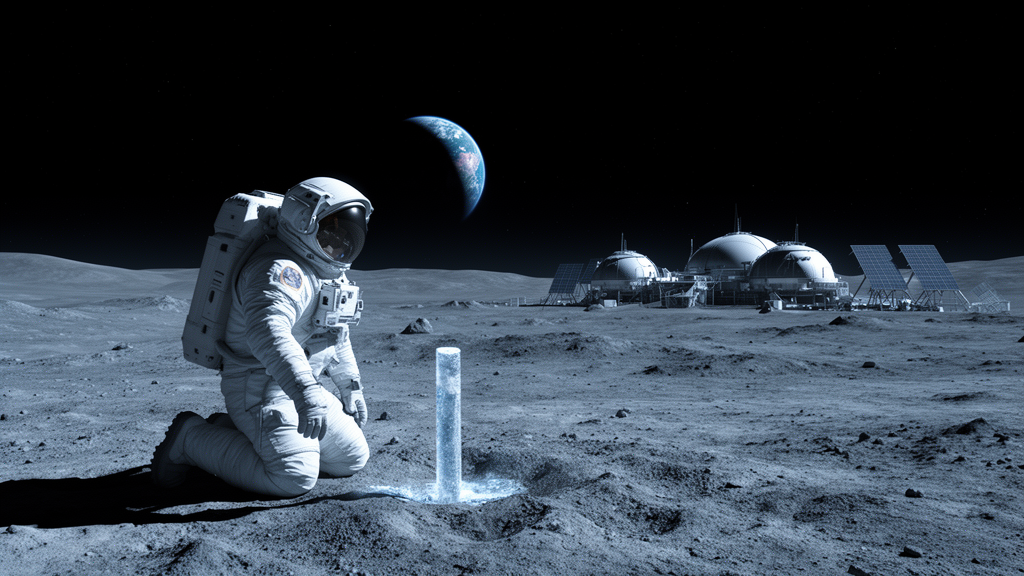
The dream of sprawling cities on the Moon has just collided with a hard numerical reality. In a new analysis published in Frontiers in Space Technologies, Martin Elvis and Jonathan C. McDowell of the Smithsonian Astrophysical Observatory and Durham University argue that the roughly one billion tons of water ice thought to lurk in the permanently shadowed craters near the lunar poles is nowhere near enough to sustain a city of one million people for more than about a century, even with the best water recycling technology currently flying in space. Power, surprisingly, turns out not to be the bottleneck. Water is.
The authors set out to test a claim that has become common in space-settlement circles: that the Moon, with its 37.93 million square kilometers of surface, an area about half again larger than North America, offers resources so vast that industry and population could grow without meaningful constraint. High-profile entrepreneurs have promoted exactly that vision, from relocating heavy industry to the lunar surface to building self-expanding cities there. To make an economic difference on a planetary scale, such plans implicitly require settlements of tens of millions of people. Elvis and McDowell instead grounded the question in three concrete parameters: how much power a lunar city would need, how much water, and how long a settlement must last to count as sustainable.
Power, the first variable, turns out to be surprisingly manageable. A typical American uses between 0.25 and 0.80 kilowatts of electricity for domestic purposes, with the high end reflecting homes in extreme heating or cooling climates. Because lunar surface temperatures swing across nearly 300 degrees, from about 95 kelvin to 387 kelvin, the authors conservatively adopted the high-end figure, giving 800 megawatts for a million residents. Agriculture adds only a modest 64 watts per person based on US energy statistics, and even if industry consumes 1.6 times the domestic rate, the total comes to roughly 2.1 gigawatts. Space-based data centers, each demanding gigawatt-level supplies, could eventually dominate the ledger, but the basic needs of a city remain within reach of available technology.
Two power sources exist on the Moon today: solar photovoltaics and nuclear fission. The Moon’s tiny axial tilt of just 1.5 degrees keeps the Sun circling near the horizon at the poles, so elevated terrain there, the so-called Peaks of Eternal Light, enjoys nearly continuous illumination. Low gravity permits solar arrays mounted on towers up to a kilometer tall, taller than the Burj Khalifa, that rotate to follow the Sun. Detailed modeling of the lunar south pole suggests such arrays could deliver a mean of about 3 gigawatts roughly 90 percent of the time, enough for a million people if industry stays modest. Fission reactors offer an alternative independent of location, though a 3-gigawatt fleet would need on the order of 7.5 square kilometers of radiators, which the frigid, permanently shadowed crater floors are well suited to host, plus about 24 tons of fuel per year per gigawatt. Either way, the authors conclude, power is only a weak constraint on lunar population.
Water is another matter entirely. Estimates of lunar ice rest on three complementary techniques: reflectance spectroscopy, which senses frost in the top microns to millimeters of soil; neutron absorption, which probes one to two meters by counting hydrogen atoms; and ground-penetrating radar, sensitive to meter-scale ice blocks down to tens of meters. Radar on India’s Chandrayaan-1 orbiter produced the first solid claim in 2013, suggesting several hundred million tons near the south pole. Subsequent ultraviolet and near-infrared observations from NASA’s Lunar Reconnaissance Orbiter and Chandrayaan-1’s Moon Mineralogy Mapper confirmed exposed ice, while recent ShadowCam imaging found water confirmed in only 3.5 percent of cold traps, though those deposits may hold up to 30 percent ice by weight mixed into the regolith.
The most careful synthesis to date, a 2022 meta-analysis of 65 large permanently shadowed regions, ranked craters by temperature and volatile potential and estimated that the eight richest, including Amundsen, Cabeus, Shoemaker, and Sverdrup, together hold on the order of 34 million tons of water. Even allowing generous margins, the authors adopt one billion tons as a deliberately optimistic baseline, roughly a cubic kilometer, enough to fill Manhattan’s Central Park to a depth of 120 meters. Not all of that ice would even be recoverable; oil fields typically extract only a third to a half of what they contain, and lunar mining fractions are unknown until drill bits meet the ice-regolith mixture in person.
Consumption math then turns brutal. A typical American directly uses about 125 tons of water per year for drinking and hygiene. Breathing adds another 1.8 tons per person annually, since every oxygen molecule inhaled must ultimately be regenerated from water. Food dominates everything: feeding one person requires 2 to 5 tons of water per day on Earth, and even assuming improved cultivation halves the low end, a lunar settler would consume roughly 500 tons per year in total. At that rate, one million people would exhaust the entire known lunar water supply in just 2.4 years without recycling. Rocket propellant, often cited as lunar water’s killer app, is far less demanding: a billion tons could fuel nearly a million Starship-class launches, about three per day for a thousand years, making water effectively abundant for that purpose alone.
Recycling changes the timeline but not the verdict. The International Space Station’s Environmental Control and Life Support System recovered 94 percent of water until 2023, when the addition of a Brine Processor Assembly pushed efficiency to 98 percent per cycle, a major engineering triumph that cut losses threefold. Yet even at 98 percent, a million-person city drains a billion tons in about a century, while a smaller settlement of 100,000 people could stretch the same supply to a thousand years. Reaching a millennium for a million residents would require efficiency above 99.75 percent, a tenfold reduction in losses that would be extraordinarily difficult to achieve and maintain, particularly since a real lunar base with laundry, showers, and low-gravity plumbing would likely perform worse than the ISS, not better.
The authors weigh the escape routes. Importing water is conceivable but staggering: sustaining a million people at ISS-level recycling means landing 10 million tons per year, roughly 27 heavy landers every Earth day. Finding more lunar water is possible, since neutron and radar instruments probe only the top few meters and the Apollo 17 sounder once reached a kilometer deep, but a tenfold increase over current estimates seems a stretch. Slashing demand through vertical farming, which one facility claims uses 97 percent less water than conventional agriculture, and through low-meat or lab-grown diets could help substantially, since beef requires at least six times the water of soybeans per kilogram. Lava tube habitats ease power needs but would still draw on the same finite polar ice.
The upshot is a sharply bounded vision of lunar settlement. A research outpost of about a thousand people, comparable to Antarctica’s winter population, could use lunar water relatively freely. A town of 100,000 demands careful stewardship. A true city of one million appears unsupportable beyond roughly a century unless recycling improves tenfold, imports arrive at industrial scale, or a vast hidden reservoir is discovered. Elvis and McDowell argue that this reality demands governance: humanity must plan, regulate, and share the lunar water supply rather than treat it as first come, first served. The Moon may host outposts and even villages, they conclude, but its ice is a precious, finite trust, not an infinite foundation for metropolises.
Subject of Research: Sustainability limits of lunar water resources for large-scale human settlement on the Moon
Article Title: No cities on the Moon: a billion tons of water is not enough for sustainability
Article References: Elvis, M., & McDowell, J. C. (2026). No cities on the Moon: a billion tons of water is not enough for sustainability. Frontiers in Space Technologies, 7, Article 1894104. https://doi.org/10.3389/frspt.2026.1894104
Image Credits: AI Generated
DOI: 10.3389/frspt.2026.1894104
Keywords: Moon, lunar water, permanently shadowed regions, water recycling, space settlement, lunar poles, sustainability, ISS life support, space resources, lunar ice mining, power systems, Frontiers in Space Technologies
Cite Scienmag News
Denise Maddox. (October 15, 2026). A Billion Tons of Lunar Water Cannot Sustain a Moon City, Study Finds. Scienmag. https://scienmag.com/a-billion-tons-of-lunar-water-cannot-sustain-a-moon-city-study-finds/
Denise Maddox. "A Billion Tons of Lunar Water Cannot Sustain a Moon City, Study Finds." Scienmag, 15 October 2026, https://scienmag.com/a-billion-tons-of-lunar-water-cannot-sustain-a-moon-city-study-finds/. Accessed 15 October 2026.
Denise Maddox. "A Billion Tons of Lunar Water Cannot Sustain a Moon City, Study Finds." Scienmag. October 15, 2026. https://scienmag.com/a-billion-tons-of-lunar-water-cannot-sustain-a-moon-city-study-finds/


