


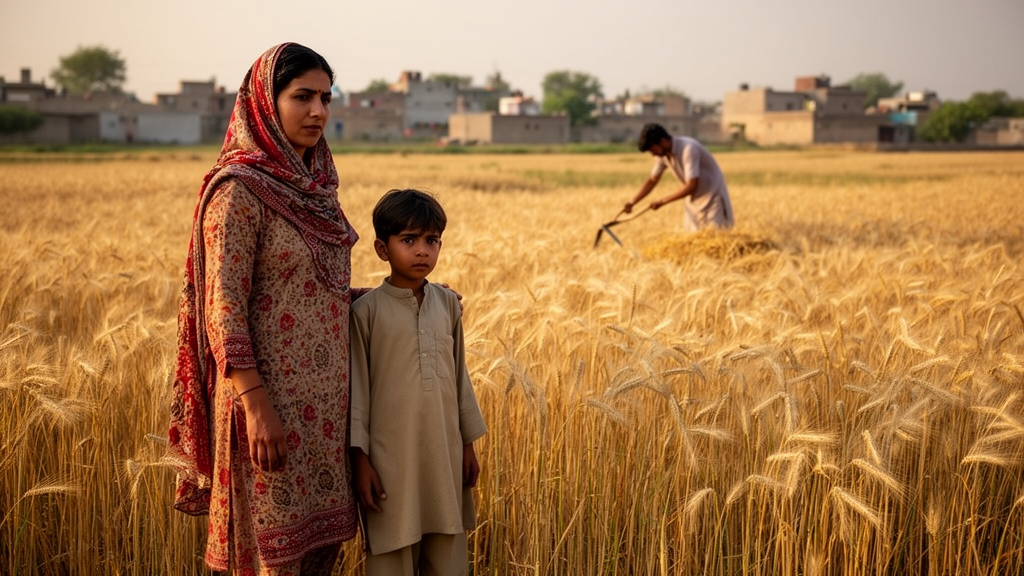
When Pakistan slashed its wheat subsidies between 2008 and 2010 under pressure from the International Monetary Fund, the reforms were framed as a fiscal necessity. A new study argues that the consequences ran far deeper than budget arithmetic: children in districts most dependent on subsidized wheat lost measurable growth, and their communities later showed weaker educational achievement and diminished civic engagement. The research, published in Frontiers in Public Health, introduces a framework the authors call nutritional lock-in, in which food policies become biologically embedded in children’s bodies and thereby shape the human capital available for political accountability itself.
The paradox the study addresses is stark. Pakistan operates one of the world’s largest wheat procurement and distribution systems, spending roughly 1.2 percent of its GDP on wheat subsidies, yet 38.2 percent of its under-five children were stunted according to the 2018 Pakistan Demographic and Health Survey. The authors ask why politically salient food policies persist even when they may impose long-term developmental costs. Their answer links three bodies of scholarship: the political economy of redistribution, the economics of skill formation, and the developmental origins of health and disease, where early-life exposures leave lasting imprints on health, cognition, and economic productivity.
The conceptual framework describes a vicious circle. Elite-driven food policies create biological constraints on child development through early-life nutrition. These constraints undermine the human capital, including cognitive abilities, information-processing skills, and collective-action capacities, that citizens need to hold elites accountable. Weakened accountability in turn reinforces the very policies that caused the harm. The model posits multiple equilibria: a low-level trap combining high subsidies, malnutrition, low human capital, and weak accountability, and a high-level equilibrium with moderate subsidies, good nutrition, and strong civic oversight. Which state a society occupies depends partly on historical conditions such as colonial land-tenure legacies, echoing path-dependence arguments in institutional economics.
To test the framework empirically, the researchers exploited Pakistan’s 2008 to 2010 wheat-subsidy reforms as a natural experiment. The timing was largely exogenous to domestic politics: international wheat prices had more than doubled above 400 dollars per ton, a balance-of-payments crisis had drained foreign-exchange reserves, and an IMF Stand-By Arrangement secured in November 2008 explicitly conditioned assistance on reducing food and fuel subsidies. The government responded by cutting procurement quantities by about 30 percent, raising Utility Stores consumer prices by roughly 35 percent in real terms, and introducing targeting mechanisms that capped sales for lower-income households.
The identification strategy rests on a difference-in-differences design. The authors measured each district’s pre-reform exposure to the public distribution system using utility-store density per 10,000 residents, drawing on 2005 to 2007 Utility Stores Corporation reports geocoded to 1998 census boundaries. Their sample comprised 37,378 children aged 0 to 59 months from 120 districts, pooled across three waves of the Pakistan Demographic and Health Survey conducted in 2006-07, 2012-13, and 2017-18. An event-study analysis found no significant pre-reform differences in nutritional trajectories between high- and low-exposure districts, with a joint F-test p-value of 0.42 supporting the parallel-trends assumption needed for causal interpretation.
The central finding is sobering. Children in districts with greater pre-reform exposure experienced a decline of approximately 0.28 standard deviations in height-for-age z-scores after the reforms, a result that was statistically significant at the 1 percent level and robust to controls for child, maternal, and household characteristics. Given a baseline mean height-for-age score of minus 1.48, the authors estimate the deficit corresponds to roughly one centimeter of lost height by age five. A sibling fixed-effects specification comparing children born to the same mother before and after the reforms yielded a nearly identical estimate of minus 0.247, suggesting unobserved household characteristics do not explain the effect.
The burden fell unevenly. Children exposed at 0 to 23 months lost significantly more than those exposed at 24 to 59 months, with coefficients of minus 0.338 versus minus 0.198 standard deviations, consistent with the heightened biological sensitivity of the first thousand days of life. The poorest 20 percent of households saw a decline of 0.401 standard deviations, while the richest 20 percent showed no significant effect, reflecting poorer families’ smaller budget shares for substitution. Regional effects were strongest in Punjab and Balochistan, where wheat dominates diets. Dietary data reinforced the mechanism: households in high-exposure districts reduced dietary diversity, cut consumption of pulses, dairy, fruits, and vegetables, and increased the share of wheat flour in food expenditures, effectively defending calories at the expense of nutrition.
Longer-term associations, though explicitly correlational, point toward durable consequences. Linking district-cohort nutritional shocks to Pakistan Standardized Achievement Test results from 2014 to 2019, the study found that a one-standard-deviation decline in height-for-age between ages 0 and 2 was associated with a 0.22-standard-deviation reduction in later mathematics scores, an estimate that survived controls for school infrastructure and teacher qualifications and bootstrapped standard errors correcting for the generated-regressor problem. The authors caution these results cannot establish causality because the nutritional shock variable is constructed rather than quasi-experimental.
The civic dimension emerged through women’s empowerment indices drawn from the demographic surveys. Women in more highly exposed districts scored lower on decision-making autonomy, freedom of mobility, rejection of gender-based violence, media exposure, and community participation, with declines ranging from 0.087 to 0.211 standard deviations. The authors interpret these as proxies for civic capacity, the informational and social resources that underpin political accountability, rather than direct measures of political behavior, since the data lack indicators such as voter turnout. Robustness checks found no significant effects on household assets, vaccination coverage, birth spacing, or migration, supporting a nutritional rather than a general income channel.
The study’s broader message is that food policy should be evaluated not merely through fiscal savings and short-term efficiency but through its intergenerational effects on human capital and institutions. The authors acknowledge that the complete causal pathway from childhood nutrition to political accountability and policy persistence remains unproven, and that unmeasured time-varying confounders cannot be fully excluded. Still, the evidence argues for embedding nutritional safeguards in subsidy reforms so that the burden of adjustment does not fall on the children least able to bear it, and it raises the provocative possibility that malnutrition itself may entrench the political equilibria that perpetuate it.
Subject of Research: Effects of wheat-subsidy reform on child nutrition, human capital, and civic capacity in Pakistan
Article Title: The bio-politics of subsistence: nutritional lock-in, human capital, and civic capacity
Article References: Shahid, M., Song, J., Rehman, A., Muhammad Naveed, H., Ali, Z., Yuksel, S., & Dinçer, H. (2026). The bio-politics of subsistence: nutritional lock-in, human capital, and civic capacity. Frontiers in Public Health, 14, Article 1937382. https://doi.org/10.3389/fpubh.2026.1937382
Image Credits: AI Generated
DOI: 10.3389/fpubh.2026.1937382
Keywords: nutritional lock-in, child stunting, food subsidies, Pakistan, wheat policy, human capital, civic capacity, difference-in-differences, IMF reform, height-for-age, political economy, early-life nutrition
Cite Scienmag News
Alan Morgan. (October 15, 2026). Wheat Subsidy Cuts Stunted Pakistani Children and Weakened Civic Life, Study Finds. Scienmag. https://scienmag.com/wheat-subsidy-cuts-stunted-pakistani-children-and-weakened-civic-life-study-finds/
Alan Morgan. "Wheat Subsidy Cuts Stunted Pakistani Children and Weakened Civic Life, Study Finds." Scienmag, 15 October 2026, https://scienmag.com/wheat-subsidy-cuts-stunted-pakistani-children-and-weakened-civic-life-study-finds/. Accessed 15 October 2026.
Alan Morgan. "Wheat Subsidy Cuts Stunted Pakistani Children and Weakened Civic Life, Study Finds." Scienmag. October 15, 2026. https://scienmag.com/wheat-subsidy-cuts-stunted-pakistani-children-and-weakened-civic-life-study-finds/


