


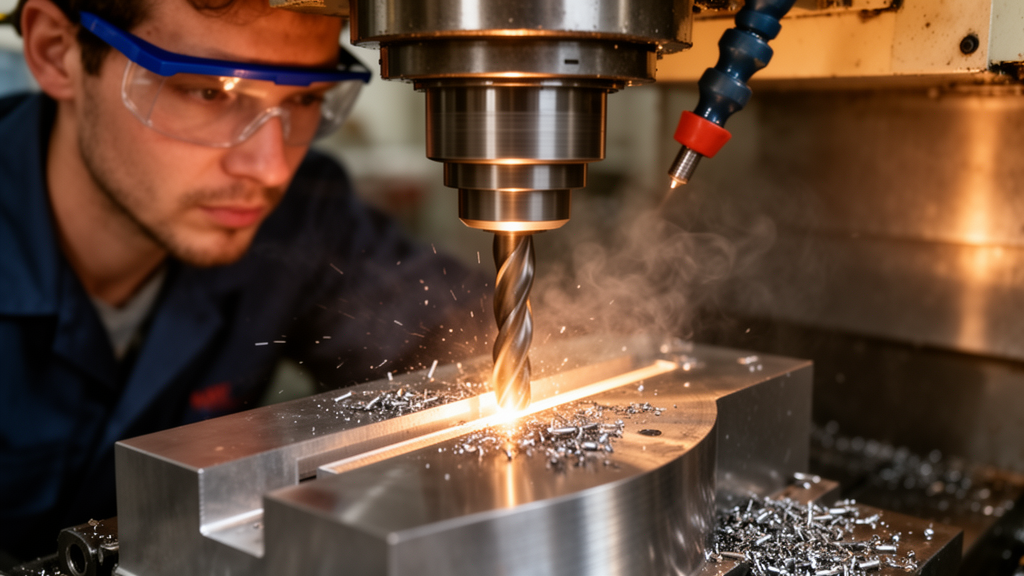
Deep inside the transmission hubs of aircraft and precision gearboxes lies a component so small and so difficult to machine that most manufacturers still rely on electrical sparks to carve it. The hardened internal keyway, a narrow slot cut into bore steel that has been heat-treated to near its hardest state, has long been the domain of wire electrical discharge machining, a process that melts its way through metal. Now a team of researchers at Xinxiang Aviation Industry (Group) Co., Ltd. in China has demonstrated that a vibrating milling cutter, humming at 30,000 cycles per second, can produce these critical slots faster, cleaner, and without the thermal scars that plague the conventional route.
The stakes are higher than they might appear. Internal keyways are the torque-transmitting interfaces between shafts and mating parts in aerospace transmission systems, and their surface quality directly governs assembly accuracy, load-carrying capability, fatigue performance, and service life. When a discharge machine melts the steel, it leaves behind a recast layer, a heat-affected zone, micro-cracks, and micro-pores that can become crack initiation sites under cyclic loading. Manual polishing is often required to remove these defects, particularly in the tight corners of the keyway, and that hand finishing can undermine the dimensional consistency that aerospace standards demand.
The alternative explored in the new study, published in Frontiers in Mechanical Engineering, is ultrasonic vibration-assisted milling, or UVAM. The concept is elegantly simple in principle: a piezoelectric transducer, driven by an ultrasonic generator and an amplitude horn, superimposes a high-frequency, low-amplitude axial vibration on the cutting tool. The vibrating edge repeatedly separates from the workpiece during cutting, producing an intermittent contact cycle. That periodic separation reduces the average cutting force, suppresses cutting temperature, improves chip evacuation, and lets lubricant penetrate the cutting zone, all of which extend tool life and improve surface integrity.
What makes the application remarkable is the geometry. The team machined keyways in hardened GCr15 bearing steel, heat-treated to 55–60 HRC, inside a 12 mm bore with a 3 mm wide slot reaching 18 mm deep and an internal corner radius of no more than 0.35 mm. The cutting tool was a 0.6 mm diameter solid carbide end mill with an 8 mm flute length, cantilevered deep into a confined space where cutting forces, heat, and chips have nowhere to escape. Conventional milling under such conditions tends to produce unstable cutting forces, poor dimensional consistency, and rapid tool degradation, which is precisely why WEDM has dominated this niche despite its thermal drawbacks.
The researchers integrated an axial ultrasonic spindle with a VMC850e vertical machining center and ran a systematic experimental campaign. Preliminary trials fixed the vibration frequency at 30 kHz and the axial depth of cut at 0.10 mm, applied with a helical tool-entry strategy to soften the impact loading. Single-factor experiments then varied three parameters independently: vibration amplitude at 1.0, 2.0, and 2.5 micrometers; spindle speed at 4000, 5000, and 6000 revolutions per minute; and feed per tooth at 20, 25, and 30 micrometers. A separate comparison tested dry cutting, cold-air cooling at about minus 10 degrees Celsius, and coolant spray lubrication using a vegetable oil-based fluid at roughly 30 milliliters per hour.
The amplitude results revealed a sweet spot. Raising the amplitude from 1.0 to 2.0 micrometers cut the average surface roughness by about 32.7 percent, from 0.52 to 0.35 micrometers, because stronger intermittent cutting fragmented chips, lowered friction, and suppressed built-up edge formation. But pushing to 2.5 micrometers backfired: the excessive oscillation of the cutting edge destabilized the instantaneous chip thickness and left shallow vibration marks on the surface, nudging roughness back up to 0.41 micrometers. Similar non-monotonic behavior appeared for spindle speed, where 5000 r/min delivered 0.35 micrometers compared with 0.48 at 4000 and 0.44 at 6000, the latter deteriorating as reduced tool-workpiece contact time weakened the intermittent cutting effect while cutting temperatures climbed.
Feed per tooth proved the most punishing variable. Roughness held nearly steady between 20 and 25 micrometers per tooth, but jumped to 0.58 micrometers at 30 micrometers per tooth, an increase of roughly 65.7 percent, as the heavier chip load overwhelmed the vibration benefit and deepened the geometric residual height between tool paths. Cooling strategy mattered just as much. Dry cutting yielded 0.65 micrometers of roughness and 0.013 mm of tool flank wear; cold-air cooling improved those figures to 0.46 micrometers and 0.010 mm; and coolant spray lubrication achieved the best result at 0.35 micrometers and 0.009 mm, a reduction of 46.2 percent in roughness and 30.8 percent in wear relative to dry cutting. The atomized oil apparently succeeded where cold air alone could not, because lubrication, not merely cooling, tames the sliding friction inside the narrow slot.
To move beyond trial and error, the team applied response surface methodology with a Box-Behnken design, fitting a second-order polynomial model relating amplitude, spindle speed, and feed per tooth to surface roughness. Analysis of variance confirmed the model was statistically significant with an R-squared of 0.91, meaning it explained about 91 percent of the observed variation, while the lack-of-fit term was insignificant. Sensitivity analysis ranked feed per tooth as the dominant factor, contributing 32.3 percent to roughness variation, followed by vibration amplitude at 28.3 percent and spindle speed at 22.7 percent, with interactions accounting for the remaining 16.7 percent. The model predicted an optimum of 2.0 micrometers amplitude, 5000 r/min, and 25 micrometers per tooth, forecasting a roughness of 0.33 micrometers; confirmation experiments measured 0.35 plus or minus 0.02 micrometers, a prediction error of only about 6.1 percent.
The validation run was the decisive test. Six consecutive hardened workpieces were machined under the optimized recipe, and every one of them landed within specification. Keyway widths ranged from 3.01 to 3.04 mm against a 3 mm nominal target, symmetry errors stayed below 0.02 mm on all six parts, and surface roughness ranged from 0.34 to 0.38 micrometers, roughly 24 to 32 percent below the allowable limit of 0.50 micrometers. Tool flank wear crept gradually from 0.001 to 0.009 mm over the six cycles, dominated by abrasive wear with no catastrophic failure, and optical inspection found no recast layer or heat-affected zone anywhere on the machined surfaces, the very defects that make WEDM output suspect in fatigue-critical components.
The implications reach well beyond a single machine shop. The study establishes a complete, statistically grounded UVAM process for hardened internal keyways, identifies the parameters that matter most, and demonstrates with hard numbers that a purely mechanical, non-electrical route can match or exceed the quality of a thermal one. The authors suggest that future systems could pair the process with synchronized monitoring of cutting force, vibration, acoustic emission, and ultrasonic generator impedance to enable online adaptive control. If such monitoring matures, the humble vibrating end mill, flickering in and out of contact 30,000 times a second inside a 12 mm bore, could become the standard way aerospace manufacturers carve the slots on which flight-critical torque transmission depends, one precisely controlled microscopic percussion at a time.
Subject of Research: Ultrasonic vibration-assisted milling process optimization and machining performance for hardened internal keyways in bearing steel
Article Title: Process optimization and machining performance of ultrasonic vibration-assisted milling of hardened internal keyways
Article References: Zhang, L., Li, X., & Han, X. (2026). Process optimization and machining performance of ultrasonic vibration-assisted milling of hardened internal keyways. Frontiers in Mechanical Engineering, 12, Article 1968060. https://doi.org/10.3389/fmech.2026.1968060
Image Credits: AI Generated
DOI: 10.3389/fmech.2026.1968060
Keywords: ultrasonic vibration-assisted milling, hardened internal keyway, GCr15 bearing steel, surface roughness, tool wear, response surface methodology, process optimization, wire electrical discharge machining, coolant spray lubrication, dimensional accuracy, aerospace transmission components, surface integrity
Cite Scienmag News
Denise Maddox. (October 15, 2026). Ultrasonic Vibrations Rescue Hardened Keyways From Heat Damage in New Machining Breakthrough. Scienmag. https://scienmag.com/ultrasonic-vibrations-rescue-hardened-keyways-from-heat-damage-in-new-machining-breakthrough/
Denise Maddox. "Ultrasonic Vibrations Rescue Hardened Keyways From Heat Damage in New Machining Breakthrough." Scienmag, 15 October 2026, https://scienmag.com/ultrasonic-vibrations-rescue-hardened-keyways-from-heat-damage-in-new-machining-breakthrough/. Accessed 15 October 2026.
Denise Maddox. "Ultrasonic Vibrations Rescue Hardened Keyways From Heat Damage in New Machining Breakthrough." Scienmag. October 15, 2026. https://scienmag.com/ultrasonic-vibrations-rescue-hardened-keyways-from-heat-damage-in-new-machining-breakthrough/


