


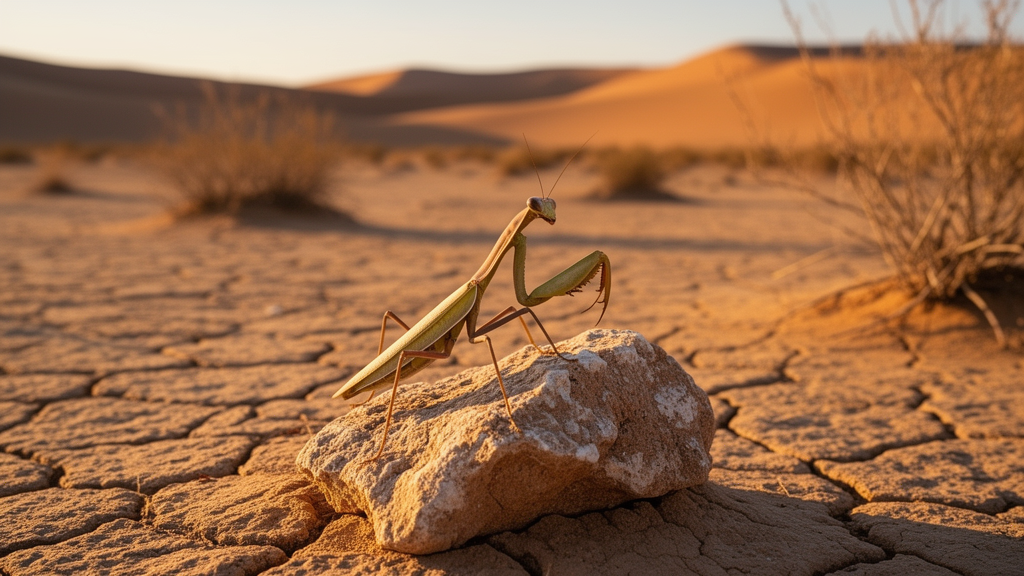
Deep in the arid valleys of southwestern Ecuador, a small, unassuming praying mantis has been quietly surviving in one of the harshest environments on Earth. Now, for the first time, scientists have pulled back the curtain on its hidden biology, revealing a creature far stranger and more adaptable than its modest appearance suggests. In a comprehensive new study published in the Journal of Orthoptera Research, researchers documented the ecology, development, and striking color variation of Musonia margheritae, a tiny member of the mantis family Thespidae that thrives along the Pacific slopes of the Andes, from central Ecuador to northern Chile.
Despite nearly 500 mantid species being recorded across the Neotropical region, the natural history of most remains poorly documented. Thespidae, the most diverse family of microhabitat specialists among Neotropical mantises, has been especially neglected, largely because its members are small, cryptic, and notoriously difficult to rear in captivity. Musonia margheritae is an exception in accessibility: it is relatively common across its range and often the only thespid, and sometimes the only mantis of any kind, persisting in the brutal conditions of the Atacama-Sechura Desert system, one of the most extreme arid environments in South America. The species even tolerates heavily modified landscapes, including farmland, secondary vegetation, and urban areas.
The research team, working between March 2022 and June 2023 in the Ecuadorian provinces of Azuay, El Oro, and Loja, combined field surveys with laboratory rearing to build the most complete biological dataset ever assembled for this species, and indeed for any mantis recorded in Ecuador. In the Yunguilla Valley, an inter-Andean dry forest dominated by acacias, cacti such as Echinopsis pachanoi, and other drought-adapted plants, the researchers searched for specimens on foot, spending roughly two hours at each site. Females and immature mantises were found mostly on the ground among herbaceous vegetation, while males turned up in the shrub layer or near artificial lights at night, hinting at sharp behavioral differences between the sexes.
Those differences extended deep into the animals’ life histories. Under controlled laboratory conditions, adult females lived nearly twice as long as males, surviving roughly two to three months compared with just 30 to 38 days for males. The researchers attribute this gap to the energetic burden of reproduction: females produce between one and four foamy egg cases, called oothecae, each containing 10 to 23 egg chambers, and the intervals between depositions, one to two weeks, depend heavily on food availability. Larger oothecae yielded more hatchlings, with each producing 15 to 35 nymphs. This prolonged reproductive investment forces females to forage for longer periods, which in turn raises their exposure to predators and likely explains why natural selection has favored longer, more robust lives in this sex.
Raising 31 individuals from egg to adulthood allowed the team to map the species’ entire development for the first time. Following a modern framework that classifies mantis stages by morphological characters rather than instar counts alone, the researchers described the short-lived prenymph, the banded and weakly sclerotized protonymph lasting about 38 days, and the deuteronymph phase spanning roughly 109 days across three instars. Throughout these stages, spines on the raptorial forelegs gradually hardened and darkened, male wing pads swelled, and genital segments became increasingly differentiated. Eggs hatched after 43 to 48 days of incubation. In Peru, wild egg cases face their own threats: tiny chalcidoid parasitoid wasps, Podagrion brasiliense and Anastatus sp., attack mantis oothecae, adding another layer of mortality to an already demanding life cycle.
Perhaps the most visually striking finding concerns color. Using standardized photography and quantitative analysis of dominant hexadecimal color codes from 40 adults, the team found that males are uniformly brown, while females display pronounced chromatic polymorphism, ranging across light to dark brown tones and beyond. Even more tantalizing was a single female collected on April 4, 2023, during the rainy season, bearing atypical green pigmentation. Brown females were collected in the same period, meaning both morphs coexist when moisture and vegetation surge. The researchers suggest this green phenotype may be a product of developmental plasticity, triggered by seasonal cues such as increased humidity and the flush of plant growth, an idea echoed by similar green morphs documented in other Musonia species and in the well-studied European mantis Mantis religiosa.
Why would females, but not males, evolve such flexible coloration? The answer likely lies in wings, or the lack of them. Males are fully winged and can escape predators by flight and relocate to substrates that match their existing coloration. Females, by contrast, are apterous, spending their lives anchored to the ground and leaf litter, where their only defense is camouflage. Trapped on heterogeneous, shifting substrates, an apterous ambush predator benefits enormously from a genotype capable of producing multiple color phenotypes, a phenomenon known as chromatic polyphenism. Prolonged foraging driven by the metabolic cost of egg production, combined with an extended lifespan, further increases cumulative predation risk for females, sharpening the selective pressure for adaptable camouflage. Immature stages, which also lack wings, show similar color variability, reinforcing the pattern.
To understand where this mantis can live, the researchers compiled 228 georeferenced records from museum collections, fieldwork, and validated citizen-science observations on iNaturalist, then built an ecological niche model using the Maximum Entropy algorithm and 19 bioclimatic variables from the CHELSA climate database. The best-supported model, selected by the Akaike Information Criterion, contained eight precipitation-related variables, with annual precipitation alone contributing 45 percent of predictive power. Suitability peaks along the western Andean slopes of Ecuador and Peru and declines toward southern latitudes, spanning elevations from sea level to roughly 2,000 meters. Notably, a statistical analysis of elevation against latitude revealed a significant non-linear pattern: suitable elevations are broadest near the Equator and contract markedly toward the south, suggesting moisture availability, not temperature, defines this species’ environmental niche.
The model was not perfect, and the imperfections are themselves instructive. It predicted suitable conditions in some northern Ecuadorian valleys where the mantis has never been found, likely reflecting dispersal limitations or biotic barriers, while failing to flag northern Chile, where the species has recently been confirmed. Such overprediction is a known weakness of presence-only niche models, which capture statistical correlations rather than the mechanisms that actually constrain where animals live. Much of the predicted range overlaps the Tumbesian region, a recognized biodiversity hotspot now suffering severe deforestation and fragmentation. Although Musonia margheritae appears resilient, the authors caution that formal conservation assessments will require data on population connectivity and habitat trends.
The study also delivered taxonomic firsts. The team produced the first high-resolution photographic documentation of male and female genitalia for the species, including the first illustration of female genitalic structures anywhere in the genus Musonia. Female genitalia have been described for only three other thespid species, and the new images reveal that certain sclerite configurations, such as a large CG8 loosely articulated with narrow CX8 elements, may help distinguish major subfamily lineages within Thespidae. That would be a significant addition to a classification currently built almost entirely on male anatomy. Together, these findings position this tiny desert dweller as a promising model system for studying phenotypic plasticity, crypsis, and evolution in Neotropical mantises, and the researchers call for experimental work to uncover the physiological and genetic mechanisms underlying its remarkable color variation.
Subject of Research: Ecology, development, and chromatic polymorphism of the Pacific desert mantis Musonia margheritae
Article Title: Integrative insights into the ecology, development, and chromatic polymorphism of the Pacific Desert-dwelling mantis Musonia margheritae ( Mantodea , Thespidae )
Article References: Guillén-Carpio, J. M., Rivera, J., & Padrón Martínez, P. S. (2026). Integrative insights into the ecology, development, and chromatic polymorphism of the Pacific Desert-dwelling mantis Musonia margheritae (Mantodea, Thespidae). Journal of Orthoptera Research, 35(2), 299-312. https://doi.org/10.3897/jor.35.185742
Image Credits: AI Generated
Keywords: praying mantis, Musonia margheritae, Thespidae, chromatic polymorphism, phenotypic plasticity, crypsis, Ecuador, Atacama-Sechura Desert, ecological niche modeling, sexual dimorphism, natural history, Neotropical Mantodea
Cite Scienmag News
Gavin Prescott. (October 15, 2026). Desert Mantis Reveals Hidden Secrets of Color-Changing Survival in South America. Scienmag. https://scienmag.com/desert-mantis-reveals-hidden-secrets-of-color-changing-survival-in-south-america/
Gavin Prescott. "Desert Mantis Reveals Hidden Secrets of Color-Changing Survival in South America." Scienmag, 15 October 2026, https://scienmag.com/desert-mantis-reveals-hidden-secrets-of-color-changing-survival-in-south-america/. Accessed 15 October 2026.
Gavin Prescott. "Desert Mantis Reveals Hidden Secrets of Color-Changing Survival in South America." Scienmag. October 15, 2026. https://scienmag.com/desert-mantis-reveals-hidden-secrets-of-color-changing-survival-in-south-america/


