


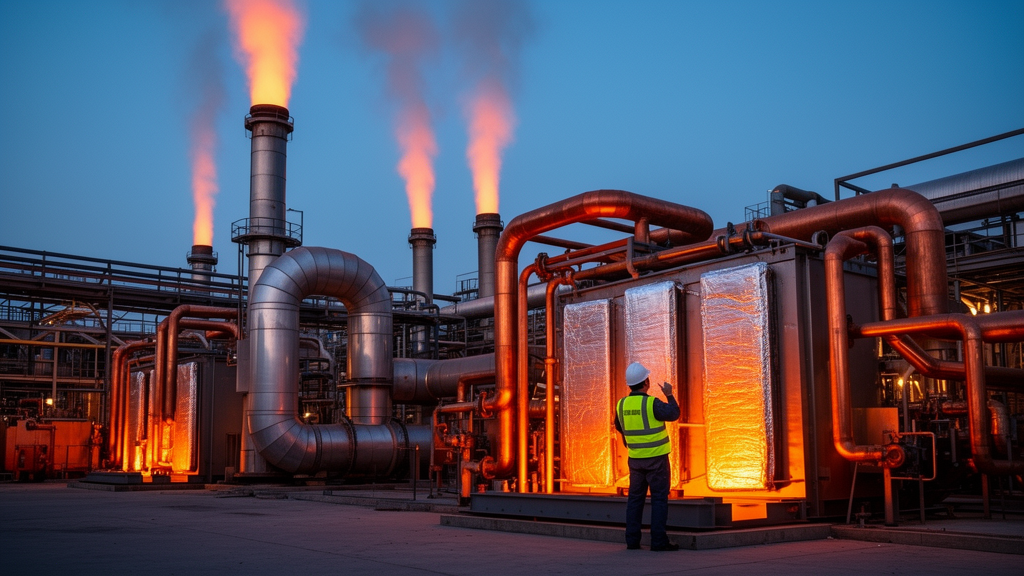
Industrial heat is one of the quiet giants of the climate crisis. Process heating, steam generation, drying, cooling and heat recovery together account for roughly 20 percent of global carbon dioxide emissions, yet the point at which that thermal energy is actually wasted remains invisible in most factories. A new perspective article published in Frontiers in Thermal Engineering argues that this blind spot is not a hardware problem at all, but a visibility problem, and that fixing it could cut site-level thermal energy consumption by 15 to 25 percent without replacing a single piece of capital equipment.
The article, written by Mohammad Harris of Inshira Technologies Limited and published on 23 September 2026, frames the challenge through the Three Zero Theory introduced by Nobel laureate Muhammad Yunus, which organises sustainable development around three commitments: zero carbon emissions, zero wealth concentration and zero unemployment. Applied to thermal engineering, the framework exposes a structural flaw that better hardware alone cannot solve. Even as engineers deploy heat pumps, solar thermal integration and waste heat recovery units, a persistent gap separates the efficiency manufacturers design for from the performance they actually achieve on the factory floor.
Harris argues that sustainable thermal engineering has concentrated almost entirely at the product layer, producing high-efficiency heat exchangers, advanced insulation, phase-change storage and recovery units. A second layer, thermal process design, sequences operations and cascades heat through a plant. But a third layer, which he calls thermal decision-system design, has been largely neglected. This layer determines how thermal performance is observed, interpreted and acted upon in real operational time, and it is the dimension where designed efficiency either survives or silently decays.
The scale of the missed opportunity is striking. The technically recoverable global waste heat potential is estimated at around 14 exajoules per year, and recovery systems can theoretically recapture between 20 and 50 percent of the thermal energy currently discharged from industrial processes. Yet the gap between theoretical potential and operational realisation remains substantial, and its source is rarely the equipment. A high-efficiency heat exchanger with no stage-level monitoring will be optimised on the day it is installed and degrade thereafter, invisibly, as fouling accumulates, insulation deteriorates, set points creep and changes in production mix shift thermal demand in ways no engineer anticipated.
The core of the argument is that most manufacturing organisations simply cannot observe their own thermal flows at the stage level where losses originate. Facility-level and scope one and two accounting aggregate energy use to the plant boundary, and ISO 50001 energy management standards establish governance without mandating the resolution needed to locate where losses actually occur. Legacy thermal equipment is instrumented only for process control, data environments are fragmented below the billing boundary, and many organisations treat thermal energy as a fixed input cost rather than a variable performance metric that can be measured and corrected.
The perspective illustrates the point with a stage-level analysis of a processing facility. Facility-level auditing showed gas consumption consistent with sector benchmarks, suggesting the plant was performing normally. But when consumption was disaggregated by process stage, nearly one-third of thermal energy was found to be consumed during production run transitions, losses that were entirely invisible at the facility boundary. Correcting them required nothing more than scheduling adjustments, yielding thermal energy reductions of 15 to 25 percent without capital replacement. Equivalent transition-state losses have been documented across ceramics, metal forming and paper manufacturing, sectors in which thermal energy constitutes 60 to 80 percent of total production energy.
Crucially, the article insists that thermal intelligence need not depend on expensive sensor networks or industrial Internet of Things platforms. Lightweight data-driven models trained on records most facilities already generate, including utility meter readings, batch logs and shift production data, can surface interpretable thermal patterns without new sensing infrastructure. The emphasis on interpretability is deliberate: an operator under production pressure will not act on signals they cannot understand. For the many small and medium-sized enterprises that make up the majority of global manufacturing firms, which face the same regulatory and market pressure to demonstrate environmental performance as large manufacturers but lack enterprise-scale budgets, such accessible tools offer a practical route to meaningful decarbonisation.
The Three Zero framework supplies what Harris describes as a triple-constraint design specification for these tools. Zero carbon demands measurable, verifiable reductions in thermal energy consumption, not dashboards for their own sake. Zero wealth concentration demands that the tools be lightweight in data requirements, interpretable without specialist training and deployable on existing records, so that decarbonisation capability does not concentrate among large organisations. Zero unemployment demands that thermal intelligence augment plant operators rather than displace them, producing outputs they can interrogate and act upon within their existing roles. The constraints are interdependent: a tool that automates decisions without engaging operator knowledge undermines the institutional expertise on which long-term thermal performance depends.
The article is candid about limits. Thermal intelligence optimises within existing configurations rather than transforming them; a factory that eliminates transition-state losses on an inefficient gas-fired line has improved its performance without changing its thermal infrastructure. Data quality also constrains everything, since poorly calibrated measurements can produce misleading signals that direct intervention in the wrong direction. The author calls for research focused on extracting reliable thermal signals from low-instrumentation environments and validating that decision-system interventions produce durable emissions reductions.
Even so, the broader trajectory is presented as unambiguous. Industrial thermal engineering, the article argues, is moving from audit-based compliance toward continuous performance management, mirroring the shift from open-loop to closed-loop control already seen in building HVAC and industrial refrigeration. Harris terms this adaptive thermal sustainability: the capacity of a thermal system to detect, respond to and correct operational degradation so that designed performance is preserved across its service life. A system with that capacity, he contends, is more genuinely sustainable than one of equivalent installed efficiency that cannot observe its own performance, because it maintains its decarbonisation contribution under real conditions while the other silently drifts. The thermal system of the future, in short, must above all be able to know itself.
Subject of Research: Decision-system design and thermal intelligence for industrial heat decarbonisation
Article Title: Thermal intelligence: a three zero theory perspective on decision-system design
Article References: Harris, M. (2026). Thermal intelligence: a three zero theory perspective on decision-system design. Frontiers in Thermal Engineering, 6, Article 1935828. https://doi.org/10.3389/fther.2026.1935828
Image Credits: AI Generated
DOI: 10.3389/fther.2026.1935828
Keywords: industrial heat, thermal intelligence, decarbonisation, Three Zero Theory, waste heat recovery, SMEs, energy management, process heating, data analytics, operational visibility, carbon emissions, manufacturing
Cite Scienmag News
Denise Maddox. (October 15, 2026). Industrial heat hides huge carbon savings in plain sight, study argues. Scienmag. https://scienmag.com/industrial-heat-hides-huge-carbon-savings-in-plain-sight-study-argues/
Denise Maddox. "Industrial heat hides huge carbon savings in plain sight, study argues." Scienmag, 15 October 2026, https://scienmag.com/industrial-heat-hides-huge-carbon-savings-in-plain-sight-study-argues/. Accessed 15 October 2026.
Denise Maddox. "Industrial heat hides huge carbon savings in plain sight, study argues." Scienmag. October 15, 2026. https://scienmag.com/industrial-heat-hides-huge-carbon-savings-in-plain-sight-study-argues/


