


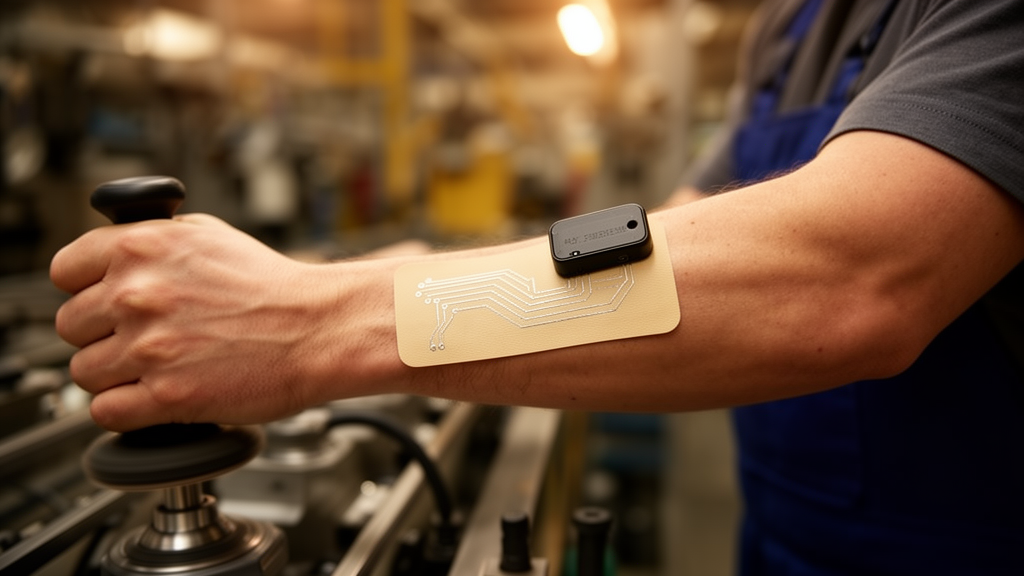
A wrist patch made from little more than paper, self-made silver nanoparticles, and a few dollars of off-the-shelf electronics can watch how you bend your wrist all day and warn you—on your smartphone—the moment your posture crosses into territory that raises the risk of carpal tunnel syndrome. That is the promise of a new study published in Frontiers in Nanotechnology, in which researchers at Vellore Institute of Technology in India describe a flexible, low-cost wearable that turns an ordinary sheet of photosheet paper into a self-sensing ergonomic guardian.
Carpal tunnel syndrome is the most common peripheral nerve entrapment disorder in the world, and its numbers are sobering. Epidemiological data suggest that roughly 3.8 percent of the general population is affected, and about one in ten people will experience it at some point in their lives. The condition arises when the median nerve, which runs through a narrow channel in the wrist formed by the carpal bones and the transverse carpal ligament, becomes compressed. The result is pain, numbness, tingling, and weakness in the thumb, index, middle, and part of the ring finger. Women are affected more often than men—9.2 percent versus 6 percent—partly because of hormonal influences and a comparatively smaller carpal tunnel anatomy.
The burden falls disproportionately on the working population. Between 60 and 70 percent of cases occur in people aged 30 to 60, the years when occupational strain and repetitive wrist movements peak. Industrial and textile workers face the highest occupational risks, but office workers are far from immune, with prolonged keyboard and mouse use and poor wrist posture emerging as major contributors. Worryingly, symptoms are increasingly reported by people in their twenties and thirties, driven by extended use of laptops, smartphones, and gaming consoles. Once symptoms appear, diagnosis relies on electromyography, nerve conduction studies, and clinical examination—all of which require specialised equipment and trained staff, and all of which come after the damage has begun.
The key insight behind the new device is prevention. Physiological evidence shows that wrist flexion or extension beyond roughly 20 degrees increases pressure inside the carpal tunnel, squeezing the median nerve and raising the risk of developing or worsening the syndrome. If a wearable could continuously detect when a wearer’s wrist crosses that threshold, it could intervene before symptoms ever appear. Existing technologies struggle to fill this role affordably: inertial measurement units offer precise tracking but carry numerous electrical components, constant power draw, and complex signal processing; electromyography needs skin-contact electrodes and elaborate conditioning circuits; vision-based systems depend on camera placement and lighting; and conventional flex sensors add cost and degrade with repeated bending.
The Indian team’s answer was to print the sensor rather than buy it. They synthesised silver nanoparticles themselves using a wet-chemical reduction method, dissolving silver nitrate in distilled water and adding it drop by drop to a heated stabiliser solution containing polyvinylpyrrolidone, glucose, and sodium hydroxide. Glucose acts as the reducing agent, converting silver ions into metallic silver, while the PVP molecules cap the growing particles and prevent them from clumping into larger aggregates. The resulting brown dispersion was washed, centrifuged at 7,500 rpm, and dried overnight at 60 degrees Celsius to yield free-standing nanoparticles.
Characterisation confirmed the chemistry had worked as intended. X-ray diffraction showed the four signature peaks of face-centred cubic silver at 38.2, 44.3, 64.5, and 77.5 degrees, and a prominent surface plasmon resonance band at 400 nanometres in the ultraviolet-visible spectrum indicated stable, roughly spherical particles. Field-emission electron microscopy revealed particles ranging from 64.9 to 276.7 nanometres with an average size of 154.8 plus or minus 44.9 nanometres—larger than the 50 to 100 nanometres typical of commercial silver inks, but deliberately so, since the moderately larger particles disperse more stably, print more reliably, and are less prone to clog nozzles. Energy-dispersive analysis confirmed the particles were overwhelmingly elemental silver with only a faint oxygen signal, evidence of minimal oxidation.
Those nanoparticles were then stirred into a water-and-ethanol binder solution of polyvinyl alcohol and gum arabic, a natural polymer that improves colloidal stability and film formation. The blend was sonicated, rested for 24 hours, and patterned onto a flexible photosheet substrate, then sintered at a modest 60 degrees Celsius—a temperature low enough to keep the paper intact. Sintering strips away the PVP capping layer and allows the silver particles to interweave, boosting electrical conductivity. Silver contacts were painted on with conductive paste, and the finished patch measured just 35.47 micrometres thick, with an average surface roughness of 259 nanometres and a smooth, well-organised coating free of aggregation.
The sensing principle is elegantly simple. When the wrist bends, the printed conductive pattern deforms, the contact between adjacent silver nanoparticles changes, and the electrical resistance of the path rises in proportion to the bending angle. At the clinically accepted ergonomic threshold of 20 degrees of wrist flexion, the patch read 67.5 ohms with a relative resistance change of 0.058—a direct experimental calibration point for the warning algorithm. The device proved remarkably fast and accurate for its price: a gauge factor of 230, a response time of 0.37 seconds, a recovery time of 0.61 seconds, and hysteresis of just 1.44 percent, meaning the signal barely deviates between bending and straightening cycles. Over 1,000 bending cycles, resistance drifted only from 67.90 to 86.64 ohms, and the response held steady across varying humidity and temperature—important for industrial workers who sweat and toil in conditions that office air-conditioning never approaches.
To turn raw resistance into useful advice, the patch was wired into a voltage divider read by an Arduino Uno. As bending increases resistance, the analogue-to-digital converter value falls, letting a simple threshold-based algorithm classify posture into five stages: Normal Position, Bending, Adjust Wrist Position, Recovery, and back to Normal. When resistance exceeded the threshold corresponding to dangerous wrist angles, the system flagged the danger. An HC-05 Bluetooth module relayed the status to a custom application built in MIT App Inventor, which displayed the wrist posture on a smartphone in real time. In demonstrations, the system correctly tracked the full cycle from neutral posture through maximal bending, prompted a correction, and confirmed the return to a safe position—all without flex sensors, inertial units, or any specialised sensing hardware.
The economics may be the most disruptive part of the story. The entire laboratory prototype, including the sensor patch, Arduino, Bluetooth module, power supply, and wiring, cost between USD 12 and 15, with the paper-based patch itself contributing only a fraction of that total. Compared with flex-sensor, IMU, EMG, and vision-based alternatives—all rated as high to very high in cost, power consumption, or both—the paper patch offers a lightweight, flexible, and genuinely portable alternative suited to continuous workplace deployment. The authors caution that long-term durability and large-scale, real-world trials remain ahead, along with plans for a more durable composite conductive ink and integration with internet-of-things occupational health platforms. But the demonstration stands: for roughly the price of a lunch, a printed strip of silver-on-paper can watch a worker’s wrists all shift long and quietly say, before the pain ever starts, that it is time to change position.
Subject of Research: A paper-based silver nanoparticle wearable sensor for real-time wrist posture monitoring and early warning of carpal tunnel syndrome risk
Article Title: Flexible paper-based self-sensing biomechanical ergonomics monitoring system for early warning of carpal tunnel syndrome risks
Article References: Sarva, P. S., & Karunanidhi, G. (2026). Flexible paper-based self-sensing biomechanical ergonomics monitoring system for early warning of carpal tunnel syndrome risks. Frontiers in Nanotechnology, 8, Article 1940496. https://doi.org/10.3389/fnano.2026.1940496
Image Credits: AI Generated
DOI: 10.3389/fnano.2026.1940496
Keywords: carpal tunnel syndrome, wearable sensors, silver nanoparticles, conductive ink, flexible electronics, ergonomics, wrist posture monitoring, printed electronics, Arduino, Bluetooth, occupational health, strain sensors
Cite Scienmag News
Denise Maddox. (October 15, 2026). Paper-Based Silver Ink Patch Warns Workers of Carpal Tunnel Risk in Real Time. Scienmag. https://scienmag.com/paper-based-silver-ink-patch-warns-workers-of-carpal-tunnel-risk-in-real-time/
Denise Maddox. "Paper-Based Silver Ink Patch Warns Workers of Carpal Tunnel Risk in Real Time." Scienmag, 15 October 2026, https://scienmag.com/paper-based-silver-ink-patch-warns-workers-of-carpal-tunnel-risk-in-real-time/. Accessed 15 October 2026.
Denise Maddox. "Paper-Based Silver Ink Patch Warns Workers of Carpal Tunnel Risk in Real Time." Scienmag. October 15, 2026. https://scienmag.com/paper-based-silver-ink-patch-warns-workers-of-carpal-tunnel-risk-in-real-time/


