


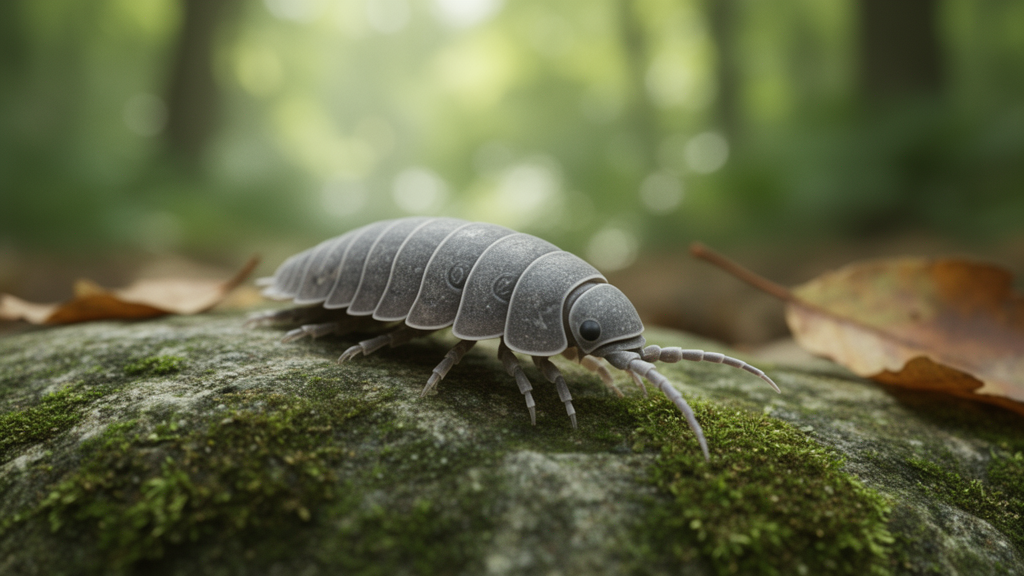
Beneath rotting logs and damp leaf litter across China lives a group of small, armored crustaceans that has quietly puzzled zoologists for nearly a century. Terrestrial isopods, the familiar woodlice and pillbugs, are among the few crustaceans to have conquered life on land, and their classification has long depended on subtle details of body armor and appendages. Now, a new study published in Zoosystematics and Evolution has used the combined power of DNA sequencing and traditional morphology to settle a long-standing dispute between two woodlouse genera, sinking one of them entirely and revealing three species previously unknown to science.
The dispute centered on Koreoniscus, a genus erected in 1937 by the German zoologist Karl Verhoeff, and Mongoloniscus, a closely related genus he had described just seven years earlier. For decades, the two groups were separated by essentially a single feature: the side plates of the thorax, known as pereonal epimera, which in Koreoniscus extend backward with wavy, sinuous margins. The Korean taxonomist Dong-Gi Kwon, who revised the group in 1993, had already flagged the arrangement as uncertain, noting that the two genera differed in little else and that a comprehensive study was needed before Koreoniscus could be considered genuinely distinct.
That comprehensive study has now arrived. A team led by researchers at the China Academy of Chinese Medical Sciences collected fresh specimens from multiple localities across China and applied an integrative taxonomic approach, weaving together careful morphological examination with phylogenetic analyses of three genetic markers: the mitochondrial protein-coding gene COI, the mitochondrial ribosomal gene 16S rRNA, and the nuclear ribosomal gene 28S rRNA. The final dataset spanned 89 taxa and 3,075 aligned nucleotide positions, providing a dense evolutionary framework for testing whether the old generic boundaries reflected real evolutionary history.
The answer was unambiguous. In both maximum-likelihood and Bayesian phylogenetic trees, the species assigned to Koreoniscus did not form their own coherent evolutionary lineage. Instead, they were scattered within the major clades of Mongoloniscus, intermingled with species that lacked the distinctive sinuous epimera altogether. Under this topology, keeping Koreoniscus as a separate genus would render Mongoloniscus paraphyletic, a situation taxonomists regard as untenable because it would split a single natural lineage into artificial groups. The team therefore formally designated Koreoniscus as a junior synonym of Mongoloniscus, transferring its two species into the older genus as new combinations: Mongoloniscus racovitzai and Mongoloniscus huaguoshanensis.
The genetic data also delivered a clean signal at the species level. Using the Kimura two-parameter model, the researchers calculated that the maximum genetic distance within a species, 4.52 percent, was comfortably lower than the minimum distance between species, 6.34 percent. This barcode gap, a cornerstone of DNA-based species identification, provided independent confirmation that the lineages recognized in the trees correspond to genuine biological entities rather than artifacts of sampling or sequencing noise.
Three of those lineages turned out to be entirely new to science. Mongoloniscus beijingensis was collected in forest parks around Beijing and is distinguished by a blunt, obtusely angled prominence on the rear margin of its first thoracic segment, along with a straight upper edge on the wrist segment of the seventh walking leg. Mongoloniscus xianensis, from waterfalls and mountain scenery near Xi’an in Shaanxi Province, and Mongoloniscus arciprominens, from Henan Province, form a closely related sister-species pair. Both bear a continuous, arc-shaped prominence merging the rear and lateral margins of the thorax, but they can be told apart by fine details of the male reproductive appendages: in M. xianensis the outer lobe of the first pleopod’s exopod is longer than the inner lobe, while in M. arciprominens the two lobes are roughly equal in length.
These distinctions may sound arcane, but in woodlouse taxonomy they are the equivalent of a fingerprint. Male pleopods, small paddle-like appendages on the underside of the abdomen used in mating, are among the most reliable diagnostic structures in the group, and the researchers dissected and illustrated them in meticulous detail for every species. All specimens were fixed in 75 percent ethanol, stained with acid fuchsin, and examined under high-resolution microscopy, with digital line drawings traced from photographs to ensure that every seta and tooth was documented accurately. Only fully mature adults, identified by well-developed sexual characters, were used, reducing the risk that growth-related variation would muddy the comparisons.
The molecular species-delimitation analyses added a further layer of rigor, and some intrigue. Three independent methods, ABGD, ASAP, and the Bayesian Poisson Tree Processes model, all recognized the three new species as distinct, but they did not always agree with one another on finer subdivisions. Most strikingly, all three methods split M. beijingensis into two putative units, yet a careful morphological re-examination found no diagnostic differences between them, and the samples showed no clear geographic separation. The team provisionally treats the Beijing species as a single entity, but the molecular divergence may represent an early stage of speciation, a snapshot of evolution in action that future work on gene flow, habitat factors such as soil chemistry and microclimate, and quantitative shape analysis could help interpret.
The broader significance of the study extends well beyond a handful of woodlice. Terrestrial isopods are morphologically conservative, meaning that distantly related species can look strikingly similar while closely related ones can differ in subtle ways, a combination that has repeatedly misled classification based on external appearance alone. Recent integrative studies across the group have uncovered cryptic species and exposed inconsistencies in morphology-based taxonomy, from the Asian genus Lucasioides, where molecular work revealed seven new cryptic species, to the European genus Tiroloscia, where DNA data resurrected a long-forgotten valid species. The present study adds Mongoloniscus to that growing list and refines the generic system of the family Agnaridae, to which these animals belong.
For a group of animals often dismissed as garden-variety detritivores, the results carry a certain viral appeal: a genus named in 1937, accepted in textbooks and checklists for nearly ninety years, dissolved by a few hundred base pairs of mitochondrial DNA and a handful of dissected appendages. The three new species, each named for its type locality or its distinctive arcuate body armor, bring the Chinese Mongoloniscus fauna to fifteen recognized species, all now resting on a firmer evolutionary footing. As molecular tools continue to meet museum-era morphology, the leaf litter of East Asia may yet yield many more surprises hiding in plain sight.
Subject of Research: Integrative taxonomy and molecular phylogenetics of terrestrial isopod genera in the family Agnaridae
Article Title: Integrative taxonomy reveals Koreoniscus as a junior synonym of Mongoloniscus ( Isopoda , Agnaridae ), with the description of three new species
Article References: Zhong, J., Li, W., & Jiang, C. (2026). Integrative taxonomy reveals Koreoniscus as a junior synonym of Mongoloniscus (Isopoda, Agnaridae), with the description of three new species. Zoosystematics and Evolution, 102(5), 1203-1220. https://doi.org/10.3897/zse.102.186565
Image Credits: AI Generated
Keywords: terrestrial isopods, woodlice, integrative taxonomy, Mongoloniscus, Koreoniscus, Agnaridae, DNA barcoding, COI, phylogenetics, species delimitation, new species, China
Cite Scienmag News
Gavin Prescott. (October 15, 2026). DNA Upends a Century of Woodlouse Taxonomy and Reveals Three New Species. Scienmag. https://scienmag.com/dna-upends-a-century-of-woodlouse-taxonomy-and-reveals-three-new-species/
Gavin Prescott. "DNA Upends a Century of Woodlouse Taxonomy and Reveals Three New Species." Scienmag, 15 October 2026, https://scienmag.com/dna-upends-a-century-of-woodlouse-taxonomy-and-reveals-three-new-species/. Accessed 15 October 2026.
Gavin Prescott. "DNA Upends a Century of Woodlouse Taxonomy and Reveals Three New Species." Scienmag. October 15, 2026. https://scienmag.com/dna-upends-a-century-of-woodlouse-taxonomy-and-reveals-three-new-species/


