


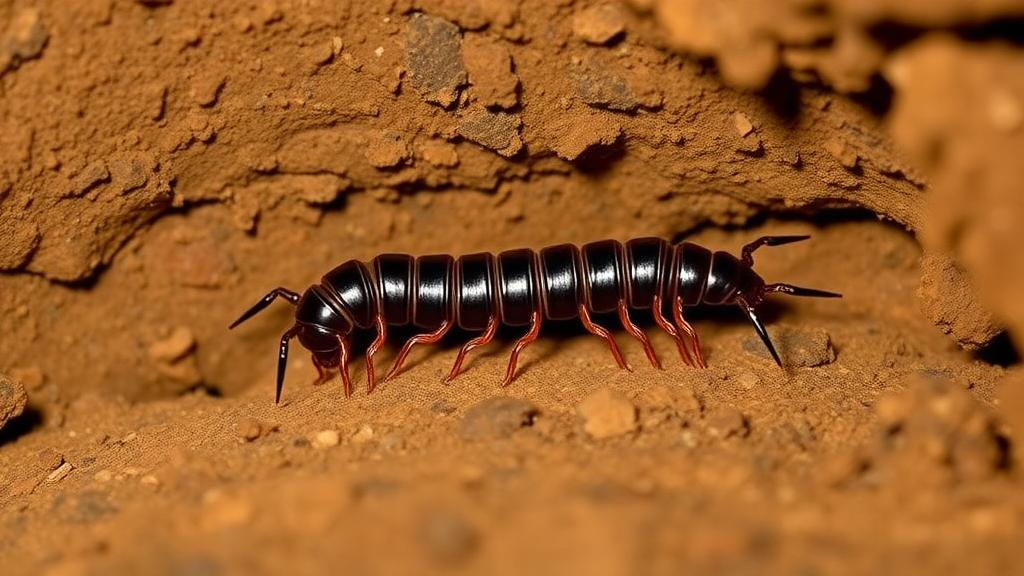
Deep inside two hypogenic caves of Serra da Bodoquena National Park in Mato Grosso do Sul, western Brazil, researchers have found a centipede so specialized for underground life that it represents only the second troglomorphic species of its genus ever recorded anywhere in the world. The newly described predator, Otostigmus (Parotostigmus) troglobius sp. nov., was identified from specimens collected in the Bacuri and Dente de Cão caves and characterized using a combination of external morphology and mitochondrial DNA analysis. The discovery, published in the journal Subterranean Biology, adds a striking new member to the fauna of a region already regarded as a hotspot for Brazil’s subterranean biodiversity.
The genus Otostigmus is one of the most diverse lineages within the order Scolopendromorpha, the group that contains many of the world’s large, venomous scolopendrid centipedes. Around 110 species are currently recognized, distributed across the Neotropical region, Africa, the Indo-Australian region and the Nearctic. Three subgenera are accepted: Otostigmus, Parotostigmus and Dactylotergitius. Parotostigmus is almost exclusively Neotropical, while Dactylotergitius is mostly Brazilian with a few records from Argentina. Despite this diversity, only a single species of the genus had ever been recognized as troglobitic: Otostigmus troglodytes, described in 1914 from material collected in Kulumuzi B cave in the Tanga district of Tanzania during an expedition to East Africa between 1911 and 1912. Dozens of centipedes were collected on that expedition, but only eight species were found inside caves, and only O. troglodytes showed the troglomorphic traits that signal permanent cave residence.
In Brazil, 18 species of Otostigmus are known, 16 of them belonging to the subgenus Parotostigmus and two to Dactylotergitius. Earlier surveys recorded four species of the genus in Brazilian caves — O. caudatus, O. muticus, O. tibialis and O. tidius — but all were considered accidental visitors rather than true cave dwellers. Unidentified Otostigmus specimens have been recorded from caves in the north, west, northeast, southeast and south of the country, yet none had shown clear adaptations to the subterranean environment. The new species changes that picture fundamentally, because the specimens from Serra da Bodoquena display a suite of characters that mark them as obligate cave inhabitants rather than stray surface centipedes.
Serra da Bodoquena lies in the southeastern part of Mato Grosso do Sul, near the border with Paraguay, at an intersection between the Cerrado and the Atlantic Forest, two of Brazil’s best-known biodiversity hotspots, and on the southwestern edge of the Pantanal. Serra da Bodoquena National Park covers 76,481 hectares, stretching 300 kilometers in length and 20 to 50 kilometers in width, and is divided into two polygons bordered by the Salobra River and Olaria Stream in the north and by the Perdido, Formoso and Prata Rivers in the south. Average annual temperatures range from 20 to 22 degrees Celsius and precipitation from 1,000 to 2,000 millimeters, with a dry season from May to September and a rainy season from October to April. Both caves where the new centipede was found lie within the park and share a hypogenic karst pattern, meaning they were dissolved from below by rising waters rather than carved by surface streams.
The Dente de Cão Cave is 3 kilometers long and 220 meters deep, known for its anastomotic, ramiform pattern in which larger chambers are connected by smaller passages and for the absence of fluvial sediments — a textbook example of hypogenic karst. The Bacuri Cave is smaller and located about 3 kilometers away in a straight line, but exhibits the same hypogenic pattern. The centipedes were collected by hand and preserved in either 70 or 100 percent ethanol; the type material is deposited at the Zoological Collection of the Federal University of Mato Grosso in Cuiabá. On three occasions the animals were observed in the aphotic zone of the caves, twice walking among calcareous encrustations on the cave walls and once on the cave floor. They move very quickly on their long legs, which closely resemble the armed legs of members of the order Scutigeromorpha, the house centipedes famous for their speed.
Morphologically, the new species is unmistakably troglomorphic. The holotype measures 47.79 millimeters in body length, and its antennae are exceptionally long at 16.67 millimeters, reaching back to the anterior margin of the seventh tergite when folded, with 17 articles each. The ultimate legs are extremely long and slender at 23.31 millimeters, with cylindrical prefemur, femur, tibia and tarsi. The diagnosis also includes legs 1 to 4 with one tibial spur, legs 1 to 17 with two tarsal spurs, tergites 1 to 3 without sutures, tergites 4 to 7 with short sutures on the anterior margin, tergites 8 to 20 with complete paramedian sutures, tergites 7 to 20 bearing a longitudinal keel, sternites 3 to 16 with short sutures on the anterior margin, sternites 6 to 16 with two shallow rounded depressions, and very long, slender, cylindrical twenty-first legs. In life, the animals show a remarkable coloration: the anterior cephalic plate is whitish, while the posterior cephalic plate, first tergite and forcipular coxosternite are violet, the second and twentieth tergites purplish blue, and the remaining tergites and sternites light purplish blue, with light blue antennae.
To test whether the specimens from the two different caves truly represent a single new species, the team extracted DNA from legs of the collected animals using a commercial extraction kit and amplified the mitochondrial marker Cytochrome C Oxidase subunit I, or COI, with the universal primers HCO2198 and LCO1490. Raw sequences were edited in Geneious, consensus sequences constructed in MEGA 12 and aligned with the Muscle algorithm. Known sequences of Otostigmus were obtained from the BOLD reference database, and the generated sequences were submitted to the NCBI database to verify similarity with previously known centipede species using the BLAST tool. Species delimitation was then performed with five independent methods: Assemble Species by Automatic Partitioning (ASAP), Bayesian Poisson Tree Processes (bPTP), General Mixed Yule Coalescent (GMYC), Multi-rate Poisson Tree Processes (mPTP) and Poisson Tree Processes (PTP). For the coalescence-based methods, an ultrametric tree was constructed in BEAST2 with the HKY evolution model selected by the Bayesian Information Criterion, a relaxed molecular clock and a Birth-Death speciation model, run in three independent chains of 10 million generations.
The number of recovered molecular operational taxonomic units, or MOTUs, varied with the method: 37 with ASAP, 40 with bPTP, 40 with GMYC, 17 with mPTP and 40 with PTP, yielding 40 consensus MOTUs. Crucially, the specimens from Bacuri and Dente de Cão caves, although not found in the same cave, grouped together into a single congruent consensus MOTU, validating the new species on both morphological and genetic grounds. The intraspecific genetic distance for O. troglobius was 1.34 percent, well below the Optimal Threshold of 2.33 percent calculated for the dataset. Interspecific distances to its congeners ranged from 11.20 percent to 24.59 percent, with the closest described species, O. aculeatus, differing by 11.66 percent and O. politus and O. multidens by 22.99 percent. The occurrence of populations in both caves indicates that these caves may be, or may have been, connected by cracks and small passages in the ground that allowed species to disperse between them and other caves throughout the region.
Among currently recognized Otostigmus species, genetic divergence is high overall, and the analysis flagged several taxa with strikingly large intraspecific variation: O. aculeatus at 8.14 to 9.64 percent, O. astenus at 14.41 to 16.75 percent, O. multidens at 10.97 to 19.72 percent, O. politus at 8.75 to 9.67 percent, O. rugulosus at 12.16 to 22.42 percent, O. spinosus at 2.72 to 10.79 percent, O. sulcipes at 17.74 to 19.77 percent, and O. tricarinatus at 0.29 to 24.42 percent. By contrast, O. troglobius at 1.34 percent, O. consonensis at 0.38 to 0.57 percent and O. reservatus at 0.00 to 0.76 percent showed low variation. These patterns suggest the possible existence of cryptic species complexes within the genus. The scarcity of genetic data for neotropical lineages in GenBank and BOLD may be influencing the distance values; until now, among neotropical Otostigmus species, only O. caraibicus had sequences deposited in these databases, so the new data represent a significant advance for the genus in the region.
Taxonomically, the new species is closest to O. inermis, O. sulcatus, O. lanceolatus and O. tidius, but differs from all of them mainly in body length, which reaches about 48 millimeters in the new species compared with roughly 30 millimeters in the related forms. The tergites of O. inermis and O. sulcatus are smooth, whereas in the new species only the first six tergites are smooth, with granules increasing gradually from the seventh segment onward. The ultimate legs resemble those of O. sulcatus and O. lanceolatus in their slenderness but differ in total length and in the shape of the tibia and tarsi, which in those species are laterally flattened with a spear-like or leaf-like appearance. It resembles O. tidius chiefly in the median keels on the tergites and the short, incomplete sutures on the anterior sternites, but is much longer and exhibits troglomorphic characters absent in the related species, including elongation of the antennae, walking legs, accessory spurs and ultimate legs. The species name troglobius is a Latin word meaning troglobiont, an animal that lives only in caves, referring to its habitat.
Fieldwork in the surroundings of the caves also sampled three surface morphospecies of Otostigmus — O. tibialis, O. muticus and an unidentified Otostigmus sp. — all quite distinct from the new cave species. Remarkably, in Bacuri Cave, O. troglobius occurs alongside another troglobitic species, Newportia eleonorae, described only recently, while in Dente de Cão Cave it shares its range with another troglobitic geophilomorph centipede of the genus Schendylops that is currently under description. Together with additional troglobitic species being described from these caves, the findings highlight the exceptional biological significance of the subterranean environments of Serra da Bodoquena and reinforce the urgent need for the preservation of Brazil’s speleological heritage.
Subject of Research: Evolutionary biology
Article Title: A new troglomorphic centipede species of genus Otostigmus Porat, 1876 ( Scolopendromorpha , Scolopendridae , Otostigminae ) from Serra da Bodoquena, Mato Grosso do Sul, Brazil
Article References: Chagas-Jr, A., & Barbosa Fernandes, H. (2026). A new troglomorphic centipede species of genus Otostigmus Porat, 1876 (Scolopendromorpha, Scolopendridae, Otostigminae) from Serra da Bodoquena, Mato Grosso do Sul, Brazil. Subterranean Biology, 58, 27-42. https://doi.org/10.3897/subtbiol.58.198345
Image Credits: AI Generated
DOI: 10.3897/subtbiol.58.198345
Keywords: troglomorphic, centipede, species, genus, Otostigmus, Porat, Scolopendromorpha, Scolopendridae, Otostigminae, Serra, Bodoquena, Mato
Cite Scienmag News
Gavin Prescott. (October 15, 2026). Second cave-dwelling centipede of its kind discovered in Brazil’s Serra da Bodoquena. Scienmag. https://scienmag.com/second-cave-dwelling-centipede-of-its-kind-discovered-in-brazils-serra-da-bodoquena/
Gavin Prescott. "Second cave-dwelling centipede of its kind discovered in Brazil’s Serra da Bodoquena." Scienmag, 15 October 2026, https://scienmag.com/second-cave-dwelling-centipede-of-its-kind-discovered-in-brazils-serra-da-bodoquena/. Accessed 15 October 2026.
Gavin Prescott. "Second cave-dwelling centipede of its kind discovered in Brazil’s Serra da Bodoquena." Scienmag. October 15, 2026. https://scienmag.com/second-cave-dwelling-centipede-of-its-kind-discovered-in-brazils-serra-da-bodoquena/


