


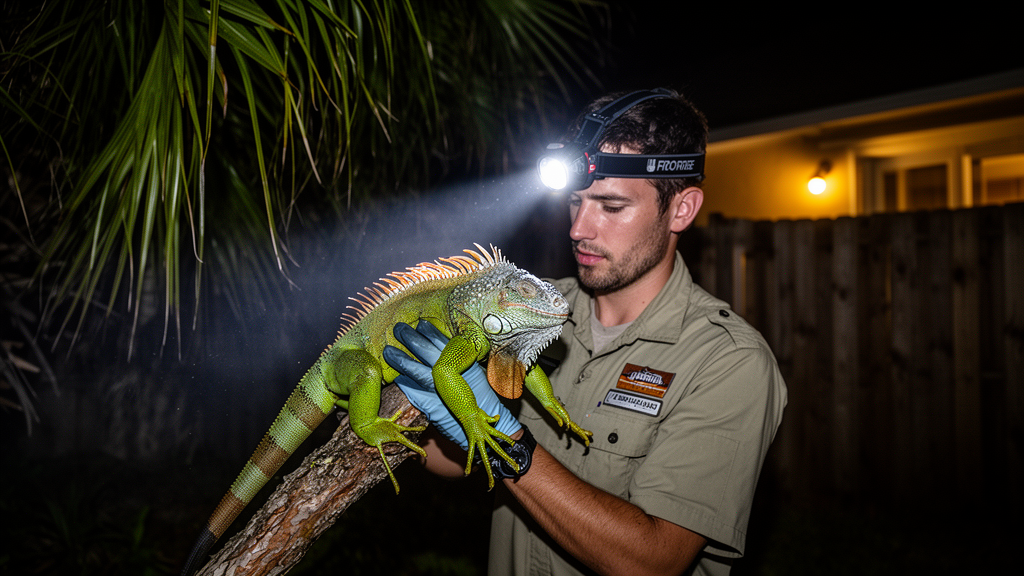
On warm nights along a canal in Broward County, Florida, teams armed with high-lumen headlamps and tactical flashlights scan the trees overhanging the water, where green iguanas sleep motionless and exposed. This nocturnal bulk-removal technique, exploited for its efficiency against a diurnal lizard that is otherwise alert and wary by day, has become one of the most promising tools for managing one of South Florida’s most visible invasive species. But a new study from researchers at the University of Florida shows that even a three-month campaign of nighttime removals that took more than 800 iguanas off a single canal section was not enough to produce a lasting dent in the population, a finding that carries sobering implications for how invasive reptiles are managed across the state and beyond.
The research, published in Frontiers in Amphibian and Reptile Science, evaluated a real-world contracted iguana removal effort rather than an artificial experiment, a choice the authors say was essential for understanding what management can actually accomplish. The team, led by Frank J. Mazzotti, Sergio A. Balaguera-Reina, Sidney T. Godfrey, Nathan P. Schwartz, and Melissa A. Miller from the University of Florida’s Fort Lauderdale Research and Education Center, focused on two roughly two-kilometer, unconnected sections of the C-11 Canal in Broward County. One section served as the treatment population, where removals took place; the other served as a control, where iguanas were counted but left alone. The sections were spaced 438 meters apart, separated by a stretch of canal and a street with no vegetation and no iguanas, allowing the researchers to treat them as distinct populations for the purposes of their surveys.
Green iguanas are native to a range stretching from northern Mexico through southern Brazil and portions of the Lesser Antilles, but in Florida they are an established invader with documented adverse effects. They damage native, ornamental, and agricultural plants, disperse non-native plant seeds, foul patios, pools, and canals with feces, and burrow into infrastructure such as runways, seawalls, and levees. Florida hosts more nonnative reptiles and amphibians than anywhere else in the world, with at least 180 introduced species and more than 60 established breeding populations. The green iguana’s expanding numbers, which grew after a historic freeze event in 2010, prompted Florida to designate the species as Prohibited on 29 April 2021, restricting possession and sale with few exceptions.
Conventional removal methods, including hand grabbing, live traps, noosing, tongs, netting, and shooting, are typically applied during the day when iguanas are active. But daytime methods are best suited to small, localized populations. For the large populations found on public lands managed for flood control and water supply, the researchers turned to a nocturnal approach that takes advantage of the iguanas’ tendency to rest in trees at night, especially over water, where sleeping animals are visible and vulnerable. Between mid-February and mid-May 2018, the team conducted 30 nocturnal removal surveys by boat and by truck and foot in the treatment section, using 900-lumen headlamps and a 1,000-lumen tactical flashlight to locate iguanas in the canopy before attempting removal with extendable poles, tongs, nets, or by hand.
The effort removed a total of 808 iguanas, with a mean of 27 per survey and a range of 3 to 106 per night. Of these, 168 were adult males, 299 were adult females, 104 were juvenile males, 233 were juvenile females, and 3 were of unknown sex. No hatchlings were captured because the removal window fell outside the May-to-August hatching season in Florida. Overall, 66 percent of removed iguanas were female and 58 percent were adults. The mean snout-vent length of removed animals was 22.5 centimeters, mean total length was 72.7 centimeters, and mean mass was 0.46 kilograms, with the largest individual reaching 3.40 kilograms. All iguanas were euthanized immediately after removal in accordance with Florida state law on Prohibited species and under an approved University of Florida animal care protocol.
To evaluate whether these removals actually reduced abundance, the researchers conducted 20 diurnal count surveys by boat across four periods: before removals in January and February 2018, immediately after in May 2018, three months after in August 2018, and twelve months after in May 2019. Across all surveys they observed 4,741 green iguanas, with the highest counts during the pre-removal period, when 937 iguanas were seen in the control section and 953 in the treatment section. Immediately after the removal campaign, counts in the treatment section dropped to 328, the lowest observed for that population during the study, while the control section remained comparatively high. Three months later, the treatment section had begun to rebound, and by twelve months the number of iguanas observed in the treatment and control sections was no longer significantly different.
Statistical modeling using generalized linear mixed models revealed a pattern that complicates straightforward interpretation. Julian date, a proxy for seasonality, was the only variable with a significant negative effect on daytime iguana counts, predicting a reduction of at least one iguana observed per day across the sampled year. Critically, the control population also showed a substantial seasonal decline, falling from 761 to 412 iguanas between the first and final survey periods, a reduction not as extreme as the treatment population’s but still substantial. This suggests that the biology of invasive iguanas, including seasonal patterns in detectability and activity, plays a major role in apparent abundance, independent of any management intervention. The authors caution that catch-per-unit-effort, a common index of abundance in removal studies, can be misleading when detectability varies with season, wariness, or environmental conditions.
The removal data themselves showed clear signs of diminishing returns. Mean catch-per-unit-effort was 5.29 iguanas per hour and 5.49 iguanas per kilometer, but per-survey values decreased from 13.93 iguanas per hour during the first survey to 8.19 during the last. Capture probability, the proportion of detected iguanas actually removed, averaged 0.21 and declined from 0.51 in the first survey to 0.21 in the last, possibly reflecting increasing wariness among surviving animals. The researchers also noted practical constraints: adult iguanas perched beyond the reach of extendable poles or hidden in burrows along the canal banks escaped removal, and the proximity of vehicles, walkways, and buildings ruled out more effective methods such as firearms.
Comparisons with other invasive species management efforts underscore the challenge. Research on green iguanas in the Cayman Islands found that harvest rates below 60 percent can paradoxically cause populations to increase rapidly, as reduced density releases survivors from density-dependent factors regulating survival and fecundity. Studies of invasive tegus in Florida found that a removal rate of 40 percent was needed to decrease the population, with rates of 30 percent allowing growth. The relatively small proportion of iguanas removed in the Broward County study, combined with the capture probability of roughly 21 percent, could explain the rebound in counts observed twelve months after the removal campaign ended.
The authors argue that one-time removal efforts, or repeated efforts conducted over a short duration, are insufficient to control population growth, and they recommend continuous, persistent removal combined with independent monitoring surveys designed to explicitly calculate detection probability, for example through N-mixture models. They also emphasize that removal is a management action, not a management objective in itself; success should be measured against goals such as population reduction, containment, mitigation of impacts on native species, prevention of infrastructure damage, or reduced risks to human health and safety. Targeted removal during the breeding season, when nesting females and their eggs can be taken together, and during the May-to-August hatching season, when young iguanas emerge in large numbers, could improve efficiency, as could supplementing nocturnal removal with burrow targeting, habitat alteration, and exclusion. But the deeper lesson, the researchers conclude, is that fundamental knowledge gaps in the population ecology of green iguanas in Florida, including movements, habitat use, nesting, vital rates, and phenology, currently hinder the development of effective management strategies. Closing those gaps, they argue, is essential to managing this well-established and problematic invader.
Subject of Research: Evaluation of nocturnal bulk removal as a control method for invasive green iguana populations in South Florida
Article Title: Evaluating invasive reptile control efforts: nocturnal bulk removal of green iguanas (Iguana iguana Linnaeus, 1758) in Florida, USA
Article References: Mazzotti, F. J., Balaguera-Reina, S. A., Godfrey, S. T., Schwartz, N. P., & Miller, M. A. (2026). Evaluating invasive reptile control efforts: nocturnal bulk removal of green iguanas (Iguana iguana Linnaeus, 1758) in Florida, USA. Frontiers in Amphibian and Reptile Science, 4, Article 1846355. https://doi.org/10.3389/famrs.2026.1846355
Image Credits: AI Generated
DOI: 10.3389/famrs.2026.1846355
Keywords: green iguana, invasive species, Florida, nocturnal removal, population control, catch-per-unit-effort, wildlife management, Broward County, reptile ecology, detectability, seasonality, Frontiers in Amphibian and Reptile Science
Cite Scienmag News
Margaret Porter. (October 15, 2026). Nighttime Raids on Sleeping Iguanas Reveal the Limits of Florida’s Invasive Reptile Control. Scienmag. https://scienmag.com/nighttime-raids-on-sleeping-iguanas-reveal-the-limits-of-floridas-invasive-reptile-control/
Margaret Porter. "Nighttime Raids on Sleeping Iguanas Reveal the Limits of Florida’s Invasive Reptile Control." Scienmag, 15 October 2026, https://scienmag.com/nighttime-raids-on-sleeping-iguanas-reveal-the-limits-of-floridas-invasive-reptile-control/. Accessed 15 October 2026.
Margaret Porter. "Nighttime Raids on Sleeping Iguanas Reveal the Limits of Florida’s Invasive Reptile Control." Scienmag. October 15, 2026. https://scienmag.com/nighttime-raids-on-sleeping-iguanas-reveal-the-limits-of-floridas-invasive-reptile-control/


