


…
The discovery that a single gall midge species, Bruggmanniella perseae, accounts for the fruit deformation observed in Nayarit carries practical significance for growers and plant health officials alike. When multiple pest species co-occur in a region, management recommendations become complicated because each insect may respond differently to timing of interventions, host plant susceptibility, and natural enemy complexes. The confirmation that only one gall-inducing species is involved simplifies the diagnostic picture considerably. Growers noticing deformed small fruits in their orchards can now be reasonably confident, at least within the surveyed municipalities of Tepic and Xalisco, that the culprit is B. perseae rather than the polyphagous Asphondylia websteri, which has also been recorded from avocado in Mexico but whose actual impact on the crop remains poorly documented. This kind of taxonomic clarity is a prerequisite for any subsequent work on pest biology, monitoring thresholds, or biological control.
The gall midge’s mode of development helps explain why the damage manifests as fruit deformation and eventual abortion. The female presumably oviposits into very young fruits, and the larva develops within a chamber inside the developing pericarp. As the third instar matures, it excavates a tunnel toward the fruit surface and pupates near the exterior, a behavior that facilitates adult emergence but also disrupts internal tissues at a critical stage of fruit development. Because the affected fruits are only one to two centimeters in diameter, the injury occurs during the earliest phase of fruit set, when the tree is naturally shedding a large proportion of its initial fruit load through abscission. This raises the unresolved question highlighted by the researchers: whether the gall midge imposes genuine economic losses by attacking fruits that would have developed into harvestable yield, or whether it merely exploits fruits already destined to drop. Distinguishing between these scenarios would require comparing fruit retention and final yield in orchards with varying levels of infestation.
Avocado phenology is central to this question. In many avocado varieties, including Hass, a substantial fraction of newly set fruits abscise naturally within the first weeks after flowering, a physiological process that allows the tree to match its fruit load to available resources. Gall midges that attack only fruits in the one to two centimeter range may therefore be interacting with a window of natural fruit thinning. If infested fruits are predominantly those that would have abscised anyway, the pest’s economic importance may be modest, and the observed parasitoid community could be performing a valuable regulatory service without any need for intervention. Conversely, if the midge attacks fruits that would otherwise persist, even moderate infestation rates could translate into measurable yield reductions, particularly in years when flowering is compressed and the vulnerable window is brief. Long-term monitoring across multiple seasons would be needed to resolve this.
The sampling design of the Nayarit study offers a useful model for similar surveys elsewhere. By collecting only symptomatic fruits with peduncles attached and maintaining them in emergence chambers with water supplied to the peduncles through Eppendorf tubes, the researchers preserved fruit turgidity long enough for insects to complete development and emerge naturally. This technique, though simple, substantially improves the quality of adult specimens obtained compared with dissection alone, since adults that emerge on their own are typically better preserved for morphological study than those extracted from dissected material. The daily inspection over a twenty-one day period also captured the full emergence window, which matters because different parasitoid species may emerge at different intervals after the host has pupated. Dissection of non-emerging fruits then accounted for insects that died before emergence, allowing a more complete estimate of mortality within the gall.
The parasitism figures reported from Nayarit are notable in a regional context. A total parasitism rate of nearly thirty-two percent in the Mendez cultivar represents a substantial level of natural mortality for a gall midge in a commercial orchard setting. In many agricultural systems, parasitism rates of native or recently established natural enemies against new pests tend to be low initially and may increase over time as the enemy community adapts. The relatively high parasitism observed here could indicate that the parasitoid species involved have a history of association with B. perseae or with related cecidomyiids in the region, or that the local landscape supports reservoir hosts that sustain parasitoid populations between avocado flowering periods. Understanding which alternative hosts sustain these wasps outside the brief flowering and fruit set window would be valuable for conservation biological control planning.
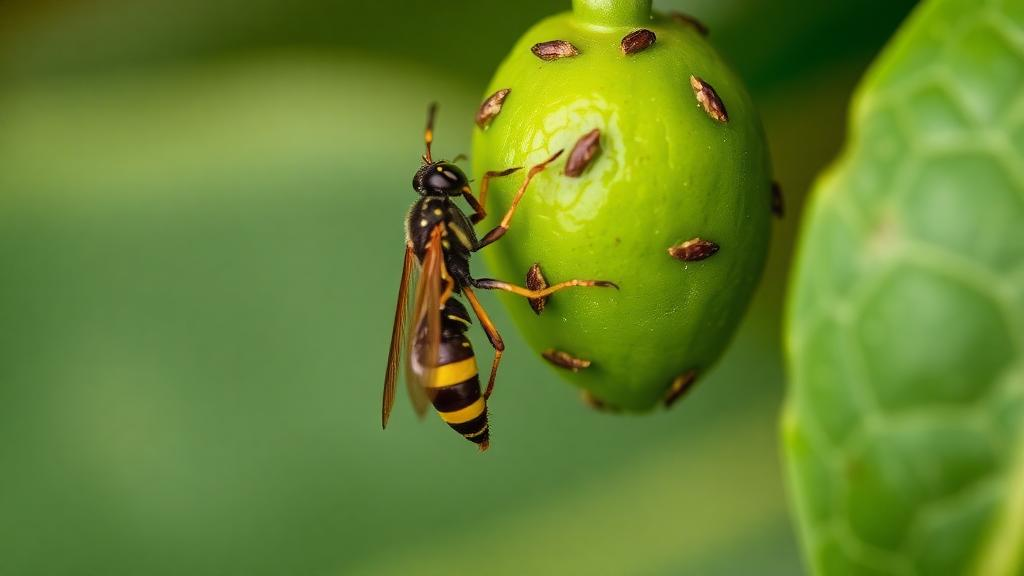
The composition of the parasitoid assemblage itself is informative. Rileya insularis, a eurytomid wasp, emerged as the dominant parasitoid, followed by Torymus umbilicatus and two species of Galeopsomyia. All four belong to the superfamily Chalcidoidea, an enormously diverse lineage of mostly small parasitoid wasps that includes many of the most important biological control agents used in agriculture worldwide. Eurytomids in the genus Rileya are known primarily as parasitoids of gall-inducing insects, which fits their role here. Torymid wasps, including Torymus, are frequently associated with cynipid and cecidomyiid galls, where their larvae develop as ectoparasitoids or kleptoparasites within the gall chamber. The presence of multiple parasitoid species attacking the same gall former suggests a structured community in which different wasps may exploit the gall resource in different ways, perhaps varying in timing, host stage attacked, or whether they act as true parasitoids or as inquilines that compete with the gall former.
The description of the previously unknown male of Galeopsomyia perseae fills a genuine gap in knowledge. In many chalcidoid groups, males are smaller, less colorful, and morphologically subtler than females, which historically has led to their being overlooked or misidentified. Hansson and Hanson had described four Galeopsomyia species from Neotropical avocado fruits but left the males of two of them, G. perseae and G. druparum, undescribed. Because species delimitation in this group relies heavily on male genitalia and antennal characters, having both sexes documented is essential for anyone attempting to identify specimens in future surveys. The use of standardized measurements of the head, mesosoma, gaster, and antenna, averaged across ten specimens and quantified with image analysis software, provides a reproducible morphometric baseline that other workers can compare against.
The involvement of taxonomic specialists in verifying identifications deserves emphasis. Eurytomid and torymid wasps are notoriously difficult to identify to species without expert examination, and misidentifications in this group have historically propagated through the literature. The verification of the eurytomid material by Michael Gates and the torymid material by Aitor Martínez-Romero lends confidence to the species-level determinations reported. Similarly, the deposition of voucher specimens in the Insect Collection of the Colegio de Postgraduados ensures that future researchers can re-examine the physical specimens if taxonomic concepts change or if molecular methods become applicable. Voucher deposition is a cornerstone of reproducible biodiversity research, yet it is frequently neglected in applied pest surveys.
From a broader biogeographic perspective, the Nayarit record extends the known distribution of B. perseae within Mexico. The species was originally described from Colombia and Costa Rica and has since been documented in several Neotropical countries, with previous Mexican records concentrated in the central producing states of the State of Mexico, Michoacán, and Morelos. Nayarit lies considerably farther northwest along the Pacific slope, and its avocado industry, while ranking fourth nationally, is concentrated in a relatively small area around Tepic and Xalisco. Whether the midge arrived recently through movement of infested plant material or has long been present but unnoticed is unknown. Given that the damage symptoms are conspicuous enough to have prompted reports from the state plant health committee, the apparent absence of earlier records suggests either recent establishment or a long period during which the damage was attributed to other causes or simply tolerated.
The fact that both Hass and Mendez cultivars were found infested indicates that host susceptibility is not confined to a single variety. Hass dominates international avocado trade, while Mendez and other locally favored cultivars are important in domestic markets. If the gall midge attacks multiple cultivars across the spectrum of commercial production, varietal selection alone is unlikely to provide a management solution, though differences in flowering phenology among cultivars could still influence infestation pressure. The higher parasitism rate observed in Mendez orchards in this study could reflect cultivar differences in gall architecture, fruit retention patterns, or simply the timing and location of sampling relative to parasitoid activity. Distinguishing cultivar effects from site effects would require replicated sampling across both varieties at multiple sites.
For plant health authorities such as CESAVENAY, the study provides an evidence base for deciding whether the gall midge warrants formal pest status designation. In Mexico, decisions about quarantine pests, phytosanitary alerts, and grower advisories depend on knowing which species are present, where they occur, and what damage they cause. Because B. perseae is already recorded from central Mexican states, its presence in Nayarit does not constitute a first country record, but it does matter for interstate movement of plant material and for regional grower education. The identification of a reasonably diverse parasitoid community also argues against immediate chemical intervention, which could disrupt natural regulation and potentially flare other avocado pests. Conservation approaches that maintain flowering resources and alternative hosts for chalcidoid wasps in and around orchards may be a more sustainable first line of defense.
Finally, the study illustrates the ongoing value of basic morphological taxonomy in applied agricultural science. Every management decision about an emerging pest ultimately rests on correct species identification, and correct identification depends on the kind of careful specimen processing, expert verification, and documentation of previously unknown life stages presented here. The photographic documentation of all recovered parasitoid species will serve as a practical reference for extension personnel and researchers throughout the avocado-producing regions of the Americas, where similar fruit deformation symptoms continue to be reported. As avocado cultivation expands into new areas of Mexico and beyond, encounters with B. perseae and its natural enemies are likely to become more frequent, and the groundwork laid in Nayarit will make those future encounters easier to interpret and manage.
Subject of Research: …
Article Title: Bruggmanniella perseae Gagné ( Diptera , Cecidomyiidae ) and its associated parasitoids in avocado in Nayarit, Mexico
Article References: Jacobo-Macías, E. R., Lomeli-Flores, J. R., Rodríguez-Leyva, E., Guzmán-Franco, A. W., Valdez-Carrasco, J. M., González-Hernández, H., & Robles-Bermúdez, A. (2026). Bruggmanniella perseae Gagné (Diptera, Cecidomyiidae) and its associated parasitoids in avocado in Nayarit, Mexico. Journal of Hymenoptera Research, 99, 1031-1043. https://doi.org/10.3897/jhr.99.200280
Image Credits: AI Generated
Keywords: Bruggmanniella, perseae, Gagn, Diptera, Cecidomyiidae, associated, parasitoids, avocado, Nayarit, Mexico, scientific research
Cite Scienmag News
Alan Morgan. (October 15, 2026). Tiny Wasps Emerge as Natural Allies Against Avocado Fruit Gall Midge in Mexico. Scienmag. https://scienmag.com/tiny-wasps-emerge-as-natural-allies-against-avocado-fruit-gall-midge-in-mexico/
Alan Morgan. "Tiny Wasps Emerge as Natural Allies Against Avocado Fruit Gall Midge in Mexico." Scienmag, 15 October 2026, https://scienmag.com/tiny-wasps-emerge-as-natural-allies-against-avocado-fruit-gall-midge-in-mexico/. Accessed 15 October 2026.
Alan Morgan. "Tiny Wasps Emerge as Natural Allies Against Avocado Fruit Gall Midge in Mexico." Scienmag. October 15, 2026. https://scienmag.com/tiny-wasps-emerge-as-natural-allies-against-avocado-fruit-gall-midge-in-mexico/


