


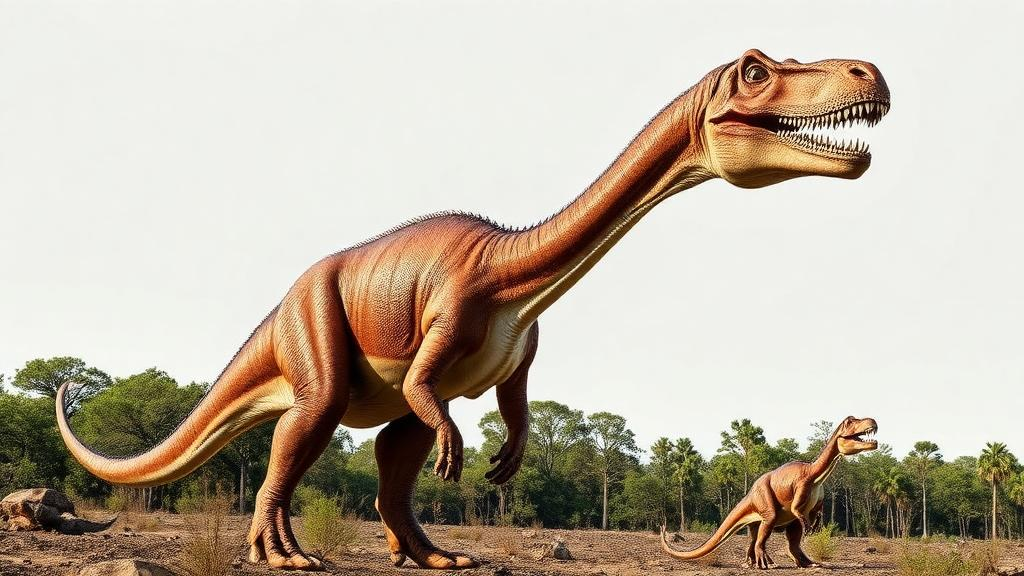
For more than a century, the story of the whip-tailed, long-necked dinosaurs known as diplodocoids seemed settled: they flourished in the Late Jurassic sun of North America, crashed at the Jurassic/Cretaceous boundary about 143.1 million years ago, and never truly recovered. A new quantitative analysis, published in the journal Fossil Record, upends that tidy narrative. By compiling 495 fossil occurrences spanning 43 genera and applying statistical methods that correct for the notorious gaps and hotspots of the dinosaur fossil record, an international research team has found that these iconic sauropods did not simply fade away after the Jurassic. Instead, they boomed twice, and their second flowering, during the Early Cretaceous, may have exceeded anything the Age of Giants ever produced.
Diplodocoidea is a subgroup of neosauropod sauropods that includes some of the most recognisable dinosaurs ever unearthed: Diplodocus, Barosaurus, Apatosaurus and Brontosaurus, along with the spiny-backed Dicraeosaurus and the broad-muzzled Nigersaurus. The clade is divided into three main subclades: Diplodocidae, with their extraordinarily long necks and tails; Dicraeosauridae, distinguished by paired tall neural spines on their vertebrae that may have supported a sail, a display crest or a fat-storage hump; and Rebbachisauridae, diagnosed by a paddle-shaped expansion at the tip of the shoulder blade. Together, these animals dominated terrestrial ecosystems as megaherbivores from the Middle Jurassic, roughly 168 million years ago, until the early Late Cretaceous around 90 million years ago, leaving fossils on both the northern landmass of Laurasia and the southern supercontinent Gondwana.
The Jurassic/Cretaceous transition was no gentle handover. Fluctuating sea levels, volcanic activity and shifting continents drove a global faunal and ecological turnover, and the diversity decline that accompanied it fell disproportionately on larger and more specialised terrestrial species. Sauropods, with their enormous bodies and specialised feeding apparatus, were hit particularly hard. Earlier studies, relying on simple counts of taxa in the fossil record, painted a picture of gradual Jurassic increase, a Kimmeridgian-Tithonian peak, an extinction event at the boundary and a later Cretaceous rise. But raw counts are now widely criticised for failing to account for preservation and sampling biases that can dramatically distort results, and the new study set out to test whether the old patterns survived modern scrutiny.
The researchers built their global occurrence database from the Paleobiology Database and an exhaustive literature review, cross-referencing every record for taxonomic validity and stratigraphic context. They applied strict inclusion criteria, excluding footprints, egg taxa and specimens based only on vague morphological similarity. Diversity was estimated at the genus level, since many dinosaur genera are monospecific and species-level identification of fragmentary sauropod material is notoriously difficult. Crucially, the team used two complementary time-binning schemes, stage-length bins and approximately equal-length bins of about 9 million years, and two datasets, one restricted to occurrences confidently dated to a single bin and one including temporally broader records. This double-pronged design allowed them to explore how different analytical choices shape the recovered diversity curves.
The statistical centrepiece was shareholder quorum subsampling, or SQS, a sample-standardisation method that accounts for unequal sampling across time bins. The algorithm randomly draws fossil occurrences from a given interval while tracking Good’s u, a measure of coverage, and records taxonomic richness once a quorum threshold is reached. The process is repeated over many iterations, with the median value across runs serving as the final diversity estimate. Whereas a quorum of 0.4 is often considered sufficient, the team achieved all estimates at a demanding quorum of 0.7, providing unusually robust standardisation. Time bins with fewer than five entries were excluded to avoid small-sample artefacts.
One bias demanded special attention: the Morrison Formation of the Late Jurassic United States, which alone yields 86.63 percent of all Jurassic diplodocoid occurrences. Such exceptionally productive deposits, known as Lagerstätten, can inflate diversity metrics through sheer quantity of preservation rather than true biological richness. To test this quantitatively, the researchers employed Generalized Least Squares modelling, treating log-transformed diversity per stage as the dependent variable and the presence of Morrison data, weighted by its share of occurrences, as a predictor, alongside stage duration to account for uneven temporal spans. The results were striking. The Morrison Formation emerged as a significant positive predictor of raw genus-level diversity, but its effect weakened under the unconstrained treatment and vanished entirely in the sampling-standardised SQS model. In other words, once sampling was standardised, the apparent Morrison-driven Late Jurassic peak dissolved, revealing that much of the raw signal reflected sampling structure rather than genuine biology.
The standardised curves tell a fundamentally different story from the traditional one. Rather than a pronounced Late Jurassic maximum followed by decline, SQS estimates indicate relatively stable diversity throughout the Oxfordian, Kimmeridgian and Tithonian, with the principal drop occurring at the Jurassic/Cretaceous boundary itself, consistent with a substantial faunal turnover. Then comes the surprise: diversity rebounds and reaches its highest value in the entire dataset during the Aptian stage of the Early Cretaceous, at 5.73 at a quorum of 0.7, exceeding even the Kimmeridgian estimate of 3.27. This second peak is driven by the rebbachisaurids, the subclade that originated in the Jurassic but only appears unambiguously in the fossil record during the Cretaceous, and which then dominated diplodocoid diversity until the group’s final disappearance shortly after the Turonian.
Geography adds a further twist. The analysis reveals that the two flagellicaudatan subclades, Diplodocidae and Dicraeosauridae, were largely restricted to high latitudes in both hemispheres, essentially vanishing from the Northern Hemisphere from the Berriasian onwards and persisting only in South America until the Barremian. Rebbachisaurids, by contrast, occupied the full latitudinal range of the clade, from 50 degrees north to 50 degrees south, including equatorial and subequatorial regions that flagellicaudatans never exploited. This pattern persisted into the Middle Cretaceous, with Northern Hemisphere rebbachisaurid occurrences confined below 25 degrees north. The team suggests that the two groups faced distinct climatic constraints, potentially reflecting different ecological strategies, and notes that rebbachisaurids share a type of skeletal pneumaticity with the broadly distributed somphospondylans, hinting at physiological parallels that may have enabled their wider reach.
The causes of the Aptian rebbachisaurid radiation remain unresolved, but the authors point to tantalising possibilities. While the rise of flowering plants does not appear to have boosted overall sauropod diversity, it may have contributed to the ecological success of rebbachisaurids, a hypothesis that remains largely unexplored. Their eventual extinction, which was not preceded by a prolonged decline, may have been linked to environmental perturbations at the Cenomanian/Turonian boundary, including global warming, oceanic anoxia and sea-level rise. At the same time, the diversification of titanosaurian lithostrotians and the expansion of other large herbivorous dinosaurs may have intensified competition, with convergent cranial and locomotor adaptations suggesting that rebbachisaurids and lithostrotians occupied similar niches and exploited comparable food resources, potentially promoting competitive replacement.
The study is candid about its limitations. Early Cretaceous occurrences, particularly from Gondwanan deposits, are often poorly constrained in time, biasing the constrained dataset toward the Late Jurassic and underestimating Cretaceous diversity, while the unconstrained approach may overestimate it. Many rebbachisaurid taxa are rare and fragmentary, and sauropod taxonomy has undergone sweeping revisions in recent years. The apparent absence of diplodocoids from Middle Jurassic equatorial regions likely reflects scarce continental outcrops and undersampling in present-day Brazil and North Africa rather than true absence, and the authors emphasise the underreported impact of socioeconomic biases and the legacy of scientific colonialism on the global fossil record. Even so, the central conclusion stands: diplodocoid dinosaurs did not peak once and perish. They peaked twice, in different hemispheres, under different climates, with different bodies, and the second peak was the greater of the two, opening new directions for research into how climate and ecomorphological traits shaped the rise and fall of Earth’s greatest herbivores.
Subject of Research: Everything, everywhere, all at once? Trends in Diplodocoidea diversity during the Jurassic/Cretaceous transition
Article Title: Everything, everywhere, all at once? Trends in Diplodocoidea diversity during the Jurassic/Cretaceous transition
Article References: Everything, everywhere, all at once? Trends in Diplodocoidea diversity during the Jurassic/Cretaceous transition. (n.d.). https://doi.org/10.3897/fr.29.189225
Image Credits: AI Generated
DOI: 10.3897/fr.29.189225
Keywords: Everything, everywhere, once, Trends, Diplodocoidea, diversity, during, Jurassic, Cretaceous, transition, scientific research
Cite Scienmag News
Gavin Prescott. (October 15, 2026). Diplodocoid dinosaurs boomed twice before vanishing at the Cretaceous peak. Scienmag. https://scienmag.com/diplodocoid-dinosaurs-boomed-twice-before-vanishing-at-the-cretaceous-peak/
Gavin Prescott. "Diplodocoid dinosaurs boomed twice before vanishing at the Cretaceous peak." Scienmag, 15 October 2026, https://scienmag.com/diplodocoid-dinosaurs-boomed-twice-before-vanishing-at-the-cretaceous-peak/. Accessed 15 October 2026.
Gavin Prescott. "Diplodocoid dinosaurs boomed twice before vanishing at the Cretaceous peak." Scienmag. October 15, 2026. https://scienmag.com/diplodocoid-dinosaurs-boomed-twice-before-vanishing-at-the-cretaceous-peak/


